On this page
How This Presents
In auto mode inside a Jurong East HDB living room, the indoor unit stops and restarts every few minutes, worsening over weeks. Cool mode runs steadily through warm Singapore evenings. The room still feels humid when cooling pauses, and nothing rattles or trips.
- Setup
- Daikin Wall-mounted10-12 yearsHDBJurong East
- Misread as
- A broken auto mode, leaving a unit that has to be run manually.
- Check first
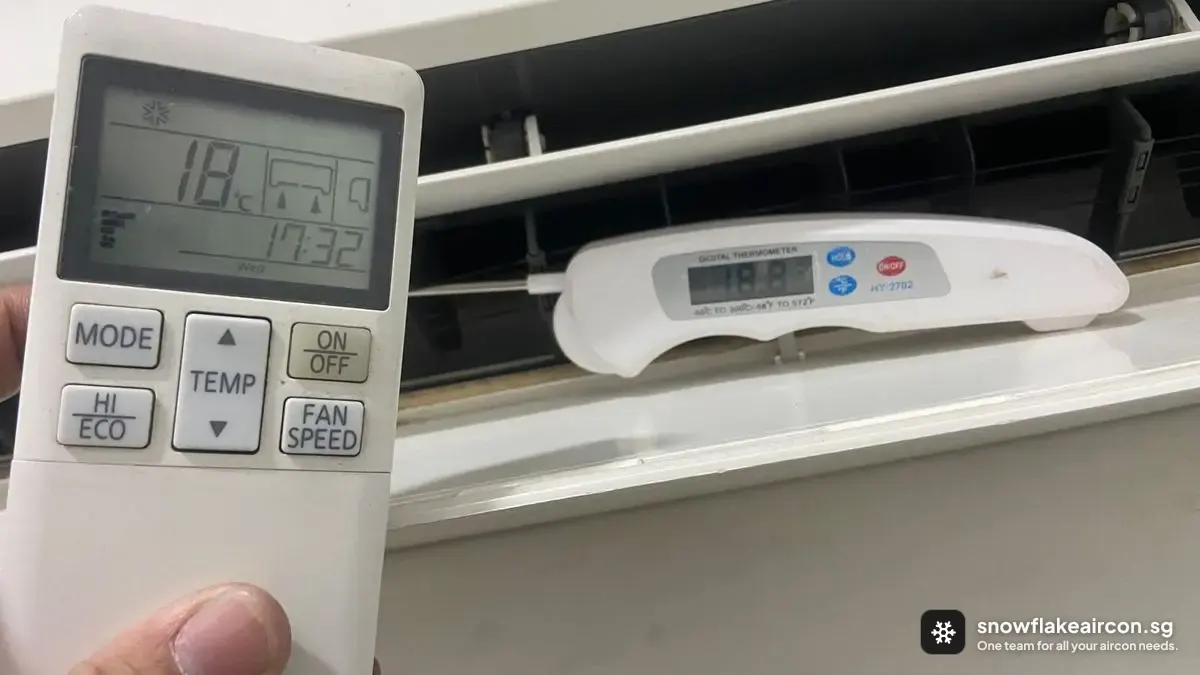
- The panel reading against a separate thermometer at the same height
What Else Produces This
Cool mode drives the compressor directly against a fixed set point. Auto relies on the indoor ambient reading to choose when to pause or switch modes. A failing compressor or main board would disrupt both modes alike. A fault that disrupts only auto mode sits in the reading, which rules out major electrical parts before any panel comes off.
Comparing the controller temperature readout against a separate thermometer at the same wall height confirms whether the sensor is skewed.
A reading that swings between cold and warm within seconds shows an unstable thermistor, distinct from a steady offset.
A stable, accurate outdoor ambient sensor keeps the fault narrowed cleanly to the indoor head.
Steady cool-mode performance under afternoon sun keeps the compressor and control board off the quote.
Why It Happens
An indoor temperature sensor tends to drift gradually rather than fail completely. Once its resistance shifts cold, auto logic assumes the HDB living room has reached target temperature and cuts the compressor early. Moments later the drifted signal wobbles upward and restarts cooling, creating rapid short-cycling that never clears tropical humidity.
What Resolution Involves
Replace the drifted thermistor with the model-matched sensor and clip it back into its proper air-path holder, clear of the cold coil fins. The control board remains untouched, and no refrigerant or wiring work follows from this finding.
How to Tell It Worked
Check that the indoor readout matches an independent thermometer within a degree across the room, then watch one full auto cycle ramp down and hold steady. Any lingering short-cycling after a matched reading points to a second control or airflow issue.
Before You Approve a Quote
Auto mode is only as good as the number it reads
- Ask whether the panel reading was checked against a thermometer. It is a two-minute test that points straight at the sensor.
- Auto failing while cool mode works rules out the board and compressor.
- A sensor is a far smaller job than a board. Ask which was tested before either is quoted.