Two Top-Ups in Four Months: Slow Leak at Indoor Pipe Joint
Two top-ups in four months, with more refills starting to look normal. When repeated topping up stops being maintenance.
By Team Snowflake | Updated 24 Aug 2026
Teaching case based on recurring Snowflake service patterns; identifying details are combined.
How this presents
Two top-ups inside four months, each buying a few weeks of proper cooling before the fade returns. The interval between refills is the diagnostic fact, and it had not been recorded or acted on either time.
- Setup
- Daikin Wall-mounted10-12 yearsHDBClementi
- Misread as
- Routine topping up, until three or four refills a year start to look normal.
- Check first
- An overnight pressure hold test, before any more gas goes in
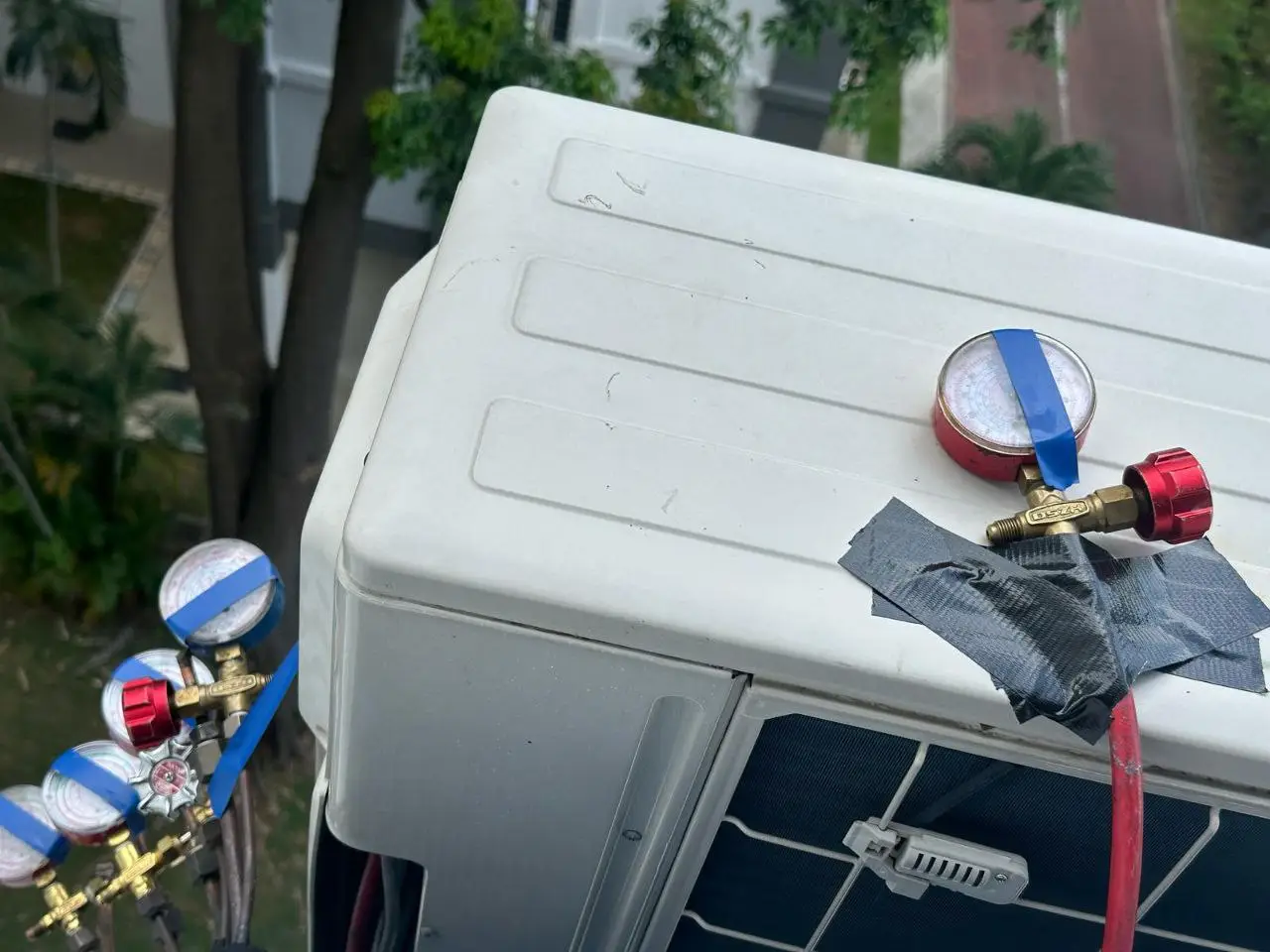
What else produces this
A low pressure reading confirms the symptom and settles nothing: it is equally true of a leak and of an undercharge. What separates them is time. A sealed circuit charged to test pressure and left overnight holds; a leaking one does not. That test costs a return visit and removes the guesswork a third top-up would preserve.
A low pressure reading confirms the system is short. It does not say whether the gas leaked out or was never fully charged.
Test pressure applied with every service port sealed turns the question into an overnight one.
A reading that has dropped measurably by morning proves an active leak rather than a one-off undercharge.
Bubble solution then narrows it to a single point: a fine gap where the copper pipe meets its brass fitting indoors.
Why it happens
The joint loosens by working, not by failing. Copper expands as the unit runs and contracts when it stops, and a joint cycles through that movement every day for years. Eventually the seal gives up a gap too fine to see and wide enough to pass refrigerant slowly. The loss is gradual, which is what makes it convincing as a charge problem: cooling stays acceptable for weeks after each refill before dropping below usable.
What resolution involves
The joint is remade rather than replaced. It comes off, the copper is cut back to clean metal, and a fresh joint is formed and reconnected. What makes that a repair rather than a hope is the second hold test: pressure goes back in and sits overnight again before any refrigerant does. Only once it holds is the system cleared and recharged. No compressor or coil work is involved at any point.
How to tell it worked
The proof is the order of operations. A repair holds test pressure overnight before any gas goes in; a recharge that happens first is a top-up with a repair's invoice attached. Ask which came first.
Before you approve a quote
Refrigerant is not consumed, so a system that runs short is losing it
- If cooling fades weeks after a refill, the gas is escaping and the escape point needs naming.
- Repeated top-ups treat the symptom. Each one costs money and buys the same few weeks as the last.
- An overnight hold test answers whether the circuit is sealed, and it should run after the repair and before the recharge.
Related diagnostics
Questions this case answers
Is it normal to need an aircon top-up twice in a few months?
What is an overnight pressure hold test?
Where do refrigerant leaks form on wall-mounted aircons?
Leaking pipe joint: repair it or replace the aircon?
Describe your situation
Tell us what’s going on. Symptoms, setup, photos, anything we should know. We’ll assess and come back with the right next step.