Third Top-up This Year: Leak at the Outdoor Flare Joint
Aircon case in Sengkang, Singapore: cooling loss traced to slow leak at the outdoor flare joint connection after targeted diagnosis checks.
Case Details
| Unit | Mitsubishi ElectricWall-mounted |
|---|---|
| Age | 8 years old |
| Location | HDBSengkang, Singapore |
| Reported | The unit had lost cooling for the third time in a year. Each gas top-up restored cooling for about three to four months before it slowly faded again. The reason for the recurring pattern was unknown. |
What We Checked
- System pressure was low, confirming gas loss.
- Indoor coil showed no obvious oil stains or major rupture signs.
- Outdoor condenser coil was visually clean.
- Applied leak detection solution to the outdoor flare joints — micro-bubbles appeared at one connection.
The Diagnosis
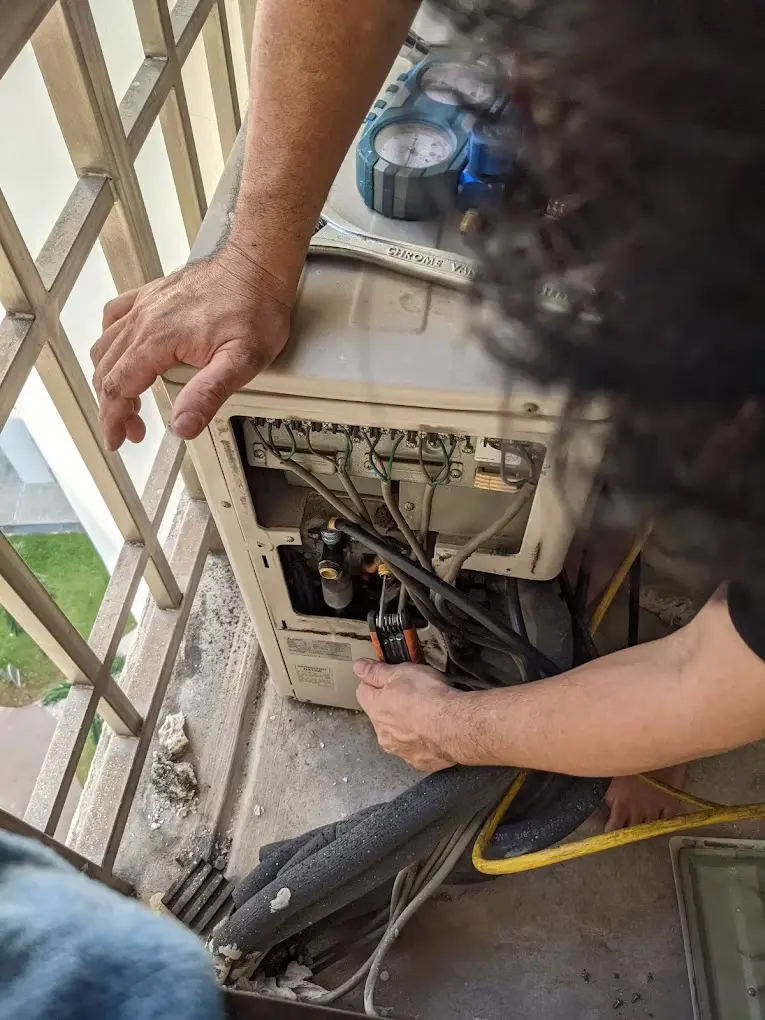
Micro-bubbles formed at one of the outdoor flare joints — the connection where the copper refrigerant pipe meets the outdoor unit fitting. Over eight years of operation, repeated thermal cycling had deformed the copper flare. Each time the compressor started, the pipe heated and expanded slightly; each time it stopped, the pipe cooled and contracted. That cycling gradually worked the flare out of shape, opening a gap too small to see but large enough for refrigerant molecules to pass through. The loss rate was consistent — roughly enough to drain the system below the cooling threshold every three months, which matched the client's reported pattern exactly.
What Fixed It
No major parts were needed. The leak was at a pipe connection, not at the compressor or coil. We cut back the copper pipe to clean metal, formed a fresh flare using a calibrated flaring tool to ensure the correct cone angle, and reconnected the fitting to the manufacturer-specified torque. A nitrogen pressure test confirmed the new seal held with no measurable drop over two hours. The system was then evacuated and recharged to the correct gas weight. The top-up cycle stops once the joint is properly sealed.
We completed the flare repair and recharged the system. The unit started cooling normally. No further top-ups have been needed since.
Why This Happens
Why repeated top-ups mean there is a physical leak.
- Refrigerant is a sealed system — it does not burn off, evaporate, or get consumed during operation. If the level keeps dropping, there is a physical gap somewhere letting it escape. The only question is where.
- A top-up restores pressure and cooling temporarily, but it does nothing to the gap itself. The same opening lets gas out again at the same rate, producing the same fade pattern on the same timeline. That predictable cycle is actually diagnostic — a consistent three-month fade points to a consistent leak rate.
- Flare joints are the most common leak point on split systems because the copper flare deforms slightly under repeated thermal expansion and contraction. The gap is often too small to see but large enough for refrigerant molecules to pass through.
- Ask your technician whether they pressure-tested the system before recharging. A top-up without a pressure test is treating the symptom while ignoring the cause. The test adds time but eliminates the cycle.
Related Reading
Guides, troubleshooting, and diagnostic case studies to help you make informed decisions.
Same situation with your aircon?
Describe what’s happening. We’ll work out the likely cause and tell you the right next step.
WhatsApp us