On this page
How this presents
Intermittent communication faults in an older building, on cabling that runs through the original trunking. The faults come and go with no pattern anyone has been able to identify. The system works normally for long stretches in between them.
- Setup
- Panasonic Wall-mounted10-12 yearsShophouseKallang
- Misread as
- Old wiring throughout the property that will all need replacing at once.
- Check first
- Where along the route the cable is unsupported and free to move
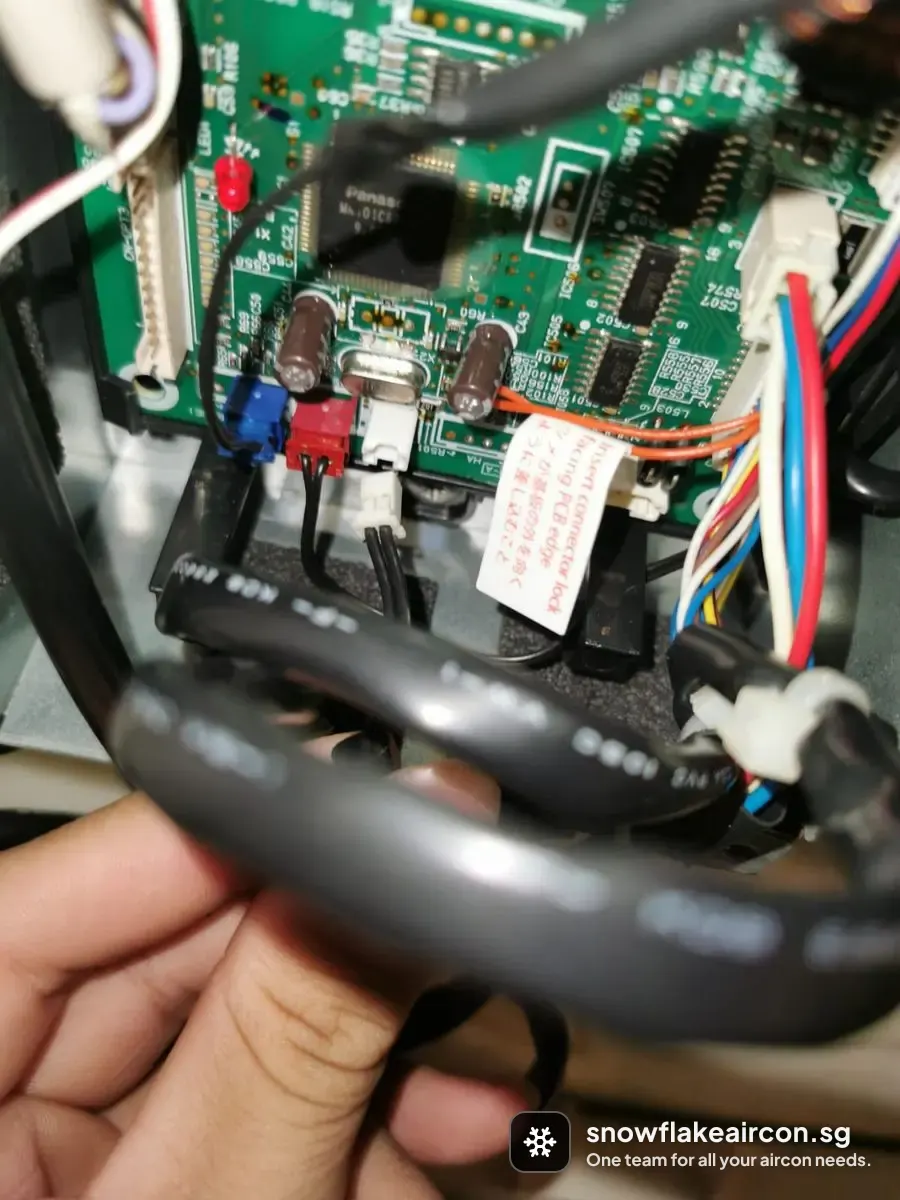
What else produces this
Age alone is a weak explanation, because supported cable lasts a very long time indoors. What wears is any span where the cable can move against a hard edge. Older trunking has fewer fixings and rougher edges, so the inspection is of support along the route, not of the cable's age.
Intermittent faults with long normal periods in between describe insulation wear rather than a broken conductor.
Cable unsupported across a span inside old trunking is free to move with vibration and temperature.
Insulation chafed through where the cable rests against a trunking edge locates the wear exactly.
Sound insulation on the well-supported sections shows the cable itself is not the problem here.
Why it happens
Cable expands and contracts as temperature changes and shifts slightly whenever anything nearby vibrates. Held firmly it does neither of those things. Left unsupported across a span it rubs against whatever edge it rests on, and over years that removes insulation at one point. The conductor is then exposed at a single spot, which produces a fault appearing and disappearing with humidity and movement rather than one that stays put.
What resolution involves
The chafed section is repaired and the run supported so nothing can move against an edge again. New cable without added support wears through on the same path as the old. Original trunking rarely carries enough fixings by current standards.
How to tell it worked
Every unsupported span on the run is inspected, not only the point that failed, then the link is watched in use. The conditions for wear usually exist in more than one place on an older route.
Before you approve a quote
Cable wears wherever it is free to move
- A firmly supported cable does not move, and a cable that does not move does not wear through.
- Intermittent faults mean exposed conductor. A severed one produces a fault that never goes away.
- Add support when repairing. New cable on an unsupported span wears exactly like the old one did.