On this page
Summary
If the unit hums without starting, switch it off at the isolator rather than retrying. Repeated stalled starts overheat the compressor winding.
Likely Causes
- A weakening run capacitor starts the compressor on mild days but not on hot ones.
- Worn cable insulation at a tight bend leaks once heat and humidity rise.
Quick Fault Summary
| Likely cause | What to check | Typical next step |
|---|---|---|
| A run capacitor that is weakening | It starts normally on cooler days and in the morning. | A technician measures the capacitor against its rated value rather than testing whether it works. |
| Worn insulation at a tight cable bend | It trips or cuts out rather than just failing to start. | A technician inspects the cable along its full route, especially any sharp bend, and tests insulation resistance. |
- Likely cause
- A run capacitor that is weakening
- What to check
- It starts normally on cooler days and in the morning.
- Typical next step
- A technician measures the capacitor against its rated value rather than testing whether it works.
- Likely cause
- Worn insulation at a tight cable bend
- What to check
- It trips or cuts out rather than just failing to start.
- Typical next step
- A technician inspects the cable along its full route, especially any sharp bend, and tests insulation resistance.
1. A Run Capacitor That Is Weakening
A compressor that starts normally in the morning but hums or struggles in the afternoon usually has a capacitor losing capacity. It still gives enough of a push on a mild day. On a hot afternoon the compressor needs more, and the capacitor cannot supply it.
How to Tell
Weakness at the moment of start points to a weakening capacitor, not worn insulation. The unit runs normally once going, and nothing trips.
- It starts normally on cooler days and in the morning.
- On hot afternoons it hums, hesitates, or will not start.
- It starts after being left off for a while.
- Cooling is fine once it does get going.
How We Confirm It
A technician measures the capacitor against its rated value rather than testing whether it works. It is replaced if it reads low, then the unit is started under afternoon load to confirm.
Do not keep retrying a compressor that hums without starting. Each stalled attempt heats the winding, and a weak capacitor left in place can turn into a compressor replacement.
Related Cases
2. Worn Insulation at a Tight Cable Bend
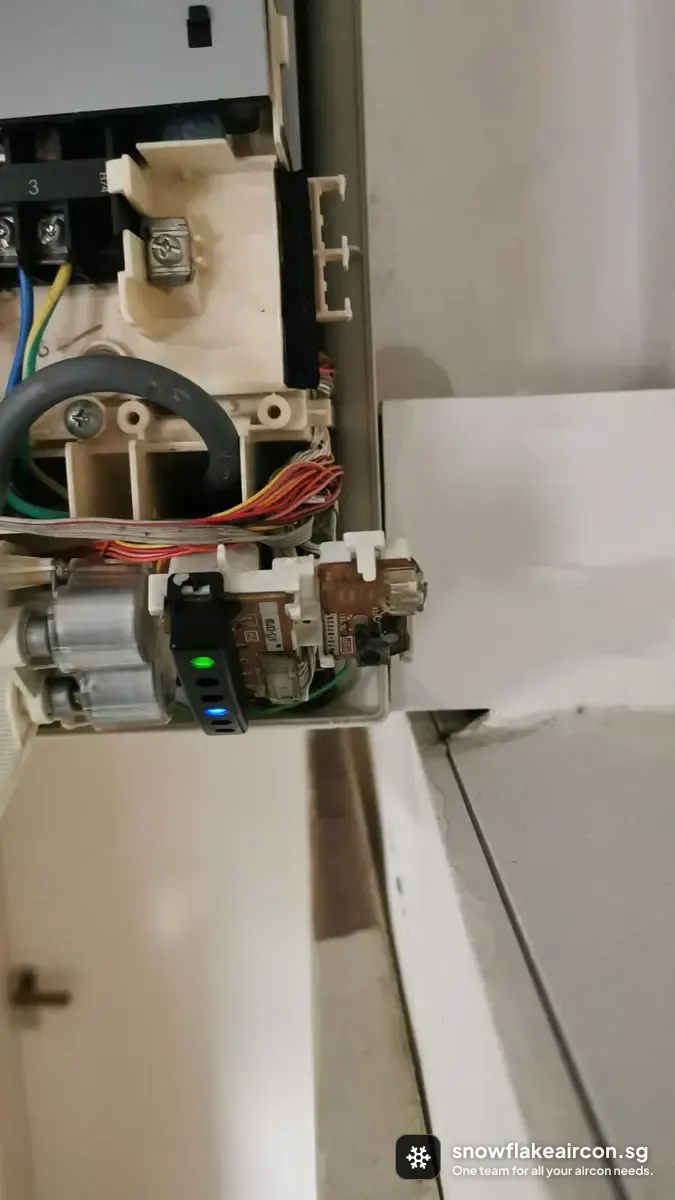
A unit that trips or cuts out on hot, humid afternoons, rather than failing to start, has cable insulation worn through at a sharp bend. Tight recesses force the cable to bend hard, years of use wear that point, and heat with humidity lets current leak.
How to Tell
A unit that trips instead of humming and failing to start points to worn insulation, not a weak capacitor. Humidity matters as much as heat, because both help current find a path.
- It trips or cuts out rather than just failing to start.
- It only happens on hot and humid afternoons.
- The cable runs through a tight recess or sharp bend.
- The installation is old and the run was always awkward.
How We Confirm It
A technician inspects the cable along its full route, especially any sharp bend, and tests insulation resistance. The worn section is replaced and rerouted so it is not bent hard again.
Worn insulation leaking to earth is what the breaker is catching, and resetting it re-energises a damaged cable. Leave it off.