Cold Air but Barely Any Wind: Dust-Caked Blower and Coil
Air from the vents is cold but barely moving. Whether that means a failing motor or something it is pushing through.
By Team Snowflake | Updated 24 Aug 2026
Teaching case based on recurring Snowflake service patterns; identifying details are combined.
How this presents
Cold air, weak wind, and a fan visibly turning behind the louvre. Nothing rattles and nothing grinds, and the cold itself never went away. Only the volume did, a little less each week, across a month or two.
- Setup
- Mitsubishi Electric Wall-mounted7-9 yearsHDBBishan
- Misread as
- A failed fan motor, and the cost of replacing one that still spins freely.
- Check first
- The fan turned by hand with the power off
What else produces this
Weak wind from a turning fan has three branches: a failing motor, a dragging bearing, or physical blockage. The first two announce themselves. A motor on the way out grinds, stalls or stops outright, and a bearing under load runs rough and hot. Neither declines quietly for weeks. The quiet, gradual version is the third, and it arrives well short of the age a motor is due.
Turned by hand with the power off, a fan that spins freely and without drag clears the bearing and the motor together.
A motor holding its normal speed while the air volume drops separates blockage from a speed or capacitor fault.
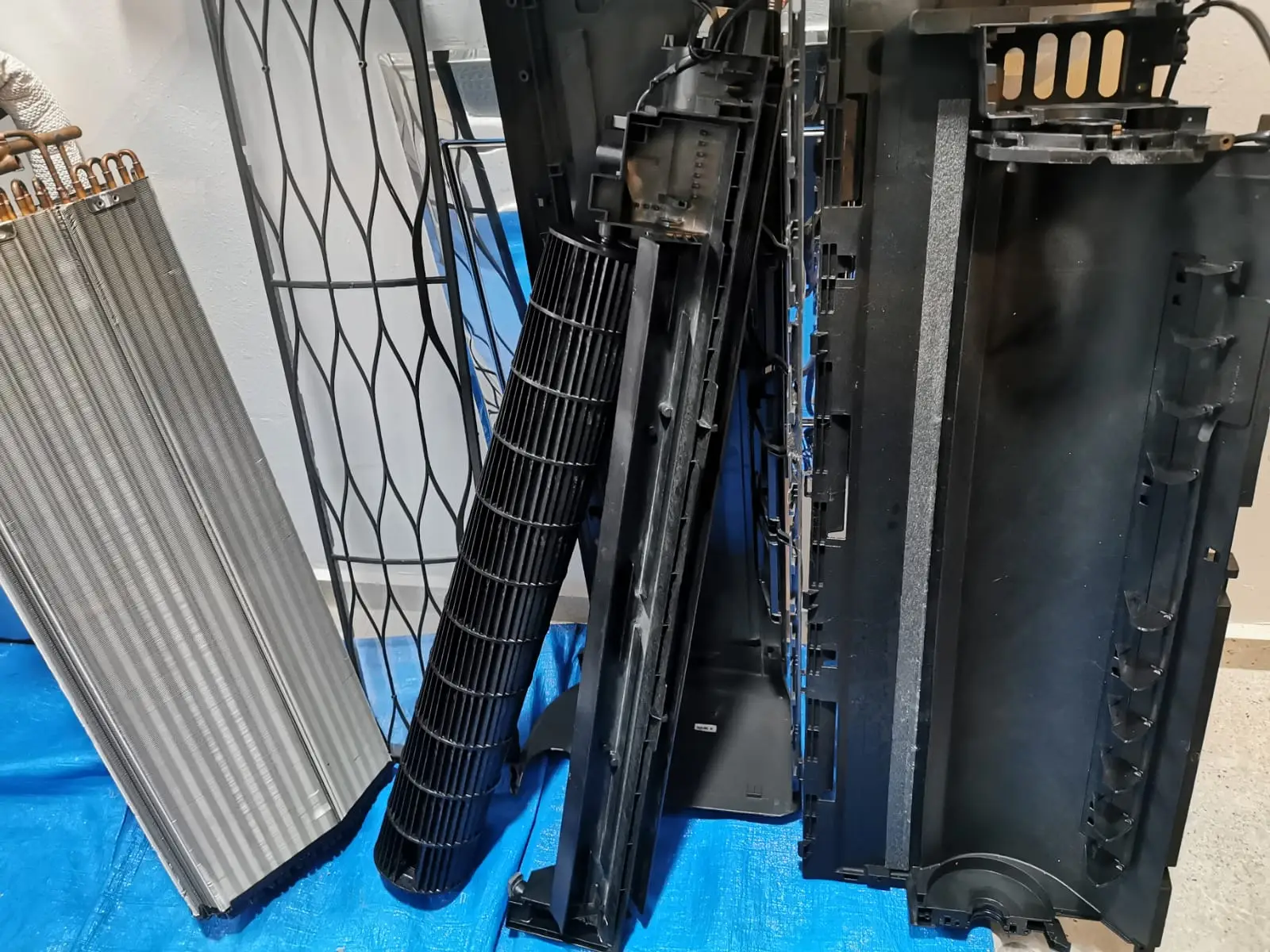
A filter that looks clean says nothing about the blades and the coil face behind it, which is where the coat sits.
Dust packed between the coil fins narrows the gaps air passes through, and it is visible before anything is measured.
Why it happens
The filter passes the finest particles, and those settle in two places over months. On the coil they fill the gaps between the fins, shrinking the surface available to exchange heat. On the blades they add an even layer that changes the blade profile, so each rotation moves less air. The motor turns at its rated speed throughout. That is the whole reason the air stays cold while the volume falls.
What resolution involves
A chemical overhaul, not a part. The indoor unit is part-stripped, the electrical components wrapped, and the fan and coil pressure-washed so the packed dust is flushed out rather than smeared across the fins. A surface clean reaches neither surface. The order afterwards matters too: if the wind is still weak once both are clean, the motor and the capacitor are the next checks, in that order and not before.
How to tell it worked
Full wind, on the original motor. If the airflow is still down after an overhaul, the dust was moved rather than removed. That is an unfinished clean, not a case for a new motor.
Before you approve a quote
Ask what was checked before the motor was quoted
- Ask whether the fan was turned by hand before a motor was named. It costs nothing and it clears two of the three branches.
- Ask whether anyone looked past the filter. The filter is the part that gets cleaned; the blades and the coil face are the parts that matter.
- A motor quoted on a fan that still spins freely is a part sold, not a fault found.
Related diagnostics
Questions this case answers
How often does a blower and coil actually need cleaning?
Can weak airflow push up my electricity bill?
What happens if the buildup is just left alone?
Is a chemical overhaul worth it, or should I replace the unit?
Describe your situation
Tell us what’s going on. Symptoms, setup, photos, anything we should know. We’ll assess and come back with the right next step.