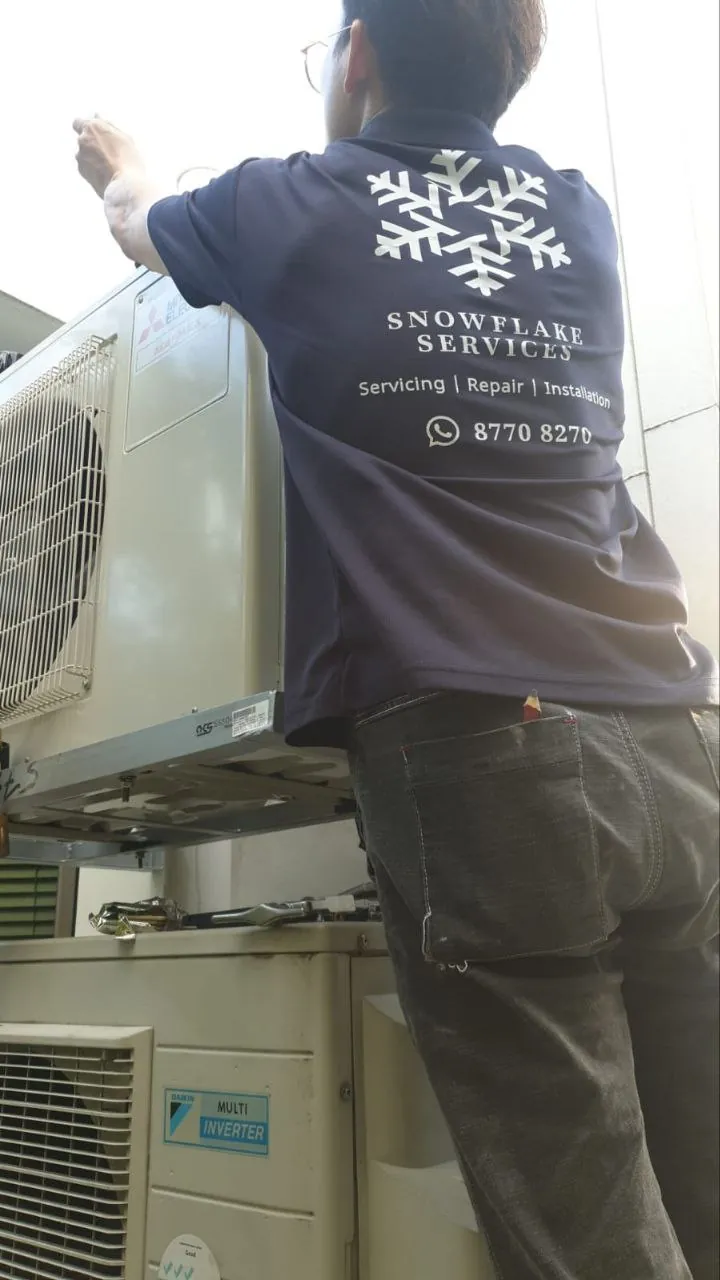
Carrier aircon compressor repair in Singapore
Carrier cooling faults that look like a failed compressor can start in the supply, starting circuit, inverter board, airflow or refrigerant. We test the compressor and the surrounding electrical parts, explain what failed and quote after diagnosis.
BCA-registered10,000+ jobs completed
Signs your Carrier aircon needs a compressor check
These symptoms can involve the compressor, but they can also come from a smaller electrical, airflow or refrigerant fault.
The aircon runs but does not cool
The indoor fan may still blow while the outdoor unit struggles to start, stops early or produces little cooling.The system shuts down or trips
Repeated stopping, protection trips or a breaker trip needs testing before the system is restarted again.An error code or unusual outdoor noise appears
A Carrier fault code, hard starting, loud vibration or a sudden change in outdoor-unit sound helps narrow the check.
Examples of Carrier systems we check
42K / 38K residential split systems
Toshiba-based Carrier inverter systems
40RM cassette and concealed ducted systems, subject to model access
Model not listed
Send photos of the indoor and outdoor model labels, plus the error code or a short video of the symptom.
It may not be the compressor
Before quoting one of the most expensive aircon parts, we check three common problems that can create the same symptoms.
Capacitor, relay or power fault
A weak starting component or unstable supply can stop a healthy compressor from starting correctly.Inverter PCB or IPM
A driver-stage fault can produce the same no-start or overcurrent symptoms as a compressor failure.Airflow, pressure or refrigerant condition
A dirty coil, failed outdoor fan, restriction or leak can trigger compressor protection without internal damage.
We check the power supply, starting circuit or inverter board, compressor electrical condition, airflow and refrigerant behaviour. How a job runs, from first message to booking.
What is different on Carrier systems
A hard-starting Carrier compressor can be caused by a weak capacitor or power fault. We test the starting circuit before quoting the compressor itself.
Carrier error codes related to compressor problems
Open the group that matches where the code appeared on your unit.
Outdoor unit35 guides
- 27Oil temperature Toil1 too-high protection; Oil temperature Toil2 too-high protection
- 34Discharge temperature Td1 too-high protection; Discharge temperature Td2 too-high protection
- 36Oil temperature Toil1 too-low protection; Oil temperature Toil2 too-low protection
- 43Discharge temperature sensor Tdi too-low protection; Discharge temperature sensor Td1 too-low protection
- 108Module rectifier-side software transient overcurrent
- 109Module rectifier-side current-detection circuit anomaly
- 110Module hardware overcurrent
- 111Compressor out of step
- 112High temperature of the module radiator
- 113Module overload
- 114Module DC-bus undervoltage
- 115Module DC-bus overvoltage
- 117Module software overcurrent
- 118Module boot failure
- 119Module current-detection connection error
- 120Module power-supply interruption error
- 123Module rectifier-side hardware transient overcurrent
- 125Compressor frequency mismatch for compressor module 1 or 2
- C7Repeated high inverter-module temperature protection lockout; Repeated inverter-module temperature protection lockout
- E5Outdoor-unit voltage protection
- F0Repeated liquid-slugging protection lockout
- F1Compressor A PTC error; Compressor B PTC error
- H4Compressor A repeated inverter-module protection lockout; Compressor B repeated inverter-module protection lockout
- H6Repeated discharge-temperature protection lockout
- L0Compressor inverter-module error
- L1Compressor inverter DC-bus undervoltage protection
- L2Compressor inverter DC-bus overvoltage protection
- L4Compressor inverter MCE, synchronisation, or closed-loop error
- L7Compressor U/V/W phase-loss protection; Compressor inverter U/V/W phase-loss protection
- L8Compressor transient frequency-variation protection; Compressor inverter transient frequency-variation protection
- L9Compressor commanded-versus-actual speed-difference protection; Compressor inverter commanded-versus-actual speed-difference protection
- P3Compressor overcurrent protection
- P4 / Operation 5xInverter compressor drive error; Discharge-temperature protection
- PLHigh inverter-module temperature protection; Inverter-module temperature protection
- PPLiquid-slugging protection
Codes that depend on the exact model9 guides
- EH3AExternal fan DC bus voltage is too low protection
- EH3bExternal fan DC bus voltage is too high fault
- P0IPM malfunction or IGBT over-strong current protection
- P1 / Operation 2xOver voltage or over low voltage protection
- P2 / Operation 3xHigh temperature protection of compressor top
- PC00ODU IPM module protection
- PC01ODU voltage protection
- PC02Compressor top or IPM temperature protection; Compressor top or IPM module protection
- PC04Inverter compressor drive error
Codes can mean different things across model and system families. Every code is in the full lookup for this brand. Last reviewed 2026-08-21.
Is Carrier compressor repair worth it?
Parts and timing
Carrier-specific boards, motors and compressors for older residential systems may need regional sourcing; newer Toshiba-based families can follow a different parts path.Our recommendation
Compressor repair is usually sensible when the rest of the system is healthy, the correct part is available and the quote is reasonable for the unit's age. Carrier systems commonly have a service life of 10-14 years. For a system over 12 years, major component failures generally favour replacement. Carrier residential parts for older models become harder to source, and unit efficiency has likely declined. Minor fixes can extend use while planning a changeover.
If replacement makes more sense, we compare the repair quote with a suitable new system. See our aircon system replacement process.
Other Carrier repair checks
If testing rules out this part, these are the next checks on the same system.
Workmanship warranty
We stand behind the repair we carry out, and we are straight about the part of the cover we do not set ourselves.
Labour
30-day workmanship warranty. If the same fault returns from our repair, we come back and the labour is on us, with no second diagnostic visit fee.
Parts
Parts carry the distributor's warranty for that component, so the term varies by part. We tell you both terms before you approve the work.
Frequently asked questions about Carrier compressor repair in Singapore
What are the signs of a Carrier compressor problem?
How do you confirm a Carrier compressor fault?
Is a Carrier error code enough to order the compressor?
Should I repair or replace my Carrier aircon?
We cover all of Singapore. Find aircon services in your area.
Describe your situation
Tell us what’s going on. Symptoms, setup, photos, anything we should know. We’ll assess and come back with the right next step.