Cafe Unit Barely Cooling: Grease Sludge on the Evaporator
A cafe unit blows warm and the compressor gets blamed. In a kitchen the cheaper explanation usually reaches the coil first.
By Team Snowflake | Updated 24 Aug 2026
Teaching case based on recurring Snowflake service patterns; identifying details are combined.
How this presents
Cooling declining across a year with quarterly servicing kept on schedule, and each cycle returning less improvement than the last. Shortening the interval changes nothing. Nothing has been opened past the front panel in that time.
- Setup
- Daikin Wall-mounted7-9 yearsF&BOutram
- Misread as
- A failing compressor, when warm air off the vents has a cheaper explanation.
- Check first
- Supply air temperature against airflow strength, then the coil face
What else produces this
Warm supply air splits two ways: the system is not making cold, or the cold is not reaching the air. A compressor that cycles normally, with no short-cycling and no unusual noise, closes the first branch early. Airflow that feels normal in strength closes the obvious version of the second. What remains is heat exchange at the coil, and that needs the panel off.
A compressor cycling normally, with no short-cycling and no overload trips, takes the expensive branch off the table first.
Airflow at normal strength but supply air several degrees warmer than the set point calls for indicates weak heat exchange, not weak air movement.
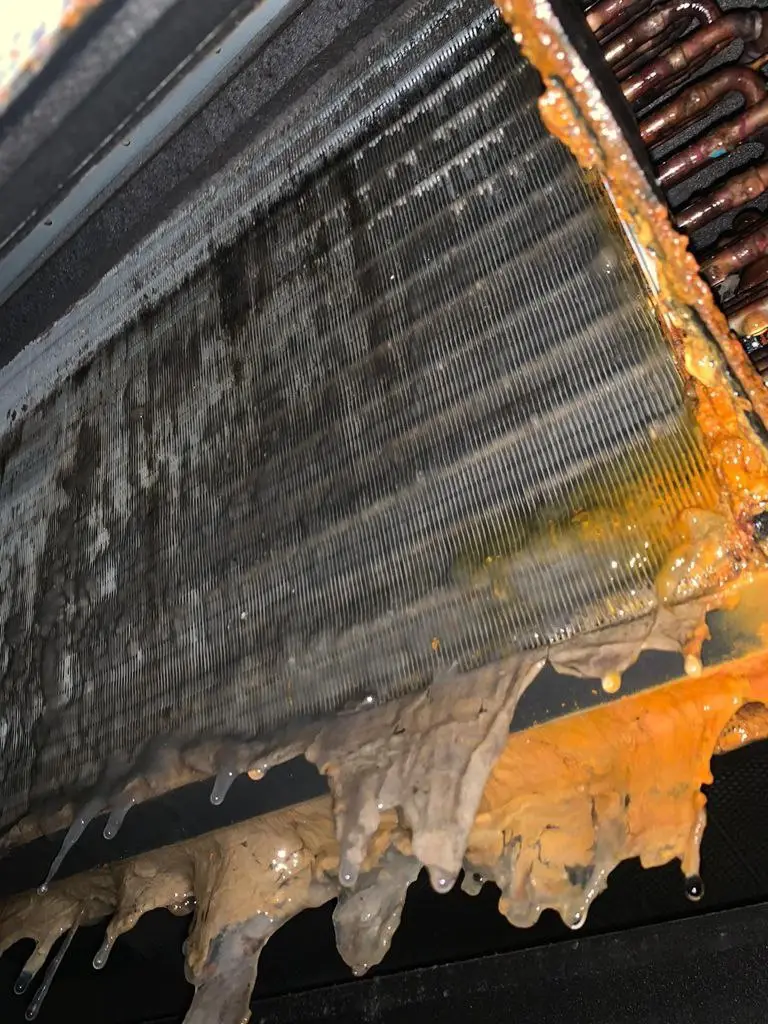
Evaporator fins caked in a thick orange-brown layer of cooking grease, dust and biofilm are visible as soon as the panel comes off.
Buildup running through the full depth of the coil, not just across its face, is what separates a fouled coil from a dirty one.
Why it happens
Airborne cooking oil settles on a wet coil and binds with dust into a film that hardens as it ages. The film is a thermal barrier: the coil still gets cold, but the air moving past it stops picking the cold up. General servicing cleans filters and the drain pan without opening the unit or washing the fins, so each visit restores filter airflow while the coil stays coated. In a dense food-and-beverage district like Outram, that gap is the whole fault.
What resolution involves
Nothing here is solved by another general service. A chemical overhaul takes the unit off the wall, strips the coil assembly, and applies an alkaline solution under pressure to dissolve grease and biofilm through the coil's depth. The drainage system is flushed at the same time. Supply air temperature measured after reassembly is what confirms the coil is exchanging heat again. On a kitchen unit the interval matters as much as the clean: six-monthly overhauls hold a line quarterly servicing cannot.
How to tell it worked
Measure the air, not the invoice. A coil that has been cleared shows a supply temperature well below what it read beforehand, on the same set point. If the number barely moves, the fins were rinsed rather than stripped.
Before you approve a quote
In a kitchen, grease blinds the coil before the compressor fails
- Normal airflow with warm supply air points at a coil that cannot exchange heat, not at a dying compressor.
- General servicing cleans filters and the drain pan. It does not reach grease baked into the depth of the fins.
- Cooking-heavy units need chemical overhauls on a schedule of their own. A shorter servicing interval is not a substitute.
Related diagnostics
Questions this case answers
Cafe aircon cooling less despite quarterly servicing: what is being missed?
Does general servicing clean the evaporator coil?
Is weak cooling with normal airflow a compressor problem?
How often should a kitchen aircon get a chemical overhaul?
Describe your situation
Tell us what’s going on. Symptoms, setup, photos, anything we should know. We’ll assess and come back with the right next step.