Ice Forming on the Copper Pipe: Airflow Blocked, Not Gas
Ice forms on the copper pipe and low gas is assumed. That reading holds only until airflow has been ruled out.
By Team Snowflake | Updated 24 Aug 2026
Teaching case based on recurring Snowflake service patterns; identifying details are combined.
How this presents
Cooling fading week by week, then a visible collar of ice on the copper pipe where it leaves the indoor unit. Air still comes out. It is simply less air than it was, and it has been getting less for a while.
- Setup
- Daikin Wall-mounted7-9 yearsHDBAng Mo Kio
- Misread as
- Lost refrigerant, the reading ice on the pipe invites until airflow is checked.
- Check first
- Airflow at the vents, and the coil face behind the filter
What else produces this
A coil ices when it cannot absorb enough heat, and there are two ways to arrive there. Refrigerant below charge drops the coil's pressure, and its temperature follows it down. Or the air that should be carrying heat into the coil is not arriving in enough volume. Both end at a frozen coil from opposite directions.
Airflow dropping for weeks before any ice appears puts the cause ahead of the freeze. A leak large enough to ice a coil rarely arrives that slowly.
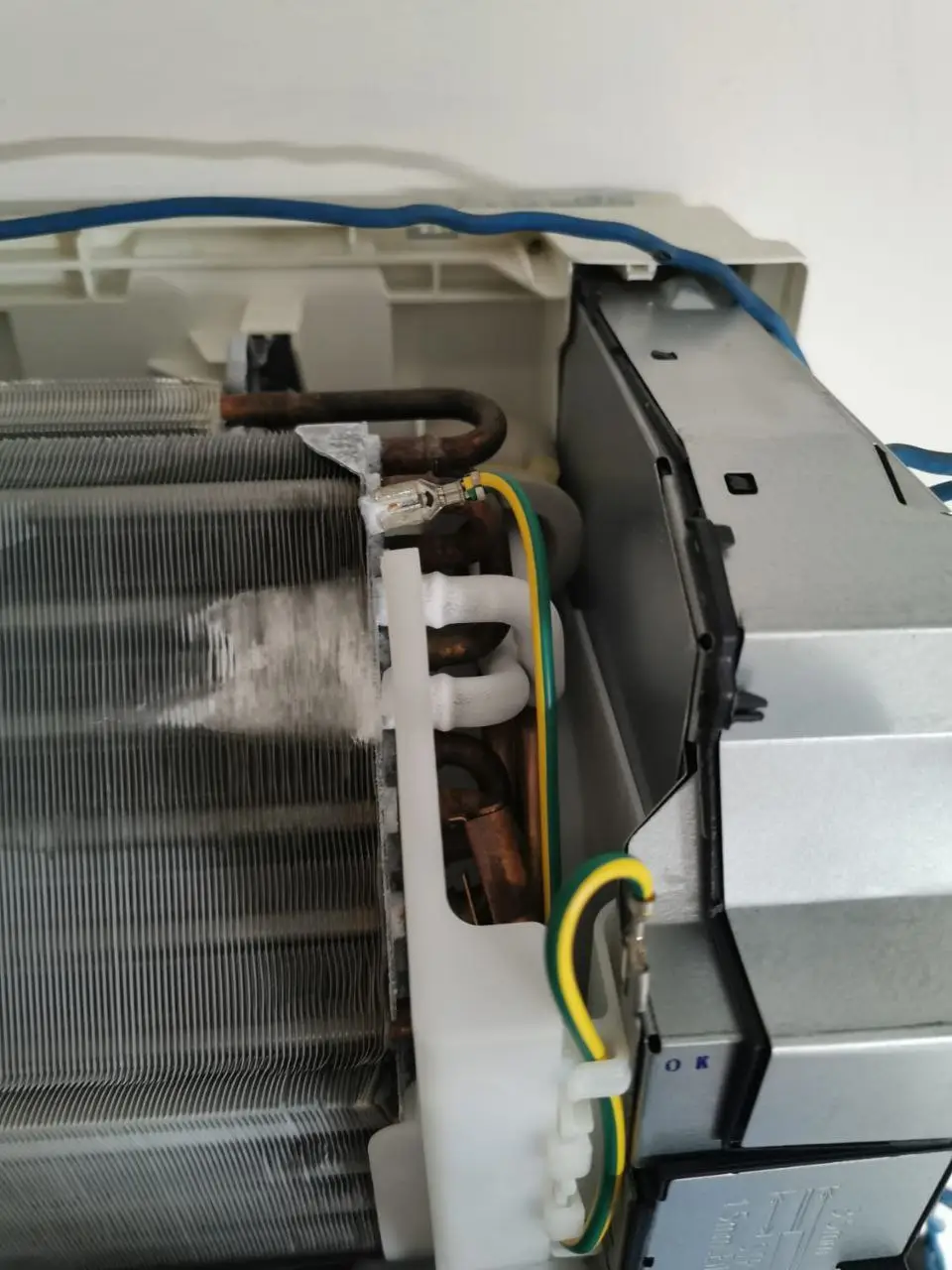
Dust and fibre packed between the blower fins, visible the moment the front panel is off, accounts for the lost volume without needing a second theory.
Ice concentrated on the lower coil section, where air movement is weakest, follows the airflow. A charge fault frosts from the inlet instead.
No hissing at the joints and no oil staining on the pipework removes what a leak normally leaves behind.
Why it happens
Dust blocks a coil in two ways at once. On the blower it adds weight and changes the blade profile, so less air moves per rotation. On the coil face it fills the gaps between the fins, so what air does arrive exchanges less heat. Below a certain volume the surface passes the dew point and then freezes. The ice blocks more air again, which is why the final stage arrives fast after months of slow decline.
What resolution involves
Cleaning is the fix, and it has to reach further than a service does. Buildup packed between blower fins must be dissolved and flushed out; a standard visit cleans the filter and passes over both surfaces that matter. Airflow at the vents afterwards, and even cooling across the coil face, are what show the path is clear. Refrigerant work stays a second step: only if icing returns once airflow is restored does the charge become the question.
How to tell it worked
Judge it at the vents, not on the invoice. Full airflow restored, and a complete cooling cycle with no ice returning, is the standard. Anything short of that means the blower and the coil face were rinsed rather than stripped.
Before you approve a quote
A top-up quoted without a look inside is a guess
- Ask whether anyone looked at the blower and the coil face before refrigerant was mentioned. It is a panel off and two minutes.
- Ask how quickly the airflow fell. Weeks of slow decline and a sudden leak are different faults wearing the same ice.
- A top-up on a blocked coil ices again within weeks. If it does, the money bought nothing and the wash is still owed.
Related diagnostics
Questions this case answers
Should I switch the aircon off if I see ice building up?
Why does my aircon still ice up after a gas top-up?
Can a dirty filter cause the aircon to freeze?
How long does ice take to melt off an aircon coil?
Describe your situation
Tell us what’s going on. Symptoms, setup, photos, anything we should know. We’ll assess and come back with the right next step.