On this page
Quick summary
A blinking green light on a Daikin wall unit signals an active fault lockout. Hold CANCEL on the ARC handset for five seconds to read A3, U4, L5, C4, or 00. Try one three-minute isolator reset, then book a S$30 check if flashing returns.
Pull the Exact Daikin Fault Code on Your Wireless Remote
Daikin wall units such as iSmileEco, iSmile, and EZi blink the same green light for electrical, sensor, drain, and wiring faults. Checking the stored code first prevents blind part swaps or wasted gas refills.
Stand beneath the flashing indoor head and aim the ARC remote straight at the receiver window. Press and keep CANCEL down for five steady seconds so the room digits clear to 00.
Release CANCEL, then press it slowly step by step while hearing each chime from the wall unit. Brief single chirps mark inactive codes. One long steady beep locks onto the active fault on screen.
Decode A3, U4, L5, C4, and 00 Before Calling for Repair
Write down the two characters shown during the long beep before touching other keys. Each Daikin code maps to a clear hardware group inside Singapore flats:
Scroll to see more columns
| Remote code | Daikin listed meaning | Common Singapore flat trigger | Safe homeowner move |
|---|---|---|---|
| 00 | Normal (no stored fault) | Brief mode glitch, dusty filter, or restart delay | Confirm cool mode at 22°C and wash filters |
| A3 | Drain level control system abnormality | Choked drain pipe, stalled pump, or stuck float | Switch cooling off to prevent ceiling overflow |
| U4 | Failure of transmission between indoor and outdoor unit | Off isolator switch, wet ledge lug, or failed PCB | Check kitchen isolator and test other rooms |
| L5 | Output overcurrent | Outdoor inverter overload or locked compressor circuit | Shut the isolator off and skip extra restarts |
| C4 | Faulty heat exchanger temperature sensor | Drifted liquid-pipe thermistor or loose board plug | Record the code for an indoor ohmmeter check |
Try One Clean Isolator Reset Without Forcing the Compressor
Brief power dips during heavy rain in Singapore can freeze a Daikin board without harming parts. One clean power cycle separates a minor lockup from a real fault.
Switch the wall unit off on the handset first. Next, turn off the 20A wall isolator near your HDB kitchen or condo yard for three full minutes. Restore power once, pick cool mode at 22°C, and watch for ten minutes.
Skip any power reset if your flat breaker tripped, a burnt smell lingered, or code L5 showed up. Repeated restarts on a shorted inverter board can damage the compressor too.
Decide When to Book a S$30 Daikin On-Site Fault Check
Use your two-minute remote readout to book the exact visit your Daikin unit needs:
- Book a S$30 diagnostic visit whenever U4, L5, C4, or A3 comes back after one reset. Snowflake waives that fee if repair proceeds, with 30-day labour cover.
- Share your Daikin code and indoor model label on WhatsApp first. Technicians then bring matching thermistors, float gauges, and test meters.
- Pick routine cleaning only when code 00 appears and dusty filters choked airflow. Routine cleaning runs S$50 when booking one Daikin unit, S$30 each when pairing two, or S$25 per coil across three or more heads (14-day cover).
- Hold off on blind board swaps until metered voltage and sensor checks confirm failure. Wall-mount PCB repairs sit between S$180 and S$320.
Diagnostic Cases for This Fault
Singapore jobs showing what we checked on-site before quoting parts or gas.
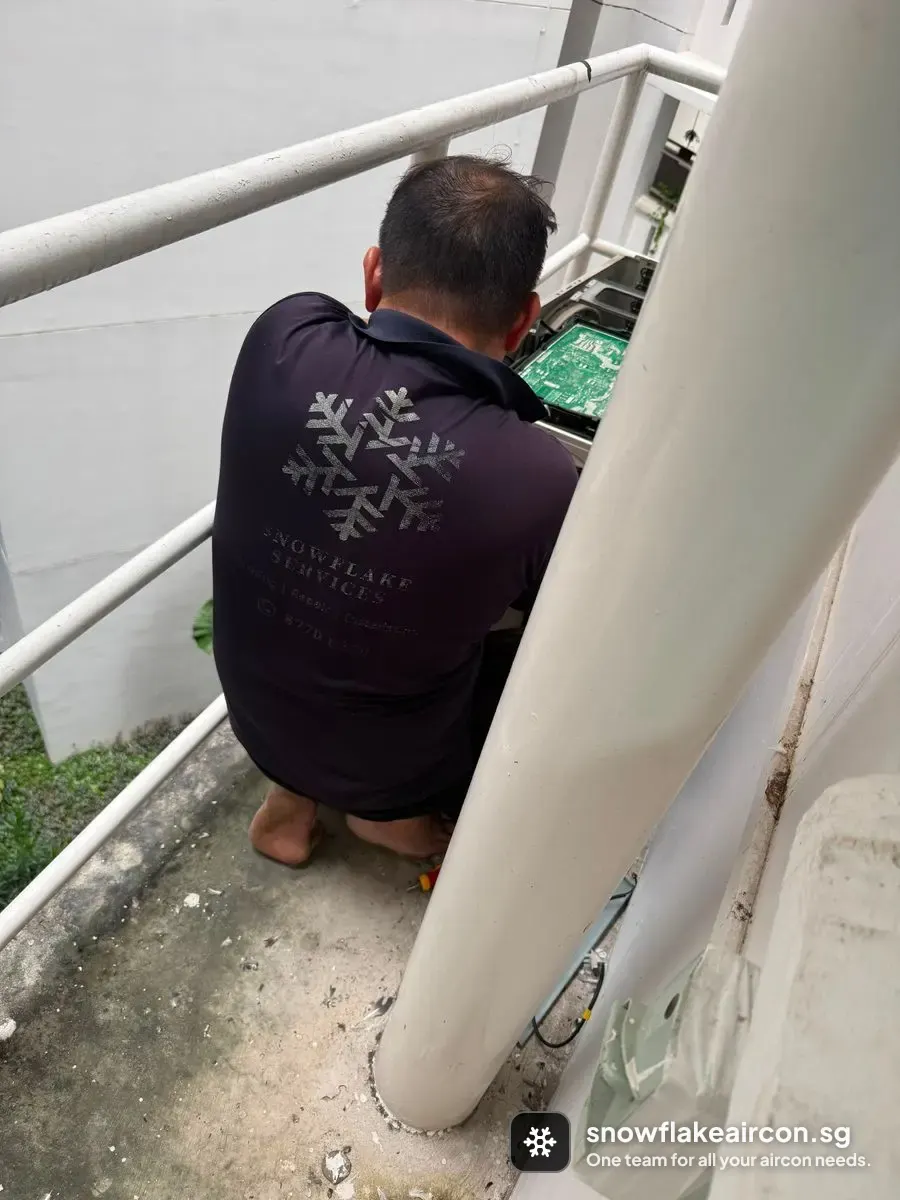
Clementi HDB · Daikin
Clementi HDB Voltage Dip: Outdoor PCB, Not Compressor
Burnt power-supply rail on the outdoor inverter control board caused by a mains voltage dip while the compressor windings and all three indoor fan coils remain healthy
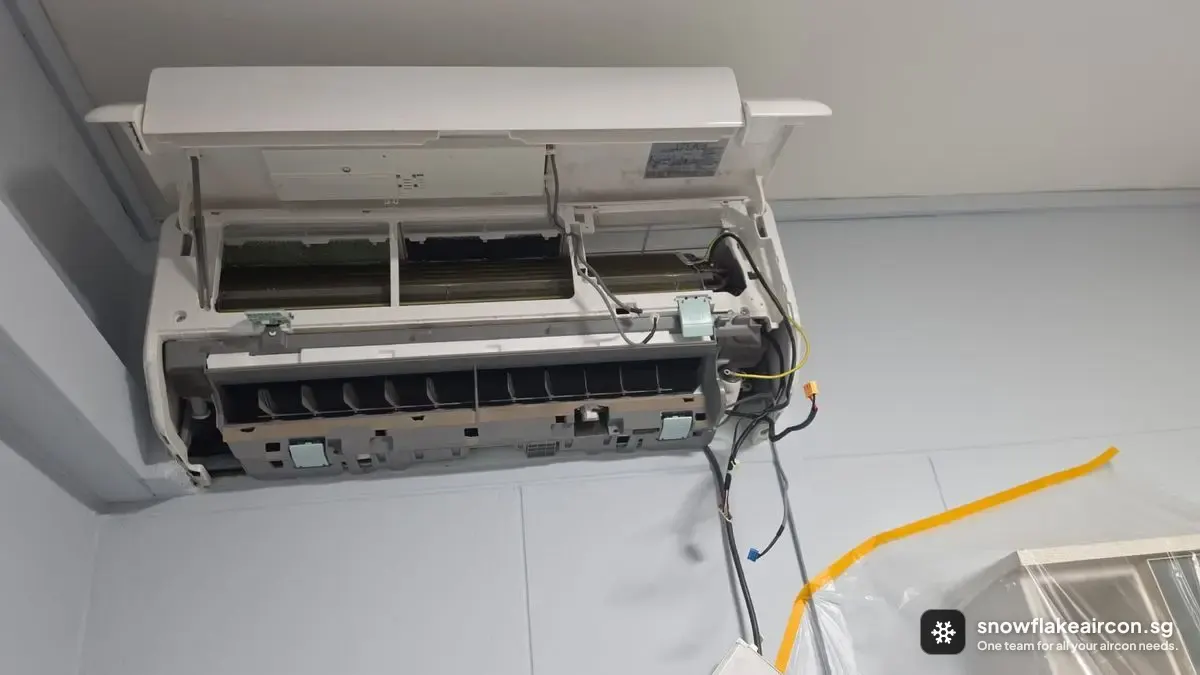
Serangoon HDB · Daikin
Daikin Flashing Lamp and No Cold: Chafed Thermistor Wire
Chafed indoor coil thermistor insulation shorting intermittently against the metal chassis frame, triggering Daikin lamp flashes while the indoor PCB stayed healthy