On this page
Quick summary
On a Singapore multi-split, an indoor FCU PCB fault hits just one room with a dead screen, phantom beeps, or stuck flap while other rooms chill fine. An outdoor inverter PCB fault warms every room at once, trips the breaker during startup, or lights outdoor fault LEDs.
Recognise Symptoms Pointing to One Indoor FCU PCB
Each bedroom wall unit houses a compact low-current indoor PCB that handles remote infrared commands, beep tones, horizontal louvre motors, room sensors, and indoor blower speed. Because each head owns its own control board, indoor PCB faults stay trapped inside that single room.
Watch for telltale single-room signs. One wall unit goes dead while two other rooms stay icy cold. It may beep on its own at night, jam its swing flap, or freeze on scrambled symbols.
Brand self-diagnosis codes often point straight inside too: Mitsubishi Electric Starmex units flash 4 blinks for an indoor control system fault, while Daikin remotes recall A1 for indoor PCB defectiveness.
Recognise Symptoms Pointing to the Outdoor Inverter PCB
Your outdoor condenser on the HDB ledge or condo balcony holds the heavy high-voltage inverter PCB that converts incoming AC power into variable-frequency compressor drive. Every indoor head depends on that one outdoor board to make cold refrigerant.
When the outdoor inverter PCB dies, every room connected to that condenser blows warm fan air simultaneously. Often the indoor blowers spin normally for one to three minutes, then shut down or blink once the condenser fails to start.
Another unmistakable clue is breaker trip timing: the household RCCB or aircon MCB holds while the indoor fan turns on, then snaps down thirty seconds to two minutes later the instant the outdoor inverter power module tries to energise the compressor. On Starmex condensers, outdoor PCB faults also light 7 indoor blinks or red outdoor LED fault patterns.
Compare Indoor and Outdoor PCB Symptoms Side by Side
Use this quick Singapore multi-split matrix from floor level so you know which side of the system actually needs metered testing.
Scroll to see more columns
| Observed home symptom | Indoor FCU PCB failure | Outdoor inverter PCB failure | What to test first |
|---|---|---|---|
| Rooms affected on System 2, 3, or 4 | Only 1 bedroom fails; sibling rooms chill fine | Every room on that condenser blows warm together | Run each bedroom solo for 4 minutes |
| Remote control and louvre behaviour | No beep, dead receiver, phantom restarts, or stuck flap | Indoor unit beeps and opens flap normally, just stays warm | Verify remote batteries and infrared LED with a phone camera |
| Household RCCB or MCB trip timing | Rarely trips breaker; if it does, trips immediately on switch-on | Trips 30 seconds to 3 minutes after cooling starts | Leave tripped breaker off; stop repeat resets |
| Typical brand fault signals | Daikin A1, Starmex 4 blinks, or single-room display error | Daikin L5, U2, or U4 across all rooms, or Starmex 5 or 7 blinks | Record exact code or blink video before cutting power |
Decide How to Budget for Indoor Versus Outdoor Board Repairs
Outdoor inverter boards cost substantially more than indoor control boards, and replacing the wrong board or missing a shorted fan motor destroys parts fast. Always verify electrical readings before approving swaps:
- Start with a S$30 split board check on site. That S$30 charge disappears from your repair bill, backed for 30 days.
- Before paying for a new outdoor board, verify motor and coil checks. A shorted outdoor DC fan motor or bad compressor winding can burn a fresh board fast.
- Swapping one faulty indoor FCU PCB on a clean multi-split under eight years old stays fast and fair. You avoid ripping out healthy rooms.
- An eight-to-ten-year-old R410A condenser with rusted fins and a dead outdoor board deserves a second look. Price a new 5-tick R32 set before sinking big cash into old boards.
Diagnostic Cases for This Fault
Singapore jobs showing what we checked on-site before quoting parts or gas.
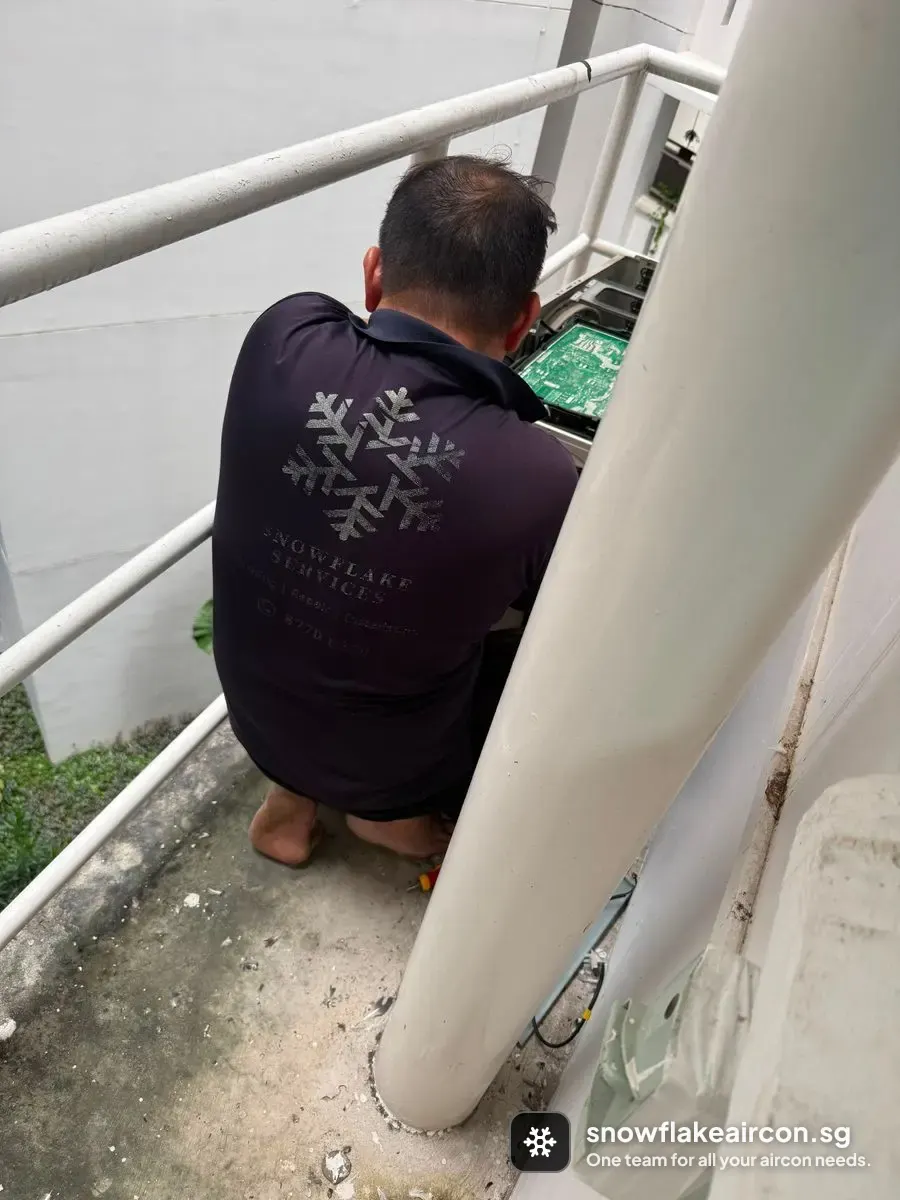
Clementi HDB · Daikin
Clementi HDB Voltage Dip: Outdoor PCB, Not Compressor
Burnt power-supply rail on the outdoor inverter control board caused by a mains voltage dip while the compressor windings and all three indoor fan coils remain healthy
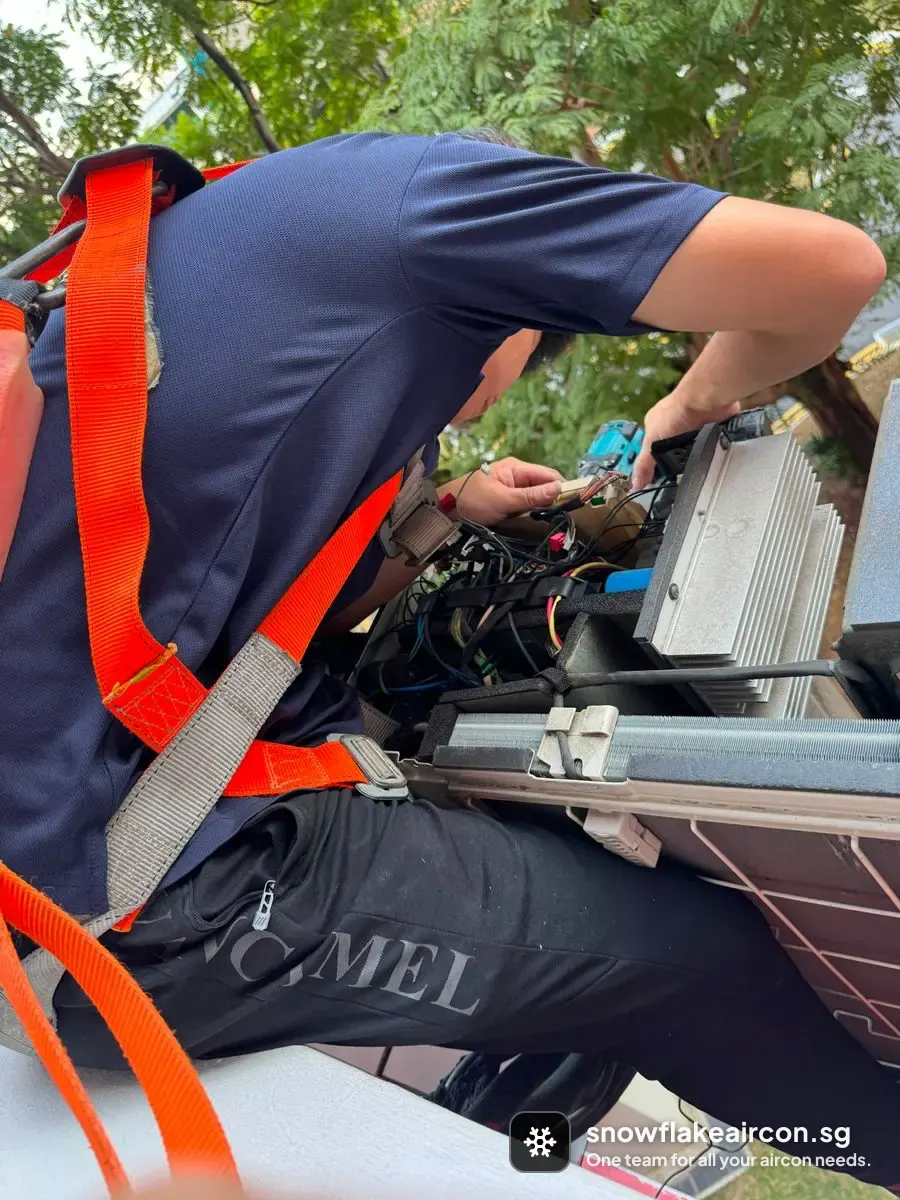
Sembawang HDB · Daikin
Daikin System 4 Storm Outage: Outdoor PCB, Not Compressor
Storm surge blew the outdoor surge protector and inverter control board on a high-floor Daikin System 4 while compressor insulation resistance remained clean