Aircon pressure testing
We hold the sealed circuit at nitrogen pressure and watch for a drop, so the piping is proven before any refrigerant goes in. We’ll assess first, then confirm whether this is the right scope before you book.
BCA-registered10,000+ jobs completed
What pressure testing covers
A sealed circuit either holds pressure or it does not. Nitrogen answers that before refrigerant is committed to the pipes, which is the last point where a bad joint is still cheap to reach. Common situations where a pressure test fits:
New or altered piping, before charging
A fresh install, an extension, or a relocation. Every new joint gets proved while the run is still reachable.
Reusing existing pipes on a replacement
Old R22 copper sees higher pressure on R32. Holding is one of three checks, alongside wall thickness and leftover oil.
Verifying work you did not watch
An independent hold test on a finished job, before or after handover.
When a pressure test isn't suitable
Nitrogen answers one question: does the circuit hold. It is the wrong first move when the fault sits somewhere else.
The system is already losing gas
That is a leak hunt, not a verification. We confirm the drop with gauges first, then go looking.
Cooling is weak but pressure reads normal
Airflow, sensor, and control faults do not show up on a hold test.
The system is charged and cooling fine
Testing means recovering the refrigerant first. There is no reason to open a circuit that is working.
What you get
A reading you can see, taken at the one moment a bad joint is still inexpensive.
A pass or fail with numbers on it
The pressure it was held at and what the gauge did, not a verbal assurance.
Faults found while they are still reachable
A weeping joint on exposed pipe is minutes of work. The same joint behind a wall is not.
Nitrogen out, vacuum, then gas
A pass is followed by evacuation and a measured charge, in that order.
Why the test gets skipped
Nothing about a pressure test is visible in a finished installation. It adds time before handover, costs no parts, and the consequence of skipping it lands months later on the homeowner rather than the installer.
It costs time, not materials
Holding pressure and watching a gauge is unbilled labour on a fixed-price install. On a thin quote it is the first thing to go.
A skipped test looks identical on day one
A system with a weeping joint still cools at handover. The gas has not had time to go anywhere yet.
The failure arrives late
Slow losses take months to show as fading cooling, by which point the install is usually somebody else's problem.
Nitrogen leaves no evidence either way
You cannot tell from a finished job whether it was tested. Asking what pressure it held at is the only check available to you.
The section under test is isolated and charged with dry nitrogen, then held at its rated pressure. Ambient temperature moves the reading, so it is accounted for before a pass or fail. How a job runs, from first message to booking.
From the field
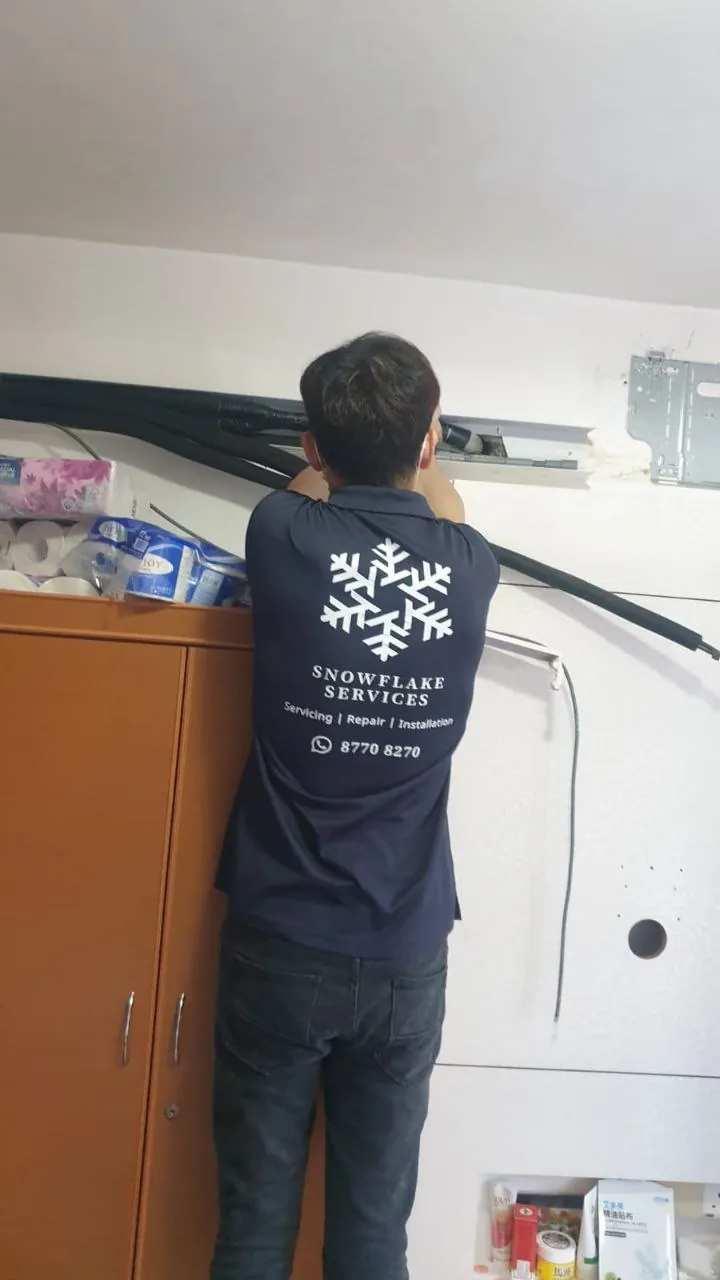
The joints a pressure test loads, while the run is still open and reachable.
What an unproven circuit costs later
Diagnosis-led case notes from installations that were handed over without the step. Open the case if the pattern looks familiar.
Frequently asked questions about aircon pressure testing in Singapore
How long does a pressure test take?
Can you pressure test a system that is already running?
Why nitrogen instead of testing with the refrigerant?
My installer says they tested. How would I know?
We cover all of Singapore. Find aircon services in your area.
Describe your situation
Tell us what’s going on. Symptoms, setup, photos, anything we should know. We’ll assess and come back with the right next step.