On this page
How This Presents
Two adjacent meeting rooms show blank wall controllers and stop cooling simultaneously mid-morning. Open-plan desks fed by the same commercial plant stay briskly cold all afternoon. Resetting the office distribution breaker brings zero response on either affected wall pad.
- Setup
- Mitsubishi Heavy Industries Ducted7-9 yearsOfficeSengkang
- Misread as
- Assuming a multi-zone office shutdown means a costly outdoor inverter PCB failure and days of workspace downtime.
- Check first
- Tracing signal voltage across the ceiling branch box PCB to see why only two downstream zones dropped out
What Else Produces This
Partial outages on a commercial multi-zone installation split cleanly by wiring layout: a dead outdoor controller takes down the whole floor, whereas a ceiling branch box fault isolates only its paired zones. Opening the corridor access hatch tests that divide directly.
Outdoor condenser runs quietly serving open-plan zones, eliminating main power supply and outdoor inverter PCB failure immediately.
Communication signal arriving at the ceiling branch box input reads healthy and stable on diagnostic meters.
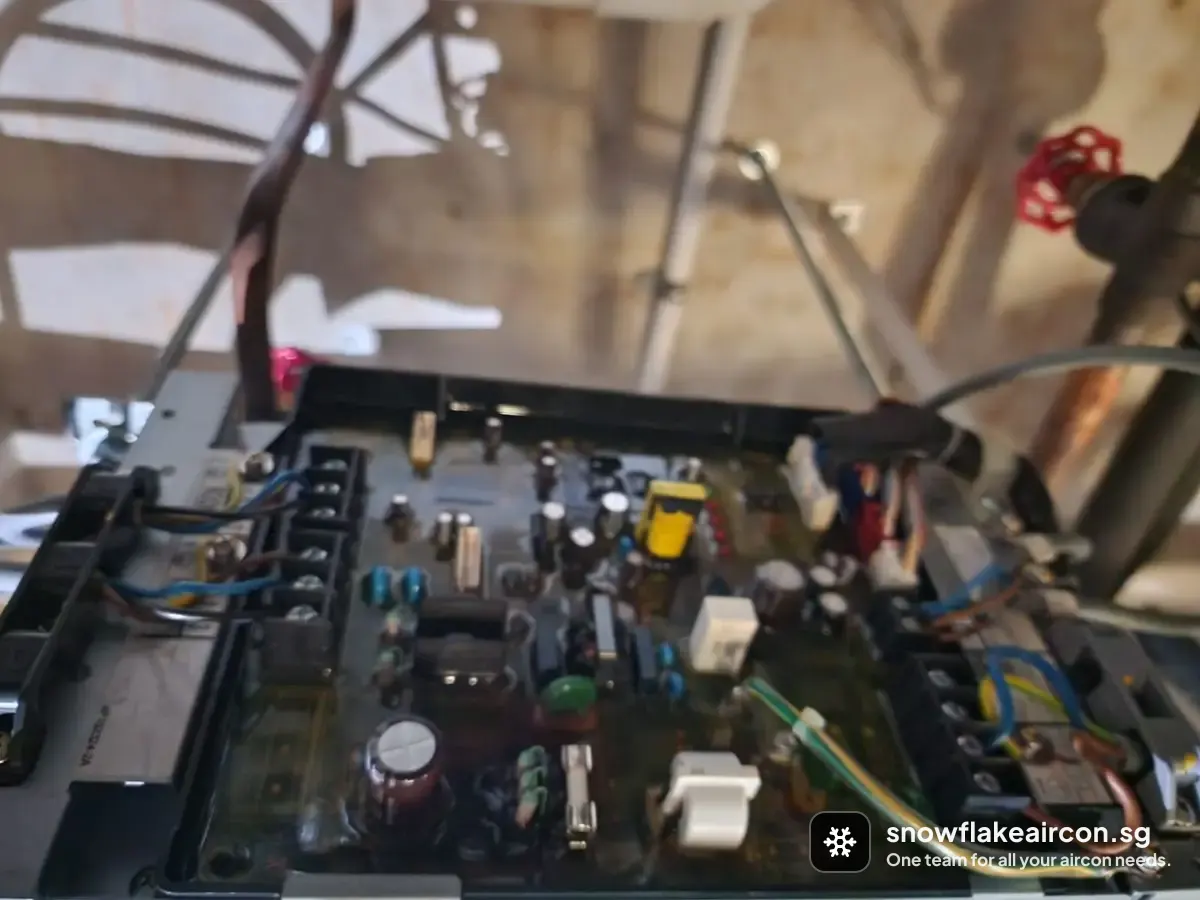
Removing the branch box cover reveals greenish oxidation along the downstream terminal block and heat scorching beneath a valve relay.
Zero output signal leaves the oxidised port toward the two affected meeting-room fan coils.
Why It Happens
Commercial ceiling plenums in Sengkang offices trap warm, humid outdoor air infiltrating near service risers. Condensation tracking along nearby pipe insulation dampened the metal branch box over years of daily use. Corroded copper pins built contact resistance, baking the relay board until both linked zones dropped offline. Because each box serves only its paired branches, the main outdoor inverter board remained completely healthy.
What Resolution Involves
Isolating circuit power allows swapping the damaged branch box control board as a self-contained module. Oxidised signal wires are stripped back cleanly and fitted with fresh crimped lugs. Sealing enclosure cable glands and re-taping adjacent chilled pipe joints keeps humid ceiling air off the fresh PCB. Office desks outside the corridor hatch keep cooling throughout the repair.
How to Tell It Worked
Powering up restores both wall controllers immediately with matching zone addresses and zero communication errors. Opening each meeting room's cooling demand confirms crisp electronic valve actuation and cold supply air within ten minutes, with open-plan desks unaffected throughout. A brief post-repair check verifies dry conduit entries above the ceiling tiles and steady bus readings.
Before You Approve a Quote
Shared zone outages map to the ceiling junction first
- When two or three office rooms fail together while other branches cool smoothly, suspect the shared ceiling distribution box.
- Unconditioned Singapore ceiling voids stay humid enough to corrode exposed board plugs over seven to nine years.
- Replacing a branch box board costs far less and finishes much faster than stripping a rooftop outdoor unit.