On this page
Quick summary
Wet patches, flaking paint, or dark mould along a Singapore condo false-ceiling box-up usually trace to perished Armaflex sleeves, humid air leaking past unsealed access panels, or shallow drain slopes. Book a S$30 diagnostic inspection through existing panels before hacking plasterboard.
Why Condo Aircon Box-Ups Collect Moisture and Blister Paint
Interior designers across Singapore condominiums hide copper refrigerant lines, drain pipes, and ducted plenums inside narrow gypsum pelmets. While neat visually, an unventilated ceiling cavity quickly fills with warm 80% humidity indoor air.
Whenever that moist air touches any bare copper pipe, thin compressed foam sleeve, or chilly supply plenum below the dew point, water droplets form immediately. Gypsum board absorbs repeated dampness until paint bubbles, edges sag, and black mildew blooms along the cornice.
Wait too long and rusted ceiling screws stain plaster yellow, forcing full repainting or partial board replacement on top of the mechanical fix.
Match Each Condo Ceiling Clue to Its Hidden Fault
Note where dampness appears relative to your indoor blower and service hatch before calling a contractor:
Scroll to see more columns
| Ceiling box-up symptom | Hidden fault inside void | Can hatch access fix it | Typical repair path |
|---|---|---|---|
| Long damp line tracing pipe run to balcony | Split or brittle Armaflex insulation sleeve | Often yes near reachable joints | Re-sleeve with Class 0 foam and vapour tape |
| Mould halo framing a hinged ceiling hatch | Unsealed hatch perimeter drawing humid air | Yes, zero plaster cutting | Apply closed-cell foam gasket and level latches |
| Brown water ring directly below indoor head | Choked pan or sagging PVC drain backfall | Usually via existing panel | Flush drain line, re-clip slope, insulate PVC |
| Cold sweating on linear slot diffuser blades | Low fan speed or warm room air hitting grille | Yes, commissioning adjustment | Seal plenum collar and raise supply airflow |
Check Insulation Sleeves, Hatch Seals, and Drain Slope First
Never let a contractor hack open an entire living room bulkhead on guesswork. Experienced technicians inspect inside existing 450mm or 600mm access panels using torches, inspection mirrors, and thermal meters.
Key checkpoints include squeezing the black foam sleeves for waterlogged mush, tracing taped seams where condensation breaks through, and checking whether the white PVC drain line holds a steady downward fall without belly dips.
On concealed ducted or cassette setups, inspecting the rubber float switch and condensate pump basin also confirms whether stalled drainage is spilling over the insulated tray.
When to Call a Technician and What Ceiling Fixes Cost
Pinpointing whether water stems from drain slime, perished foam, or hatch gaps keeps condo repair bills contained:
- Begin with Snowflake's S$30 site diagnosis to inspect inside the pelmet and verify the wet source; that inspection charge is credited back once repair starts.
- Where choked trays cause spillover, standard servicing bills S$50 for a solo FCU, S$30 each when cleaning two FCUs, or S$25 per FCU on three-plus bookings (14-day cover).
- Heavy algae requires chemical flushing (S$80 one FCU, S$70 per pair, S$60 for triple-plus; 60-day cover) or dismantled overhaul (S$150 one FCU, S$125 per pair, S$115 for triple-plus; 90-day cover).
- Where concealed foam sleeves fail along unreachable spans, technicians mark the smallest inspection cut needed. That keeps your MCST permit and plaster patch work minimal.
Diagnostic Cases for This Fault
Singapore jobs showing what we checked on-site before quoting parts or gas.
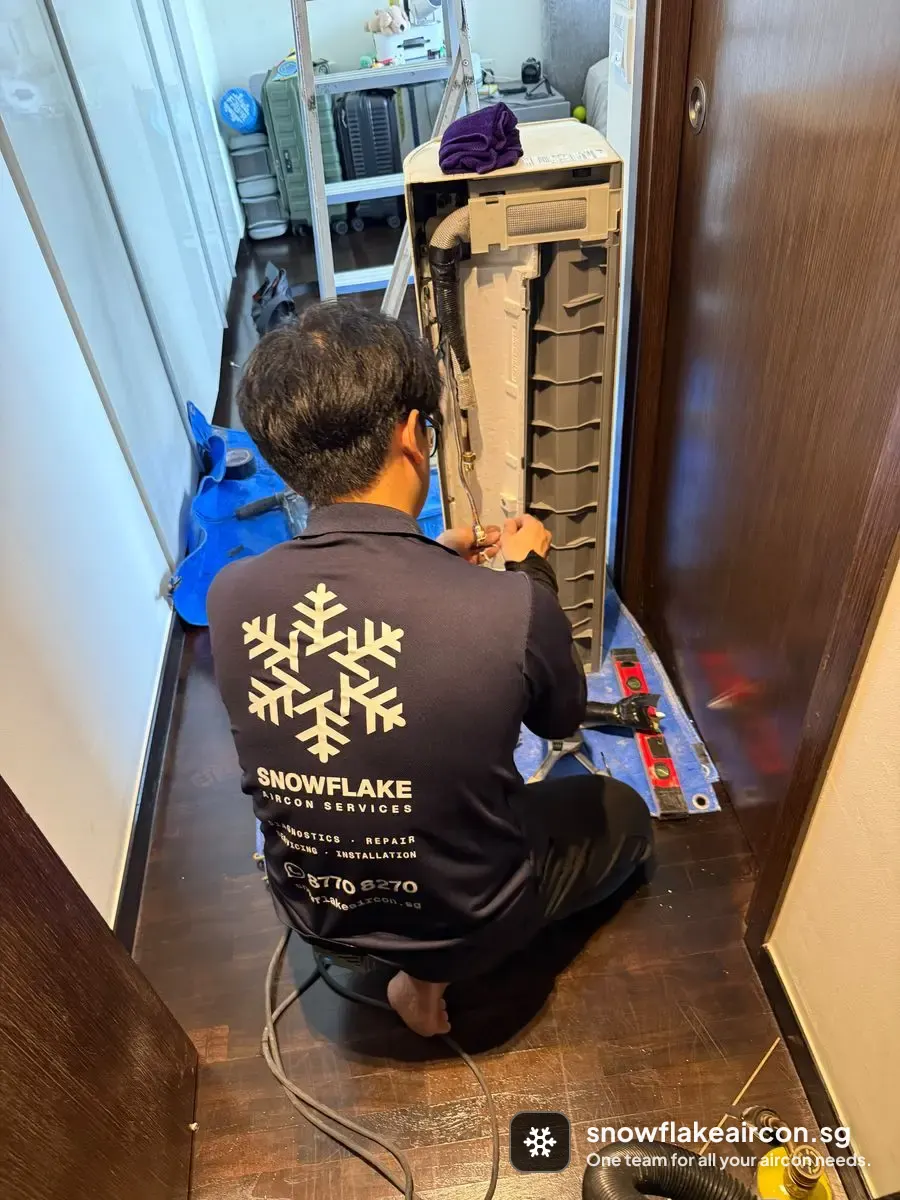
Woodlands HDB · Mitsubishi Electric
Starmex Leaks After Wash: Floor Overhaul Clears Sludge
Dense biofilm sludge bridging the narrow rear drain channel and inner evaporator fin pack that wall-hung general servicing could never reach on the Woodlands Starmex unit
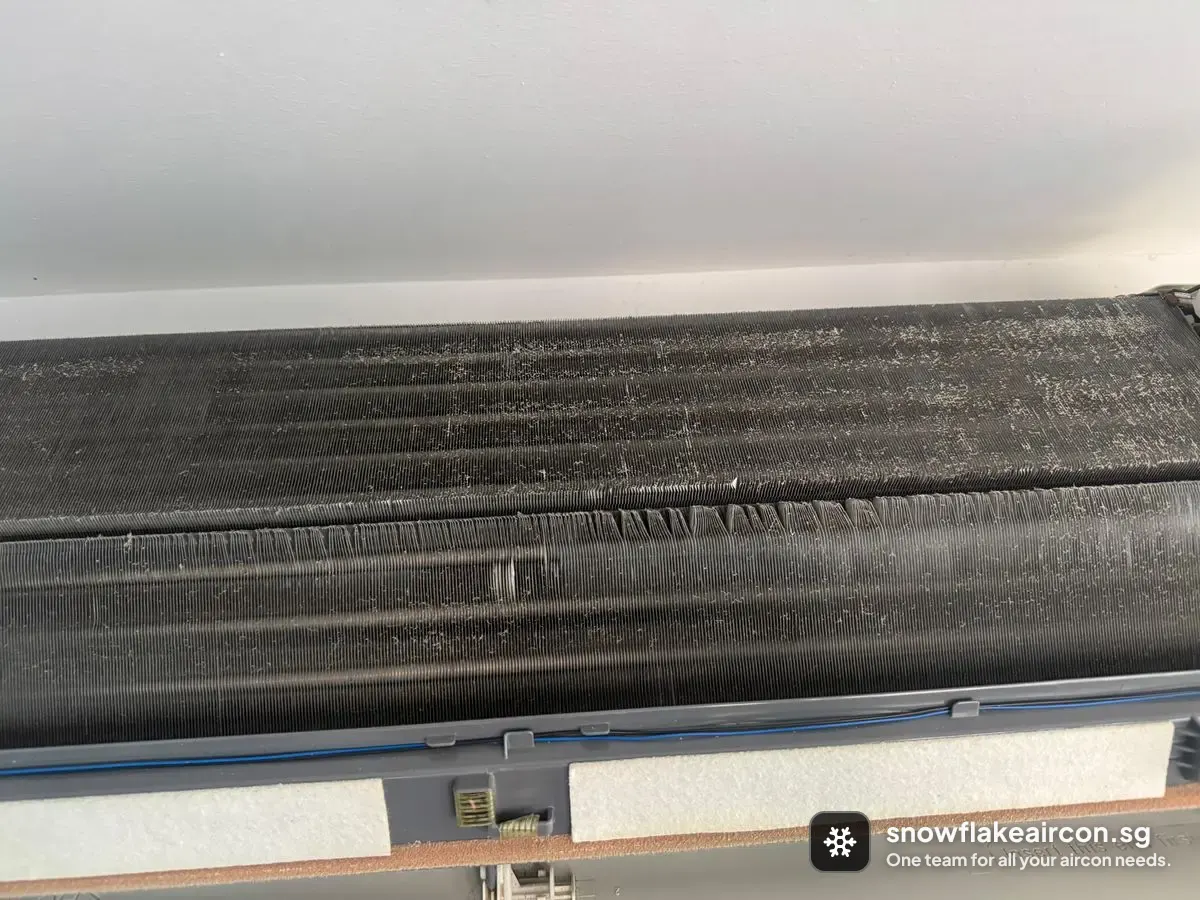
Bukit Merah Retail · Midea
Shop Aircon Runs Non-Stop: Dust Mat Across Indoor Coil
Dense lint and retail dust felt blanketing the exposed evaporator coil face behind rinsed mesh filters