On this page
Quick summary
An aircon blowing strong room-temperature fan air means the outdoor unit failed to chill refrigerant. Verify cool mode below room temperature, check whether the outdoor condenser starts at all, and separate electrical startup faults from refrigerant leaks before paying.
Confirm Cool Mode, Low Setpoint, and Isolator Power First
Accidental fan mode, eco mode, or a high temperature setpoint is the simplest cause of unchilled wind. A bedroom unit set to 27°C in a shaded room runs only its indoor blower by design.
Switch the handset to the snowflake cool icon, lower the target to 20°C briefly, and wait five minutes. Inverter compressors enforce a built-in three-minute delay after every power toggle.
Check the 20A outdoor isolator switch near the kitchen yard and inspect the distribution board aircon breaker. Never keep forcing a tripped breaker back on because repeat trips warn of a live short.
Match Outdoor Condenser Behaviour to the Exact Repair Scope
Step safely to the window overlooking your outdoor ledge after five minutes on cool mode. Observing fan spin from indoors narrows both cause and starting rate:
Scroll to see more columns
| Outdoor condenser behaviour | Most probable fault | Singapore flat clue | Published starting range |
|---|---|---|---|
| Completely dead and silent | Tripped isolator, blown fuse, or outdoor PCB | Indoor blower runs; outdoor fan never twitches | S$30 trip (waived on fix); wall PCB S$180 to S$320 |
| Brief hum or click, then silence | Weak start/run capacitor or thermal overload | Older non-inverter or heavy-duty outdoor unit | S$30 trip (waived on fix); quoted after meter test |
| Fan spins steadily, discharge air stays cool | Low R410A or R32 refrigerant from a leak | Cooling faded slowly over weeks or months | Leak test + R410A S$80 to S$150; R32 S$120 to S$200 |
| Fan runs, discharge air blasts scorching hot | Choked condenser fins or indoor sensor drift | Unit loses chill during hot afternoons | Outdoor wash S$60 to S$120 or S$30 sensor check |
Separate Electrical Startup Failures from Slow Refrigerant Loss
Homeowners often get sold routine gas top-ups when the root reason for warm fan air is electrical. Adding refrigerant never restarts a dead outdoor board, open thermal switch, or weak capacitor.
Equally vital, sealed Singapore split systems never burn up gas during normal cooling. Low pressure on R32 or R410A gauges means a loose flare nut or pinhole coil leak let gas escape.
Topping up gas without sealing that leak brings warm wind right back in weeks. Nitrogen pressure testing and flare checks first protect both your budget and compressor oil.
Plan Your Repair Budget Before Booking an Aircon Technician
Measured electrical and gauge checks upfront prevent paying twice for the wrong service slot:
- Start with a S$30 troubleshooting trip when airflow already blows strong. Snowflake drops that fee when repair goes forward, with 30-day cover.
- Ask for live AC voltage, amp draw, and capacitor readings before approving board swaps. Wall-mount PCB fixes run S$180 to S$320.
- Approve gas recharges only after gauges verify low operating pressure and leak points get checked. R410A refills range between S$80 and S$150. R32 recharges span S$120 to S$200.
- Keep wash visits for dusty coils once cooling works. Routine cleaning drops to S$25 per fan coil across three or more rooms, while chemical washes start at S$60.
Diagnostic Cases for This Fault
Singapore jobs showing what we checked on-site before quoting parts or gas.
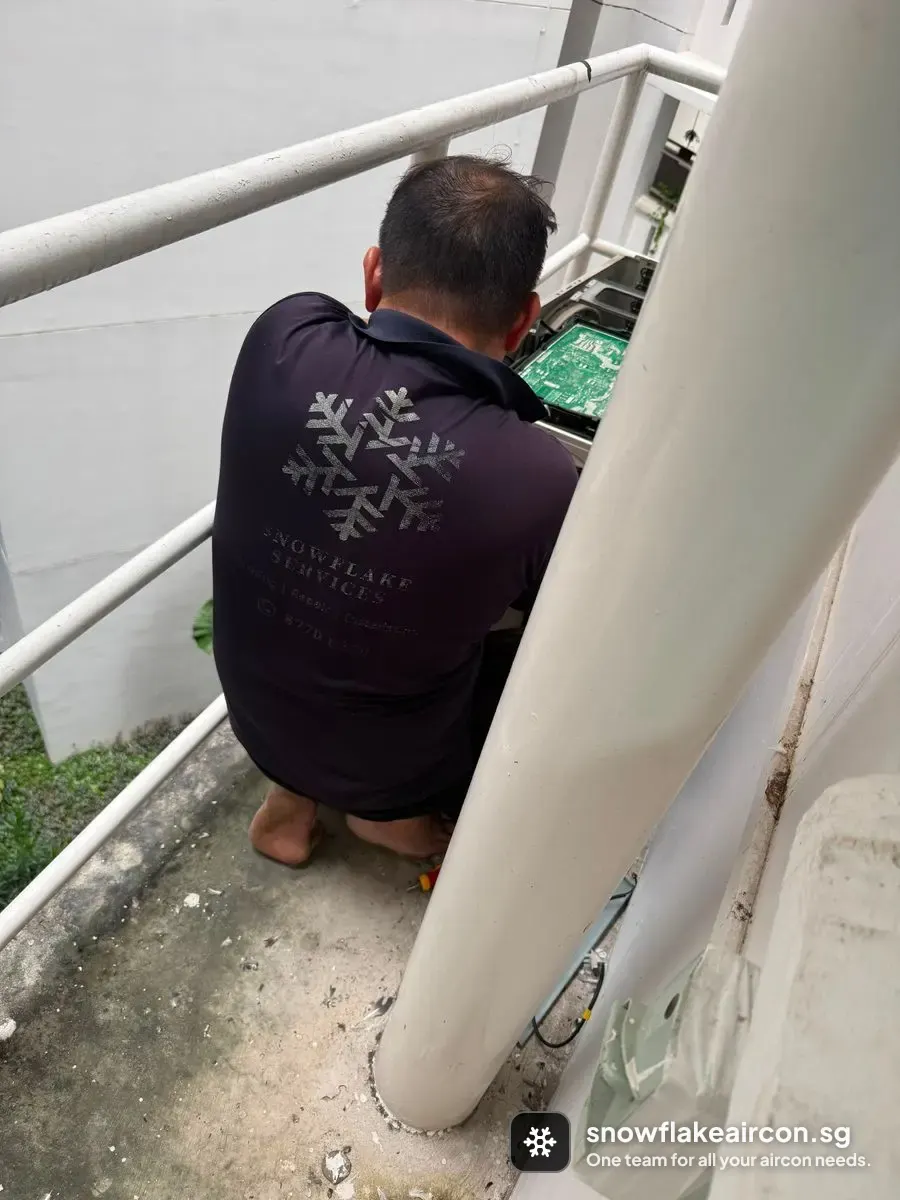
Clementi HDB · Daikin
Clementi HDB Voltage Dip: Outdoor PCB, Not Compressor
Burnt power-supply rail on the outdoor inverter control board caused by a mains voltage dip while the compressor windings and all three indoor fan coils remain healthy
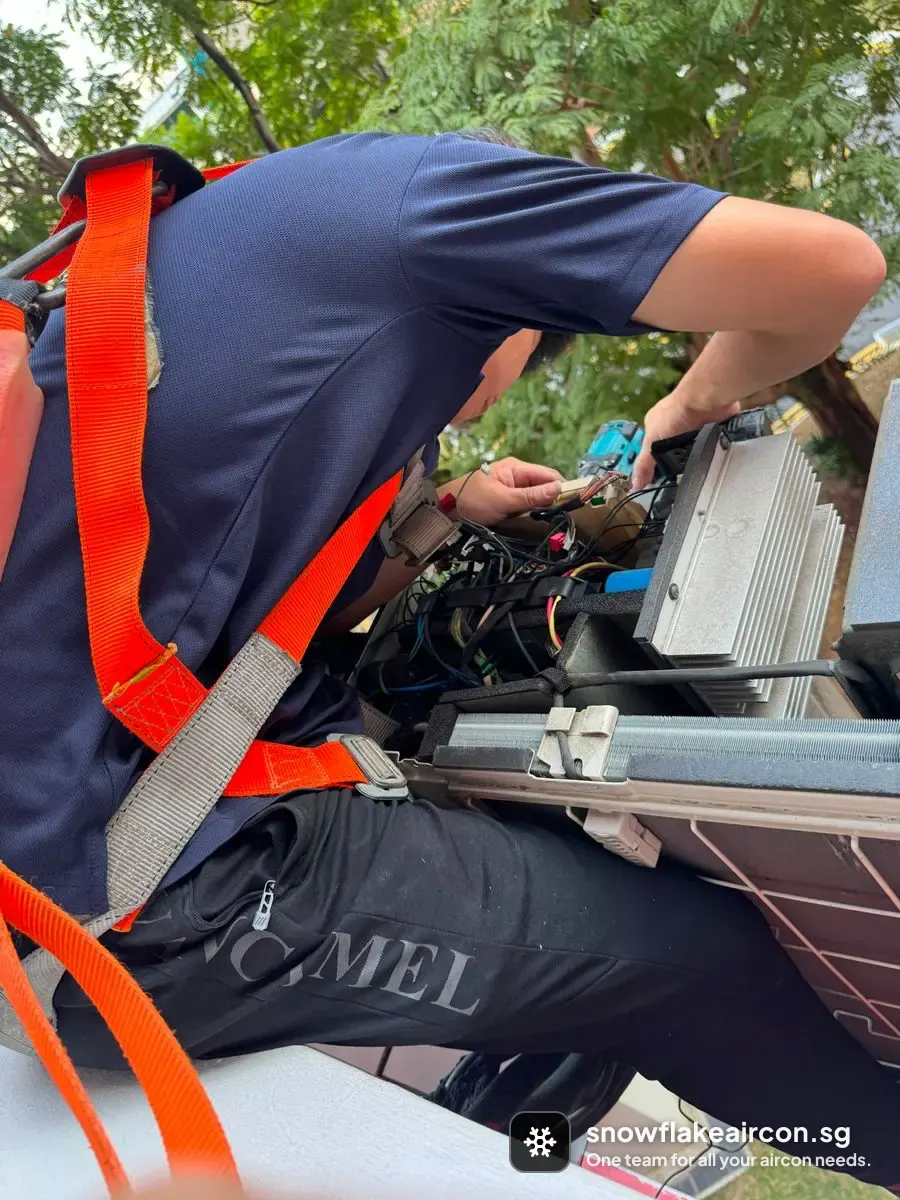
Sembawang HDB · Daikin
Daikin System 4 Storm Outage: Outdoor PCB, Not Compressor
Storm surge blew the outdoor surge protector and inverter control board on a high-floor Daikin System 4 while compressor insulation resistance remained clean