Aircon Flexible Ducting Insulation: Why It Sweats
Flexible ducting and insulation are the foil-wrapped insulated supply and return tubes connecting a concealed ducted aircon unit to ceiling diffusers in Singapore condos, landed homes, and offices.
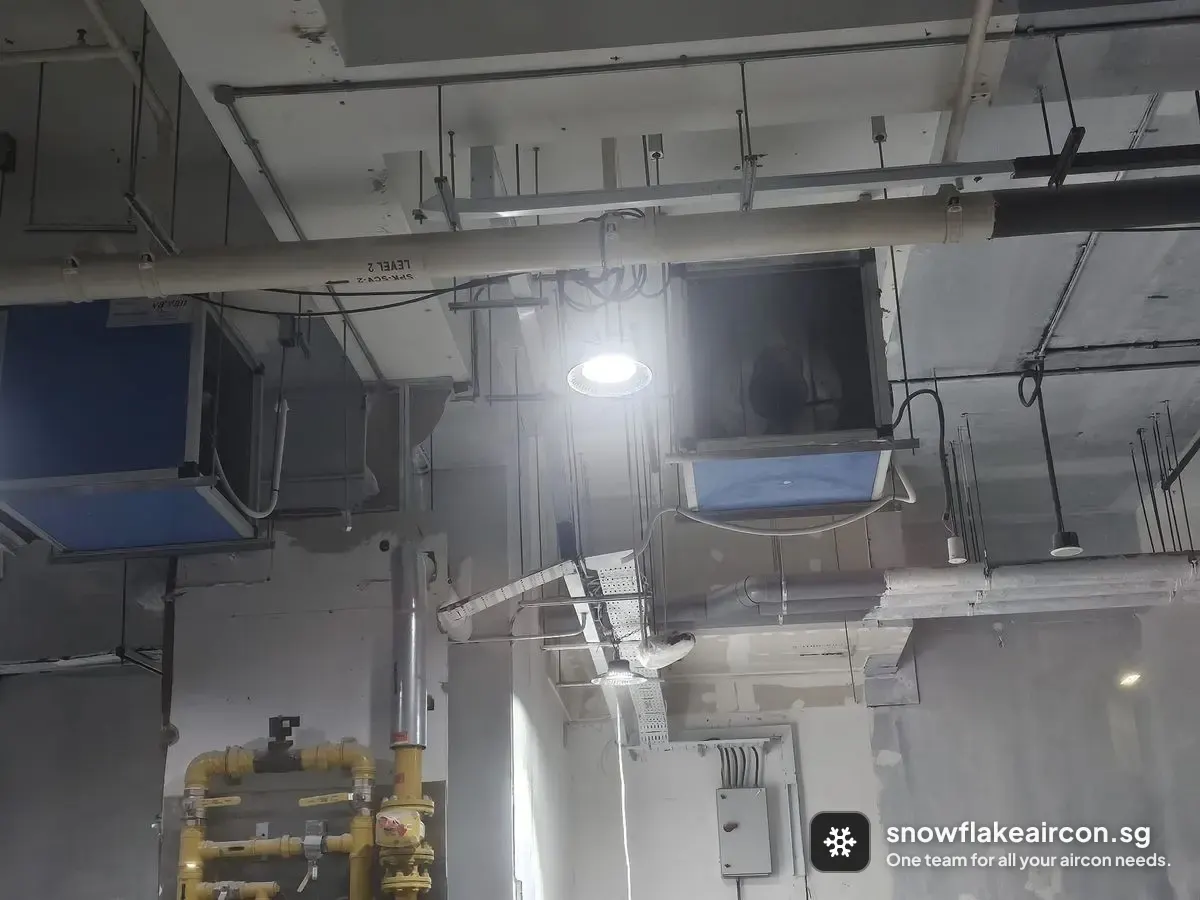
What the flexible ducting and insulation does
Cold air leaving a concealed ducted FCU travels through round or rectangular insulated ducts inside an unconditioned false-ceiling void. A sealed aluminium-foil vapour barrier over fibreglass or closed-cell foam keeps humid Singapore ceiling air from touching the cold duct wall and condensing.
Mechanical component
Flexible ducting and insulation failure signs
Match the symptom, then see what a technician checks to confirm the cause.
| What you observe | Likely causes | How we verify |
|---|---|---|
| Brown water stains or mould spots on plasterboard away from the FCU | Torn outer foil vapour barrier exposing cold inner duct wall to humid ceiling air, Unsealed tape joint at the supply plenum collar or diffuser neck, Compressed insulation where a duct rests hard on ceiling framing | Inspect above the ceiling hatch with a torch and thermal camera while the unit runs at low temperature to locate wet foil seams. |
| One room blows noticeably weaker or warmer air than other rooms | Kinked or crushed flexible duct run above the ceiling, Detached duct collar leaking cold supply air into the ceiling void | Measure airflow and supply temperature at the diffuser versus the main plenum, then trace the flex run above the ceiling. |
| Musty odour or ceiling noise when the ducted unit starts | Return-air duct gap pulling warm dusty ceiling-void air into the FCU, Loose inner liner fluttering at high static pressure | Inspect the return plenum seal and flex-duct collars while the blower runs on high speed. |
- What you observe
- Brown water stains or mould spots on plasterboard away from the FCU
- Likely causes
- Torn outer foil vapour barrier exposing cold inner duct wall to humid ceiling air, Unsealed tape joint at the supply plenum collar or diffuser neck, Compressed insulation where a duct rests hard on ceiling framing
- How we verify
- Inspect above the ceiling hatch with a torch and thermal camera while the unit runs at low temperature to locate wet foil seams.
- What you observe
- One room blows noticeably weaker or warmer air than other rooms
- Likely causes
- Kinked or crushed flexible duct run above the ceiling, Detached duct collar leaking cold supply air into the ceiling void
- How we verify
- Measure airflow and supply temperature at the diffuser versus the main plenum, then trace the flex run above the ceiling.
- What you observe
- Musty odour or ceiling noise when the ducted unit starts
- Likely causes
- Return-air duct gap pulling warm dusty ceiling-void air into the FCU, Loose inner liner fluttering at high static pressure
- How we verify
- Inspect the return plenum seal and flex-duct collars while the blower runs on high speed.
Replacing the flexible ducting and insulation
Replace
Replace flexible duct sections when the inner liner is torn, the foil vapour barrier is brittle and crumbling, or fibreglass insulation is waterlogged with mould.
You can wait
A single loose tape seam with dry insulation can be resealed cleanly during routine ducted servicing.
Do not wait
Active dripping from a sweating duct onto false-ceiling plasterboard risks ceiling collapse and mould spread across rooms.
If you proceed
- Typical replacement cost
- S$180–S$650
- Replacement timeline
- Same-day for collar resealing or single-run swaps; 1–2 days for full multi-room re-ducting
Minor collar leaks are resealed with HVAC foil tape and nylon duct straps. Waterlogged or collapsed runs are swapped for new insulated Class 0 ducting through the ceiling access hatch.
Always check whether a concealed ceiling hatch exists near the sweating run. If plasterboard must be opened, clarify whether ceiling patching is included or handled by a contractor.
Source: Code of Practice to eliminate halocarbon emissions from refrigeration and air conditioning systems: chapter 3, Environment and Climate Change Canada, checked .
Repair service: Ducted aircon repair.
How we verify a flexible ducting and insulation fault
These are technician checks to confirm whether the part is at fault.
Open the ceiling access hatch and trace supply and return duct runs from the FCU plenum to each diffuser neck.
Tools: Step ladder, Inspection torch
Healthy reading: Ducts hang smoothly on wide saddles without sharp kinks, sagging water pockets, or torn foil.
Check foil-tape seams at the plenum spigot and diffuser boots for cold air leaks or damp insulation.
Tools: Thermal camera or infrared thermometer
Healthy reading: Outer foil stays at ceiling-void temperature with dry joints and zero cold air escaping.
Measure supply-air temperature drop at the diffuser against the FCU outlet to detect ceiling-void heat gain.
Tools: Digital air thermometer
Healthy reading: Supply air loses less than 1–2°C across a properly insulated residential duct run.
Frequently asked questions about the aircon flexible ducting and insulation
What are the warning signs that the flexible ducting and insulation is wearing out?
The first sign of a flexible ducting and insulation problem is this: brown water stains or mould spots on plasterboard away from the FCU, and the same fault can also show as one room blows noticeably weaker or warmer air than other rooms.
Does the flexible ducting and insulation need repairing or replacing?
Replace flexible duct sections when the inner liner is torn, the foil vapour barrier is brittle and crumbling, or fibreglass insulation is waterlogged with mould. You can wait in this case: a single loose tape seam with dry insulation can be resealed cleanly during routine ducted servicing.
When should I stop using the aircon because of the flexible ducting and insulation?
Active dripping from a sweating duct onto false-ceiling plasterboard risks ceiling collapse and mould spread across rooms; the warning sign to track is this: brown water stains or mould spots on plasterboard away from the FCU. Another sign: one room blows noticeably weaker or warmer air than other rooms.