Ducted Centrifugal Blower: Low Airflow and Noise
The ducted centrifugal blower assembly is the squirrel-cage wheel and scroll housing inside a concealed ducted aircon that generates the static pressure needed to push cold air through long ceiling ducts.
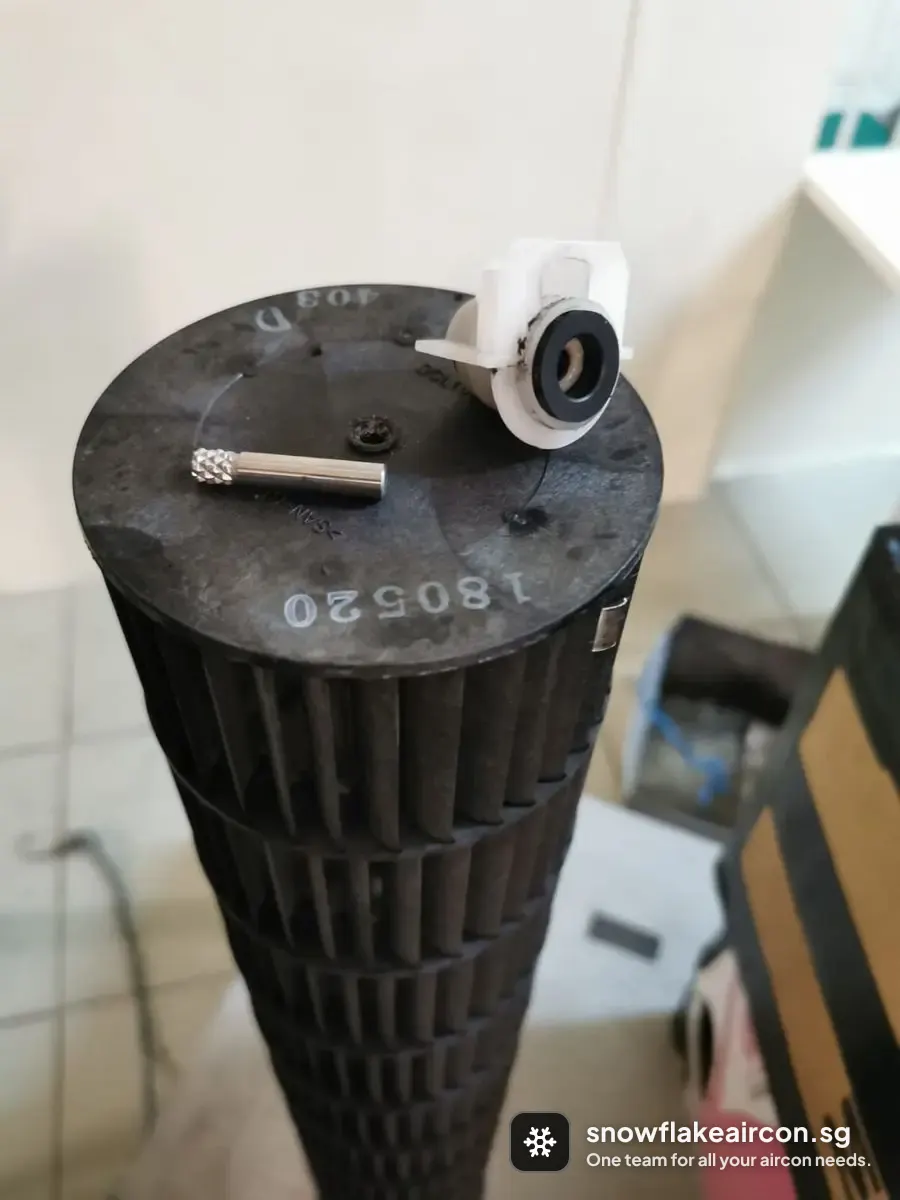
What the ducted centrifugal blower assembly does
Unlike a wall unit's open cross-flow drum, a ducted FCU uses one to three multi-blade squirrel-cage centrifugal wheels mounted inside sheet-metal scroll housings. Spinning on a shared heavy-duty motor shaft, the wheels build enough external static pressure to overcome duct bends, filters, and grilles.
Mechanical component
Ducted centrifugal blower assembly failure signs
Match the symptom, then see what a technician checks to confirm the cause.
| What you observe | Likely causes | How we verify |
|---|---|---|
| Airflow drops across every ceiling diffuser, especially rooms farthest from the unit | Dust and mould caking the forward-curved squirrel-cage blades, External static pressure setting misconfigured on the indoor PCB, Worn fan motor capacitor or failing ECM drive lowering shaft RPM | Open the bottom service panel, inspect the blower wheel vanes for dust buildup, and measure motor amp draw and static pressure. |
| Deep rumbling, thumping, or metallic scraping above the false ceiling | Out-of-balance squirrel-cage wheel from uneven dirt or bent vanes, Loose grub screw allowing a wheel to slide sideways against the scroll housing, Worn shaft bearings on the blower motor | Isolate power, spin each wheel by hand through the access hatch, and check radial runout and grub-screw seating. |
| Evaporator coil freezes repeatedly despite clean return filters | Severe blade fouling starving the coil of airflow, One wheel spinning loose on a dual-blower shaft | Verify both wheels spin tightly with the shaft and clear blade fouling before checking refrigerant charge. |
- What you observe
- Airflow drops across every ceiling diffuser, especially rooms farthest from the unit
- Likely causes
- Dust and mould caking the forward-curved squirrel-cage blades, External static pressure setting misconfigured on the indoor PCB, Worn fan motor capacitor or failing ECM drive lowering shaft RPM
- How we verify
- Open the bottom service panel, inspect the blower wheel vanes for dust buildup, and measure motor amp draw and static pressure.
- What you observe
- Deep rumbling, thumping, or metallic scraping above the false ceiling
- Likely causes
- Out-of-balance squirrel-cage wheel from uneven dirt or bent vanes, Loose grub screw allowing a wheel to slide sideways against the scroll housing, Worn shaft bearings on the blower motor
- How we verify
- Isolate power, spin each wheel by hand through the access hatch, and check radial runout and grub-screw seating.
- What you observe
- Evaporator coil freezes repeatedly despite clean return filters
- Likely causes
- Severe blade fouling starving the coil of airflow, One wheel spinning loose on a dual-blower shaft
- How we verify
- Verify both wheels spin tightly with the shaft and clear blade fouling before checking refrigerant charge.
Replacing the ducted centrifugal blower assembly
Replace
Replace the centrifugal wheel or blower housing when blades are rusted through, bent out of round, or the hub bore is worn loose on the motor shaft.
You can wait
Mild dust noise with healthy static pressure can wait for scheduled ducted chemical cleaning.
Do not wait
Metallic scraping or heavy ceiling vibration risks seizing the motor and causing an electrical trip or coil freeze-up.
If you proceed
- Typical replacement cost
- S$260–S$680
- Replacement timeline
- Same-day for cleaning and common bearings; 3–7 working days for brand-specific metal wheels
Dirty wheels are dropped out through the ceiling access panel and cleaned. Damaged wheels or bearings are replaced as a matched OEM assembly while checking motor capacitor and static pressure settings.
Adequate ceiling access hatch clearance beneath the ducted FCU is essential; verify whether your ceiling hatch spans the full blower service cover.
Source: Maintenance Checklist, ENERGY STAR (US EPA), checked .
Repair service: Ducted aircon repair.
How we verify a ducted centrifugal blower assembly fault
These are technician checks to confirm whether the part is at fault.
Isolate power, open the concealed FCU bottom access panel, and inspect all blower wheels and scroll housings.
Tools: Step ladder, Inspection torch
Healthy reading: All blades are clean and unbent, with uniform clearance inside each scroll housing.
Check grub screws and shaft play on every wheel along the motor shaft.
Tools: Hex key set
Healthy reading: Each wheel locks firmly on the shaft flat and spins smoothly with quiet bearings.
Measure motor operating current and verify the indoor PCB external static pressure setting matches the duct run.
Tools: Clamp meter
Healthy reading: Current matches nameplate amps and airflow reaches the furthest diffuser steadily.
Frequently asked questions about the aircon ducted centrifugal blower assembly
What are the warning signs that the ducted centrifugal blower assembly is wearing out?
The first sign of a ducted centrifugal blower assembly problem is this: airflow drops across every ceiling diffuser, especially rooms farthest from the unit, and the same fault can also show as deep rumbling, thumping, or metallic scraping above the false ceiling.
Does the ducted centrifugal blower assembly need repairing or replacing?
Replace the centrifugal wheel or blower housing when blades are rusted through, bent out of round, or the hub bore is worn loose on the motor shaft. You can wait in this case: mild dust noise with healthy static pressure can wait for scheduled ducted chemical cleaning.
When should I stop using the aircon because of the ducted centrifugal blower assembly?
Metallic scraping or heavy ceiling vibration risks seizing the motor and causing an electrical trip or coil freeze-up; the warning sign to track is this: airflow drops across every ceiling diffuser, especially rooms farthest from the unit. Another sign: deep rumbling, thumping, or metallic scraping above the false ceiling.