On this page
How This Presents
A living-room split in a high-floor Ang Mo Kio HDB flat cools fine at dawn, then blows warm air by early afternoon. Out on the ledge, the outdoor unit hums loudly while its fan blade sits still before the system cuts out.
- Setup
- Daikin Wall-mounted7-9 yearsHDBAng Mo Kio
- Misread as
- Worrying about a seized compressor or a full condenser change whenever living-room cooling drops off and the outdoor unit hums on a high HDB ledge.
- Check first
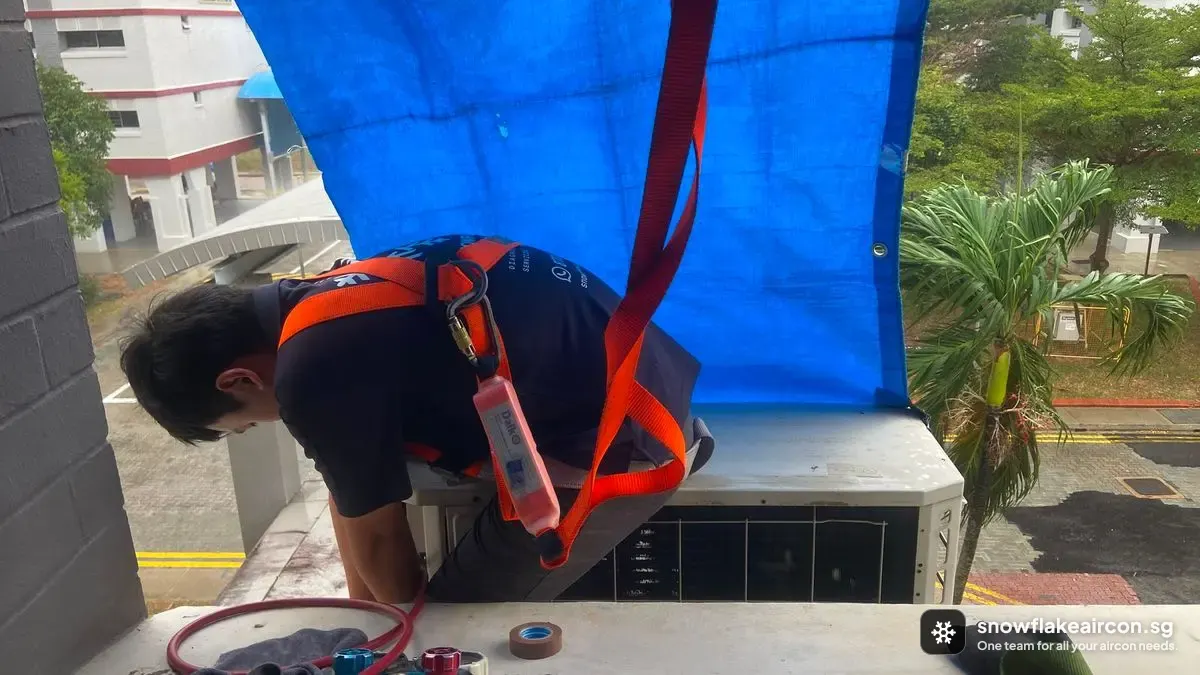
- Working in a full safety harness on the HDB aircon ledge to isolate power, spin-test the fan bearings, and measure the capacitor against its label rating
- Actual finding
- Weakened outdoor fan run capacitor failing under afternoon ledge heat, stalling condenser airflow while the compressor and fan motor remained sound
- Scope saved
- Targeted repair instead of full replacement
What Else Produces This
A humming condenser with a still blade points to a starting fault rather than a seized unit. Safe harness access onto the ledge lets a technician test each part directly.
Clipping into a safety harness anchored inside the service yard gives safe reach onto the Ang Mo Kio HDB ledge.
Turning off power and nudging the Daikin fan blade confirms smooth spin with no bearing drag.
Opening the side cover exposes the outdoor fan capacitor clipped beside the wire strip with dull spade plugs.
Testing the disconnected capacitor shows less than half its rated value, while the fan motor and compressor test fine.
Why It Happens
Years of direct afternoon sun and rain on an Ang Mo Kio HDB ledge slowly dried out the fan capacitor. Once afternoon heat built up around the unit, the weak part could no longer spin the blade. Trapped heat then forced the healthy compressor to cut out.
What Resolution Involves
Keep the healthy Daikin compressor and fan motor in place. Fit an exact-rated replacement outdoor fan capacitor, crimp tight new spade clips onto clean wire ends, lock the canister into its clip, and shut the weather cover tightly.
How to Tell It Worked
Restore mains power and run the living-room Daikin on 23°C cool mode in afternoon heat in Ang Mo Kio. The outdoor fan starts fast with no delay, warm air flows off the ledge, and indoor supply air drops crisp and cold.
Before You Approve a Quote
Test the outdoor fan capacitor before replacing a high-ledge condenser
- A fan blade that turns smoothly by hand yet hums under power needs a fresh start part, not a new outdoor unit.
- High-floor HDB ledges in Singapore trap strong afternoon sun that wears out small outdoor parts faster than indoor gear.
- Safe harness access lets a technician find the exact fault on the ledge and complete a quick one-visit swap.