On this page
Quick summary
Passive cabinet door louvers paired with a DC inline exhaust fan clear router and NAS cupboard heat for S$3 to S$6 monthly in Singapore. Dedicated 9,000 BTU aircons cost S$56 to S$101 monthly while risking short-cycling and drain spills over electronics.
System 2 installed from $2,600 (22 SWG copper) · $30 site survey waived on install · View packages
Compare Continuous Wattage and Monthly SP Group Bills
Most home routers, optical terminals, and two-bay NAS boxes generate under 120 W of heat inside a cupboard. Cooling that tiny load with a full 9,000 BTU wall split inflates power bills dramatically under Singapore's Q4 2026 residential rate of 31.16 cents per kWh including GST:
Scroll to see more columns
| Closet cooling option | Average continuous load | Monthly energy draw | Estimated monthly bill |
|---|---|---|---|
| Passive louver + 15W DC fan | 0.015 kW steady | 10.8 kWh | About S$3.40 |
| Dual 25W DC inline exhaust | 0.025 kW steady | 18.0 kWh | About S$5.60 |
| 9,000 BTU split (low duty) | 0.25 kW average | 180 kWh | About S$56.10 |
| 9,000 BTU split (warm closet) | 0.45 kW average | 324 kWh | About S$101.00 |
Why 9,000 BTU Splits Struggle Inside Enclosed Cupboards
Dedicated 9,000 BTU blowers overwhelm small HDB utility cupboards and study wardrobes in minutes. Rapid temperature swings make the inverter compressor start and stop constantly, accelerating mechanical wear and cutting real-world efficiency.
Running indoor refrigerant coils inside a tight equipment cabinet also introduces pressurized condensate trays directly above live power strips and hard drives. Any algae clog turns one routine drain spill into ruined storage hardware.
Size Passive Louver Intake and DC Exhaust Airflow Cleanly
Cut a slatted intake louver near the bottom of the cupboard door so cooler flat air enters naturally at floor height. Mount a low-noise DC inline exhaust fan near the cabinet top to extract rising warm air into an open hallway or utility yard.
Consumer NAS hard drives and fibre switches run safely inside 28 to 35 degree ambient indoor air when hot pockets keep moving. Vacuum cabinet intake grilles monthly so dust never chokes airflow.
Choose Between Exhaust Airflow and Dedicated Room Cooling
Reserve full refrigerant cooling strictly for high-wattage racks or shared occupied study rooms:
- Pick door louver vents and DC inline exhaust whenever routers and NAS units stay under 150 W. Cupboard gear needs moving room air rather than chilled walls.
- Keep an existing study split clean when sharing that workspace daily. Routine single-room cleaning costs S$50 solo, S$60 for dual blowers, or S$75 total for three blowers under 14-day workmanship terms.
- Arrange a S$30 physical inspection (waived on confirmed work; S$80 on VRV suites) if an existing wall unit sweats above racks. HDB owners can also apply S$400 in Climate Vouchers toward 5-tick upgrades until late 2027.
Diagnostic Cases for This Fault
Singapore jobs showing what we checked on-site before quoting parts or gas.
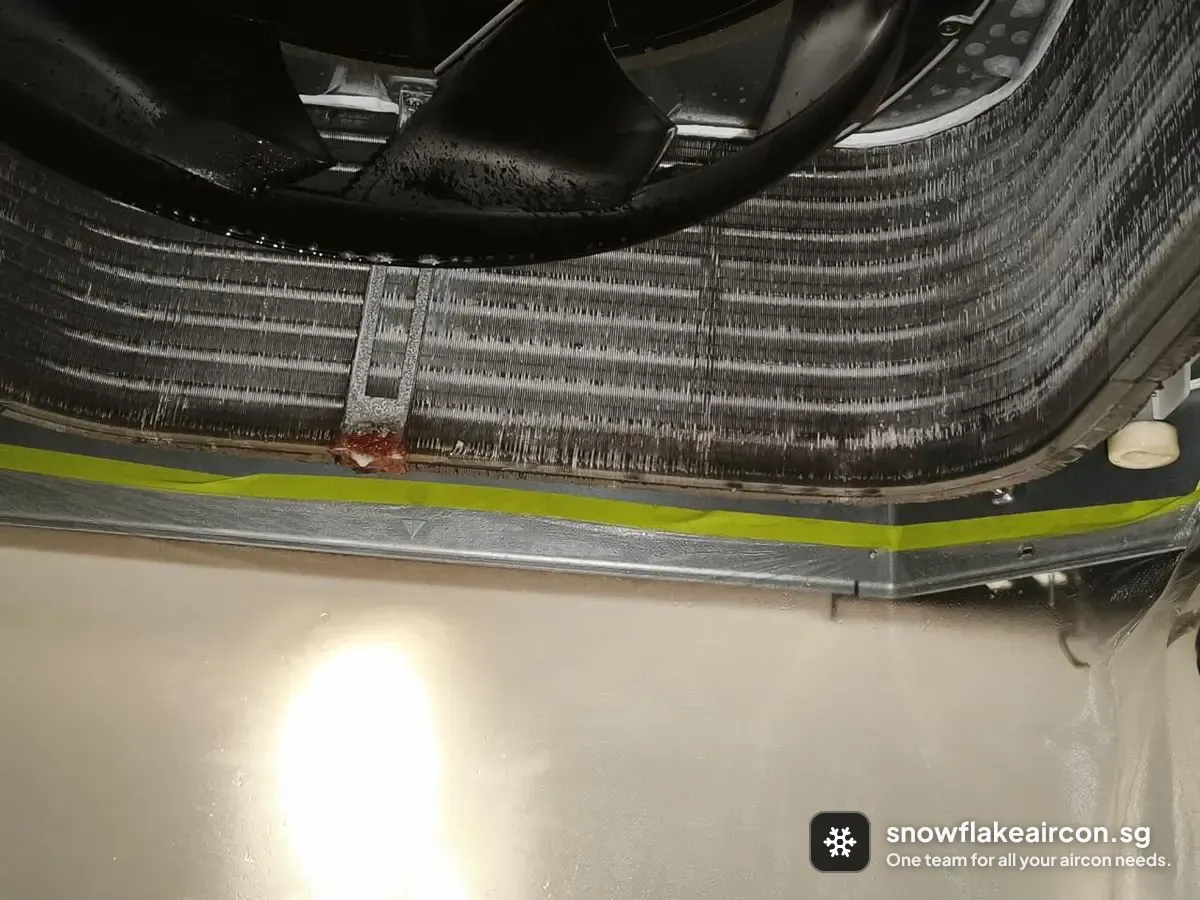
Hitachi · Cassette
Cassette weak on two sides: coil fouled behind outlets
Compacted deposit on the coil sections behind two cassette outlets
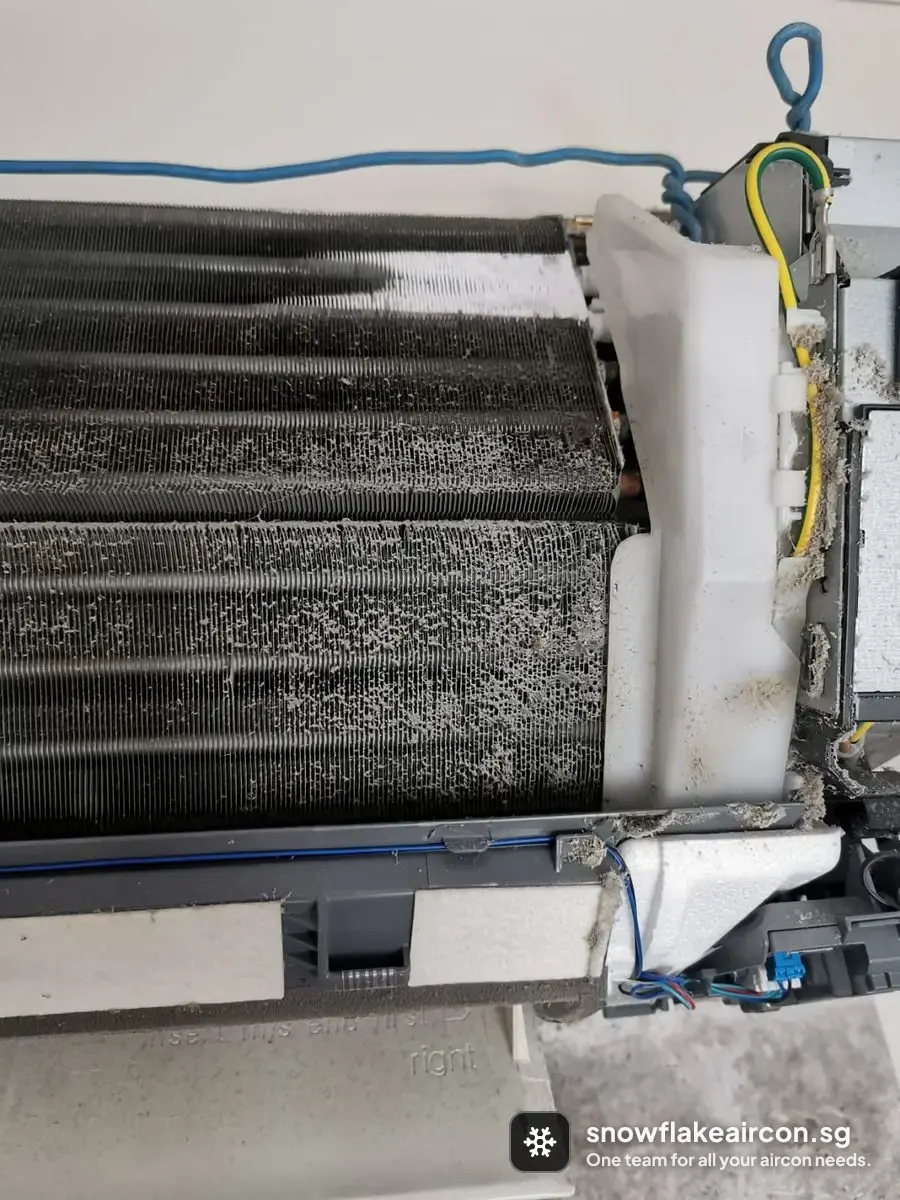
Mitsubishi Heavy Industries · Wall-mounted
One room warm on a multi-split: coil buildup, not low gas
Coil and airflow restriction confined to the single affected indoor unit
Common Questions
How much electricity does a 9,000 BTU aircon burn running nonstop for a router cupboard?
Can passive door louvers and a DC fan protect a NAS without aircon in Singapore?
Why is putting an indoor aircon blower inside a tight IT closet risky?
When does a home server setup require dedicated split aircon cooling?
Sources
Sources checked 27 Nov 2026