On this page
Quick summary
Renovation alone does not call for a chemical wash. Weak airflow after the filter is cleaned, or a smell that persists, points to coil buildup and justifies one. Normal cooling needs a standard service. On-and-off shutdowns after the work need diagnosis, not cleaning.
What renovation does to aircon units
Renovation puts dust, paint and adhesive vapour and small debris into the air. A unit running during the work draws it in. The filter catches most of it, and finer particles pass through to settle on the coil and fan barrel.
The load depends on the work, the distance from the units and whether they were covered or switched off. Heavy hacking and plastering leaves a different residue from a repaint.
Three signs after the work: weaker airflow, a smell in operation that was not there before, or cooling that is slower or cannot reach the set temperature. With none of them, the unit needs a filter clean and nothing more.
When chemical servicing is the right call
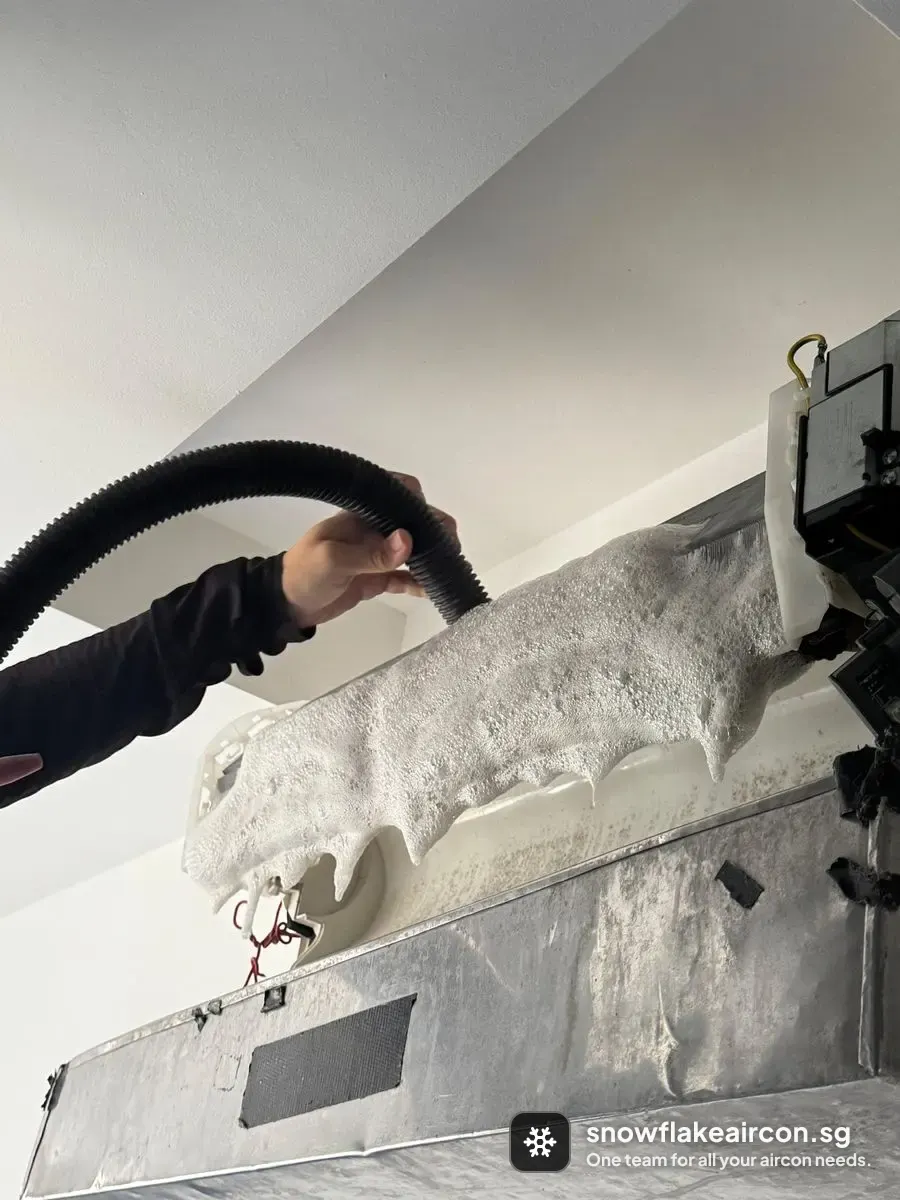
Chemical servicing fits when the evidence points to the coil, not surface dust on the filter: airflow stays weak after the filter is cleaned, a musty or chemical smell continues, or cooling is reduced in one or more rooms with clean filters.
Renovation residue is finer and stickier than normal-use buildup, especially after adhesive or paint vapour. Fine sanding or plaster dust collects behind the filter, and paint or adhesive work leaves tacky residue. A standard clean does not shift it. A chemical solution applied to the coil does.
The recommendation should rest on what the technician saw on the coil. Clear fine-particle buildup or staining beyond normal dust justifies the wash. A clean coil and normal airflow do not, however heavy the renovation was.
When to start with a lighter scope
Stable cooling and normal airflow call for a standard service: filter clean, drain flush and a wipe of the accessible surfaces. That is enough for most homes after a light renovation.
It also gives a baseline. If performance holds, the buildup was shallow. If airflow stays weak after the service, the next visit has a clear case for chemical servicing, and the technician checks whether the blower, coil or fan is restricting air.
On-and-off shutdowns or control faults that started after the work call for diagnosis before any cleaning. A power fluctuation, a wiring disturbance from the work or a sensor fault is not a dirt problem.
| Post-renovation pattern | First step | Why |
|---|---|---|
| Normal cooling, light surface dust only | Standard service and filter clean | Lighter scope often resolves surface buildup |
| Weak airflow, filter already clean | Chemical servicing assessment | Buildup is likely deeper on the coil |
| Smell during operation | Chemical servicing if coil shows residue | Paint or glue vapour settles on coil surface |
| On-and-off shutdowns or control issues | Diagnosis first | Not all post-renovation issues are cleaning problems |
What a good chemical servicing recommendation looks like
It names the finding and the change expected: weak airflow, a smell or poor cooling, and why the coil is the cause. A general full clean after renovation names neither.
When two contractors disagree, the one who describes the coil condition and ties the scope to it is better grounded.
What to note before the technician arrives
Note per room what changed since the work: airflow, cooling speed, smell, sound. Some units may be affected and others not.
Photograph each filter before cleaning it. A filter heavy with fine grey dust, rather than the usual coarse hair and lint, shows how much dust entered and whether the coil took a similar load. Say whether the work was cutting, drilling and plaster or a repaint, since the residue differs and sets the inspection depth.