On this page
Quick summary
When an outdoor compressor keeps humming after the indoor blower stops, power off the wall isolator immediately to prevent coil freezing and liquid floodback damage. Common Singapore causes include seized fan motor bearings, failed AC fan capacitors, indoor PCB relay faults, or heavy coil icing blocking rotation.
Shut off the Wall Isolator Before Coil Ice Builds Up
Without indoor blower airflow moving room heat across the evaporator fins, cold refrigerant fails to boil off cleanly. Frost skins the copper tubes within minutes and can travel back down the suction line toward the outdoor condenser.
Turn the unit off on the remote, then switch off the dedicated wall isolator near the indoor unit or distribution board. Leaving only the remote off may not stop a stuck outdoor contactor or shorted relay from energising the compressor.
Place a towel beneath the indoor casing in case thawing ice overflows the drain tray while you wait for inspection.
Match Indoor Blower Stop Signs to the Likely Fault
Four main hardware or maintenance faults stop an indoor fan drum in Singapore HDB and condo split systems:
Scroll to see more columns
| Symptom observed indoors | Most likely culprit | Why the compressor stays on | Typical repair path |
|---|---|---|---|
| Humming motor, slow start, then dead | Weak AC fan capacitor or stiff bearing | Thermal cut-out trips motor before board faults | Test capacitance and bearings; replace failed part |
| Zero fan movement, blinking timer LED | Failed DC fan motor or Hall sensor | Delayed fault lock on older non-inverter links | Meter DC motor windings and indoor PCB feedback |
| Frost visible behind open louvre | Severe coil icing from dirt or low gas | Ice physically jams the plastic blower barrel | Full thaw, chemical clean, and gas leak test |
| Compressor stays on even with remote off | Welded relay on indoor or outdoor PCB | Stuck relay feeds continuous live power outdoors | Isolate power; diagnose and repair or swap PCB |
Follow Safe Homeowner Checks and Electrical Stop-Lines
Once power is off at the wall isolator, lift the front plastic grille and check whether the washable mesh filters are completely choked or frost is clinging to the silver fins. Checking the remote mode to confirm it is not stuck on dry or timer-off is also completely safe.
Stop there and keep screwdrivers away from the internal electrical box. EMA consumer electrical safety guidelines reserve live voltage testing, capacitor discharging, and PCB probing for qualified technicians because stored charge and 230V mains present shock risks.
Never poke a stick into the louvre to push-start a jammed blower barrel, as spinning a seized motor under power can burn out the control board.
Plan Your Next Repair Check and Upfront Service Cost
Identifying whether you face an icing clog or a failed electrical part prevents paying for unnecessary component swaps:
- Booking Snowflake's S$30 troubleshooting assessment lets a technician test motor windings, capacitance, and board relays first; that fee disappears completely when you approve the quoted repair.
- When heavy dust froze the evaporator without electrical failure, full strip-down chemical cleaning bills S$150 (solo unit), S$125/unit (two units), or S$115/unit (three-plus), backed by 90 days of cover.
- Lighter post-thaw coil sludge clears with wall-mounted chemical washing: S$80 (1 unit), S$70/unit (2 units), or S$60/unit (3+ units), covered for 60 days.
- Once blower airflow returns, keep ice away using routine quarterly visits priced at S$50 (1 unit), S$30/unit (2 units), or S$25/unit (3+ units) with 14 days of cover.
Diagnostic Cases for This Fault
Singapore jobs showing what we checked on-site before quoting parts or gas.
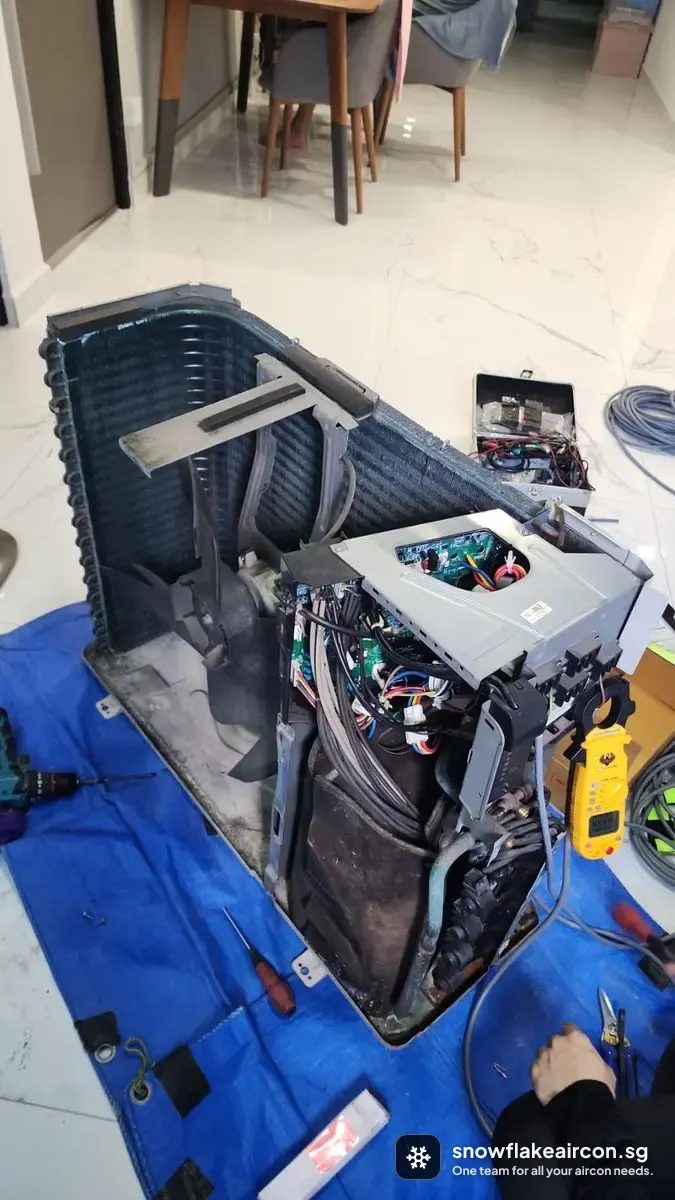
Tampines HDB · Daikin
Daikin Outdoor Unit Dead: Burnt PCB Relay, Not Condenser
House lizard bridging the outdoor Daikin PCB power relay traces, scorching the circuit track while the compressor windings and refrigerant loop remain undamaged
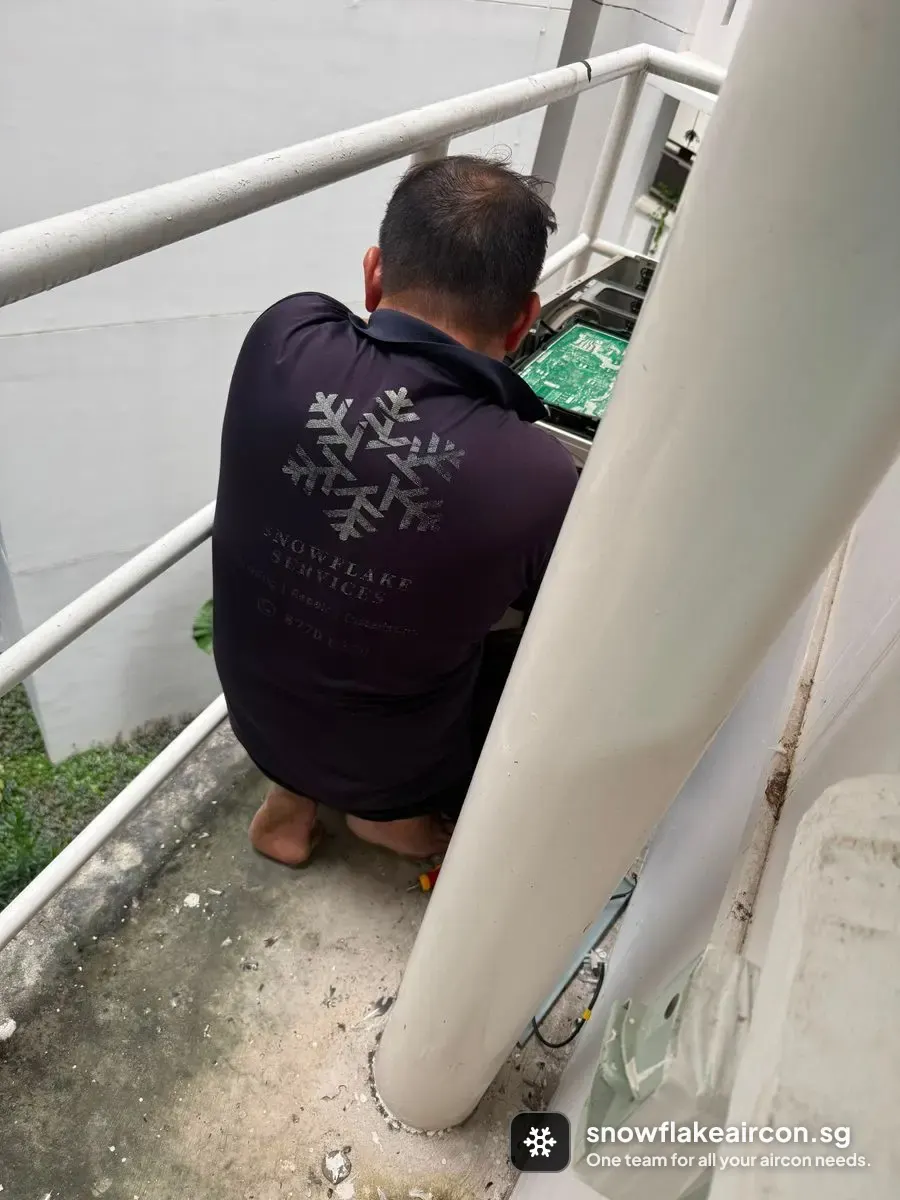
Clementi HDB · Daikin
Clementi HDB Voltage Dip: Outdoor PCB, Not Compressor
Burnt power-supply rail on the outdoor inverter control board caused by a mains voltage dip while the compressor windings and all three indoor fan coils remain healthy