On this page
Quick summary
An indoor aircon fan that surges up and down usually points to Auto fan mode hunting, a dust-caked squirrel-cage blower wheel, or a failing fan motor Hall sensor or capacitor. Lock a fixed fan speed first, rinse filters, then book a wash or S$30 diagnostic check.
Rule Out Auto Fan Mode and Clogged Filters in Three Minutes
Before assuming a broken motor, look at your handset screen. In Auto fan mode, modern inverters step airflow up and down constantly as room temperature hovers near your setpoint.
Switch from Auto to a fixed Medium or High fan bar on Cool mode at 24°C. If steady airflow returns immediately, the unit was simply hunting around its target temperature rather than failing.
Next, lift the front intake cover and pull out the nylon mesh filters. A thick dust blanket chokes intake air and triggers turbulent surging as the blower wheel starves for air across the evaporator.
Separate a Clogged Blower Wheel from a Failing Motor or Sensor
When airflow still surges on a fixed fan speed with clean mesh filters, compare your symptoms against these four causes:
Scroll to see more columns
| Airflow behaviour on fixed speed | Most likely Singapore cause | Secondary clue to watch | Correct service or check |
|---|---|---|---|
| Gentle rhythmic pulsing with weak air throw | Dust-caked squirrel-cage blower wheel blades | Dark lint visible with torch behind louvre | Chemical wash (S$60-S$80) or overhaul (S$115-S$150) |
| Sharp revs up then stalls or blinks error LED | Failing DC motor Hall speed feedback sensor | Unit shuts down after 1 to 3 minutes | Book S$30 fault check (waived on repair) |
| Sluggish startup, hums softly, speed drifts down | Weak AC fan motor run capacitor or dry bearing | Blower struggles on low speed but runs on high | Book S$30 fault check for motor/capacitor test |
| Speed drops briefly then resumes with normal cold air | Anti-freeze coil protection or room thermistor drift | Occurs mainly during long cool nights | Clean filters first; S$30 check if recurring |
How a Grime-Packed Blower Drum Causes Choppy Bedroom Airflow
Inside every wall-mounted split sits a cylindrical squirrel-cage blower wheel with dozens of curved fins. In humid Singapore bedrooms, damp dust sticks along those blades and fills the narrow gaps between them.
Once dirt fills those blades, the wheel can no longer scoop air smoothly across its full width. Airflow stalls and re-attaches in rapid waves, creating a choppy whoosh-whoosh sensation across your mattress.
Running a heavy, unbalanced blower wheel for months also strains the indoor motor bearings and control board. A routine surface filter rinse never reaches deep grime packed inside the curved wheel.
When to Call for a S$30 Fan Check vs Chemical Wash and Cost
Choosing the right job avoids paying twice for a wash when a DC motor or Hall sensor is already failing:
- Book general servicing (S$50 for a single wall unit, dropping to S$30 for two and S$25 each for three+, 14-day cover) only when mild airflow unevenness clears after filter cleaning and no dark sludge coats the blower.
- Book a chemical wash (in-place chemical wash at S$80 (one), S$70 each (two), or S$60 apiece (three+), 60-day cover) when torch inspection shows furry dust gripping the blower wheel without blinking timer lights.
- Book a chemical overhaul (full dismantled wash at S$150 (one), S$125 each (two), or S$115 apiece (three+), 90-day cover) when thick black slime coats the wheel and evaporator coil, requiring full wheel removal.
- Book a S$30 fault check (waived on repair) first if the fan revs erratically, stops dead, or triggers a blinking LED code—those signs point to a Hall sensor, capacitor, or indoor PCB.
Diagnostic Cases for This Fault
Singapore jobs showing what we checked on-site before quoting parts or gas.
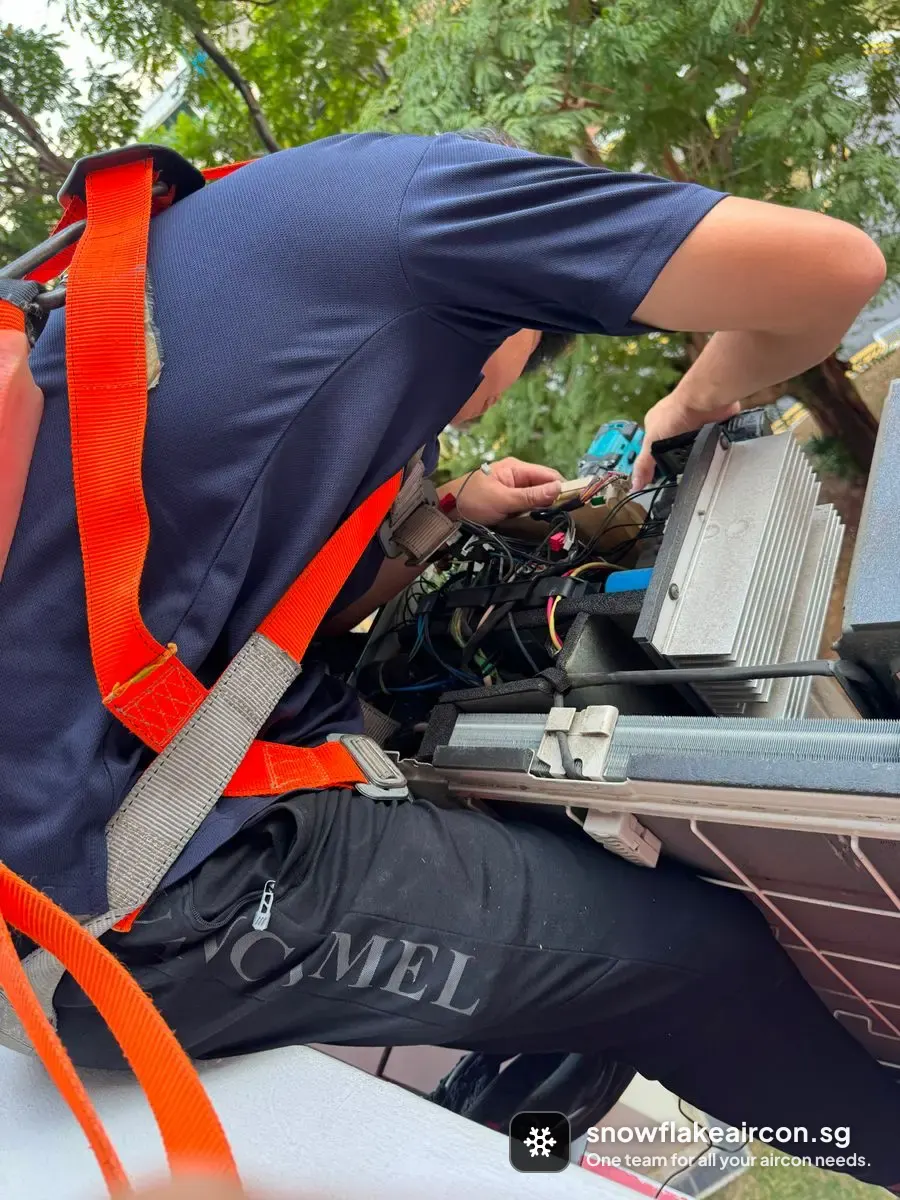
Sembawang HDB · Daikin
Daikin System 4 Storm Outage: Outdoor PCB, Not Compressor
Storm surge blew the outdoor surge protector and inverter control board on a high-floor Daikin System 4 while compressor insulation resistance remained clean
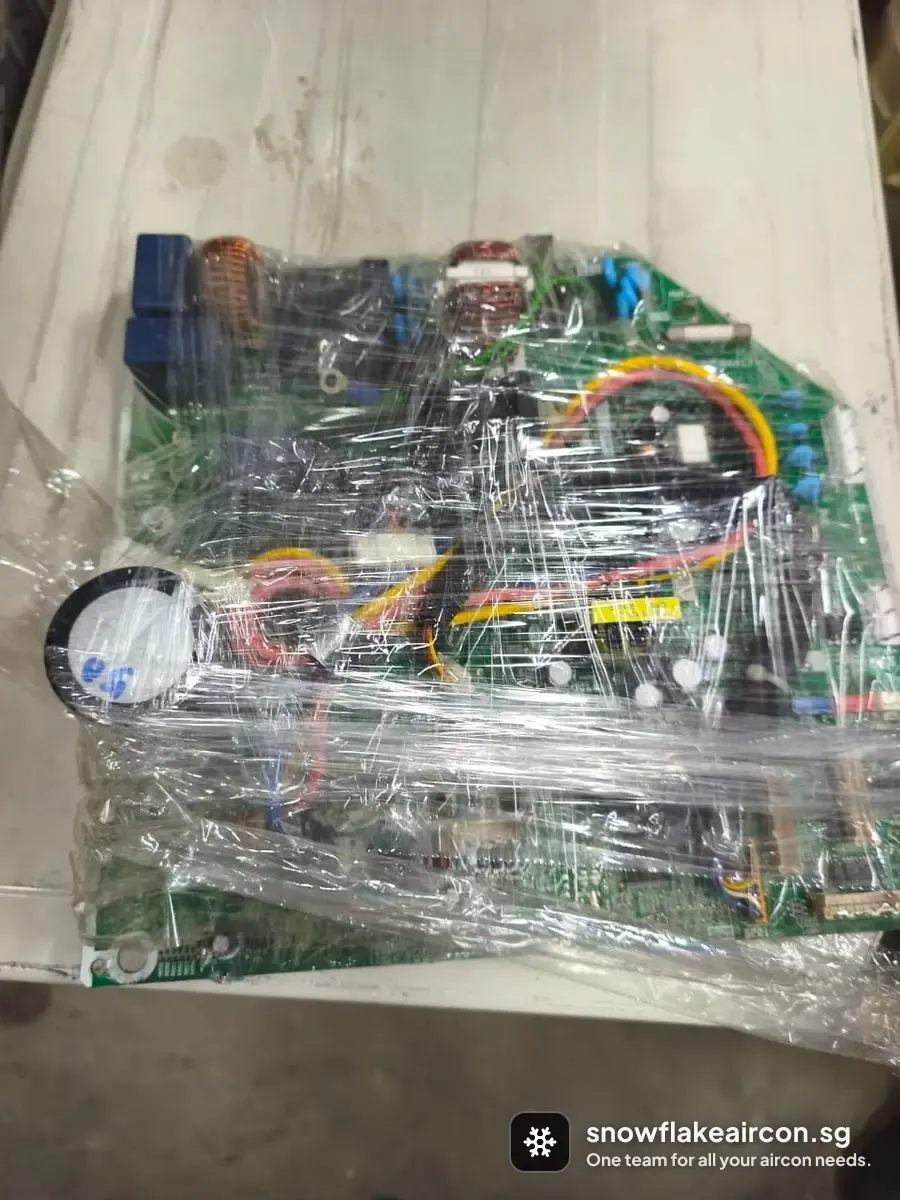
Clementi HDB · Daikin
Daikin Dead After Power Trip: Matched PCB, Keep System 3
Failed indoor PCB power stage on one master-bedroom fan coil after a mains trip while the indoor DC fan motor, thermistors, and shared System 3 condenser stayed healthy