On this page
Quick summary
When an indoor fan coil runs yet the outdoor condenser fan stays still after 3 minutes, the cause is usually a weak fan capacitor, seized motor, faulty outdoor PCB, or jammed blade. Leave high-rise HDB ledges untouched, flip the wall isolator off, and book electrical testing.
Rule Out Normal Startup Delays and Wrong Remote Settings
Most inverter split systems pause the outdoor condenser fan for up to 3 minutes after power-on while equalising refrigerant pressures. Wait 5 minutes on cool mode at 20 degrees before concluding the outdoor fan has failed.
Confirm the remote shows a snowflake rather than fan mode. Fan mode runs indoor blowers with the outdoor unit off. In multi-split HDB flats, check that no other room sets a conflicting mode.
Wait 5 minutes on cool mode. If the outdoor blade still sits still while indoor air stays warm, flip off the wall isolator so the compressor will not overheat.
Match Outdoor Fan Symptoms to Capacitor, Motor, or PCB Faults
Listening safely from indoors and counting blinking timer lights helps narrow down which outdoor part failed before any cover opens:
Scroll to see more columns
| Clue observed safely indoors | Most likely culprit | What happens if left running | Typical repair path |
|---|---|---|---|
| Faint outdoor hum, fan blade motionless | Failed AC fan capacitor or stiff shaft | Motor overheats and trips overload | S$30 check; test capacitance and motor spin |
| Indoor light blinks shortly after startup | Seized DC fan motor or Hall sensor | Board locks out compressor within minutes | S$30 check; test windings and board output |
| Total silence outdoors, no hum or click | Outdoor PCB, blown fuse, or link wire | Indoor head blows room air endlessly | S$30 check; test 230V feed and board relay |
| Blade visibly wedged by twigs or birds | Physical ledge obstruction or bent guard | Locked rotor burns motor coils or IPM | Clear ledge safely with fall protection |
Respect EMA Electrical and MOM Ledge Safety Limits
Never step onto an HDB ledge, perch on a sill, or poke sticks through bars to nudge a stalled blade. MOM and BCA rules restrict ledge work to trained workers wearing fall arrest gear.
EMA electrical safety rules also keep outdoor covers, fan capacitors, and inverter power boards off-limits to homeowners. Stored DC charge inside outdoor PCBs stays hazardous even minutes after switching off the main breaker.
Flipping the indoor wall isolator off keeps your family safe. It also protects the compressor until a technician checks the unit with meters and safety lines.
Decide Between a S$30 Diagnostic Check and Repair
Testing motor windings, capacitor strength, and board output on site avoids buying costly PCBs when a smaller part failed:
- A S$30 diagnostic visit (S$80 on VRV plants) tests motors, capacitors, and boards first. That visit fee vanishes if you proceed with quoted repair.
- Outdoor jet washing runs S$100 per condenser when dry dirt stalls heat rejection. Greasy exterior fins call for chemical jet cleaning at S$120 apiece.
- Standard indoor care covers one split for S$50, two at S$30 each, and three-plus at S$25 each (14-day cover). Chemical washes bill S$80 for one box, S$70 per unit on two, or S$60 per unit on three-plus with 60-day terms.
- Heavily fouled coils after heat trips take full teardown overhauls. Expect S$150 solo, S$250 total for two (S$125 each), or S$115 apiece from three upward (90-day warranty).
Diagnostic Cases for This Fault
Singapore jobs showing what we checked on-site before quoting parts or gas.
Tampines HDB · Daikin
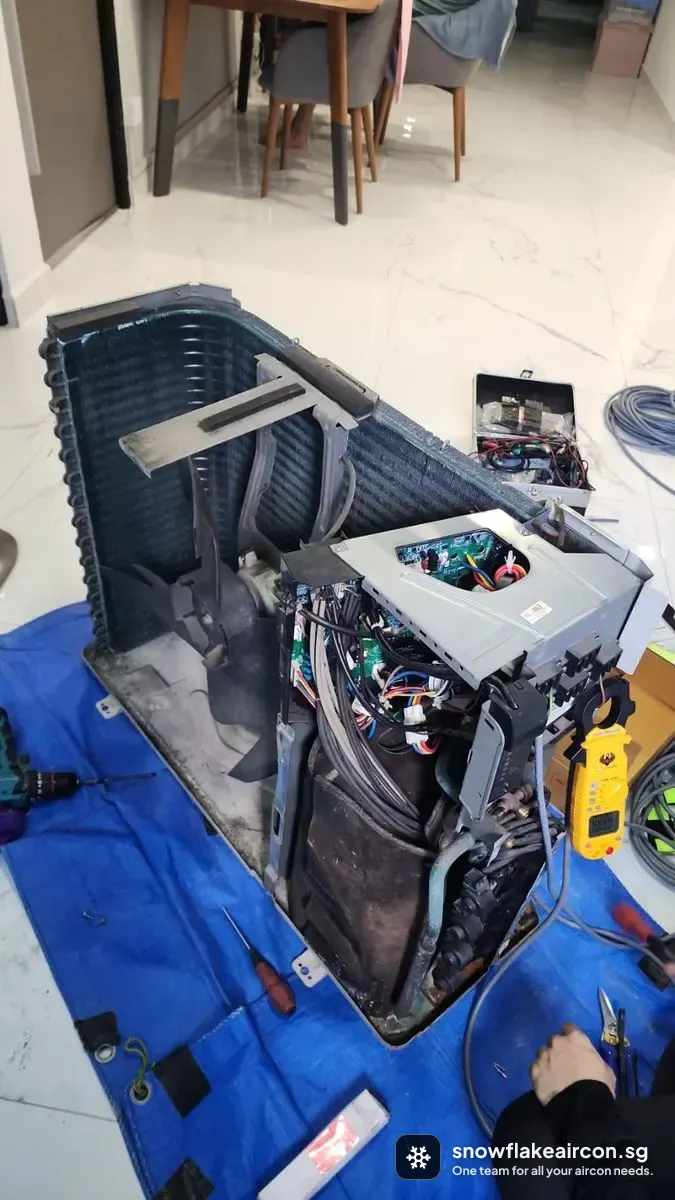
Daikin Outdoor Unit Dead: Burnt PCB Relay, Not Condenser
House lizard bridging the outdoor Daikin PCB power relay traces, scorching the circuit track while the compressor windings and refrigerant loop remain undamaged
Clementi HDB · Daikin
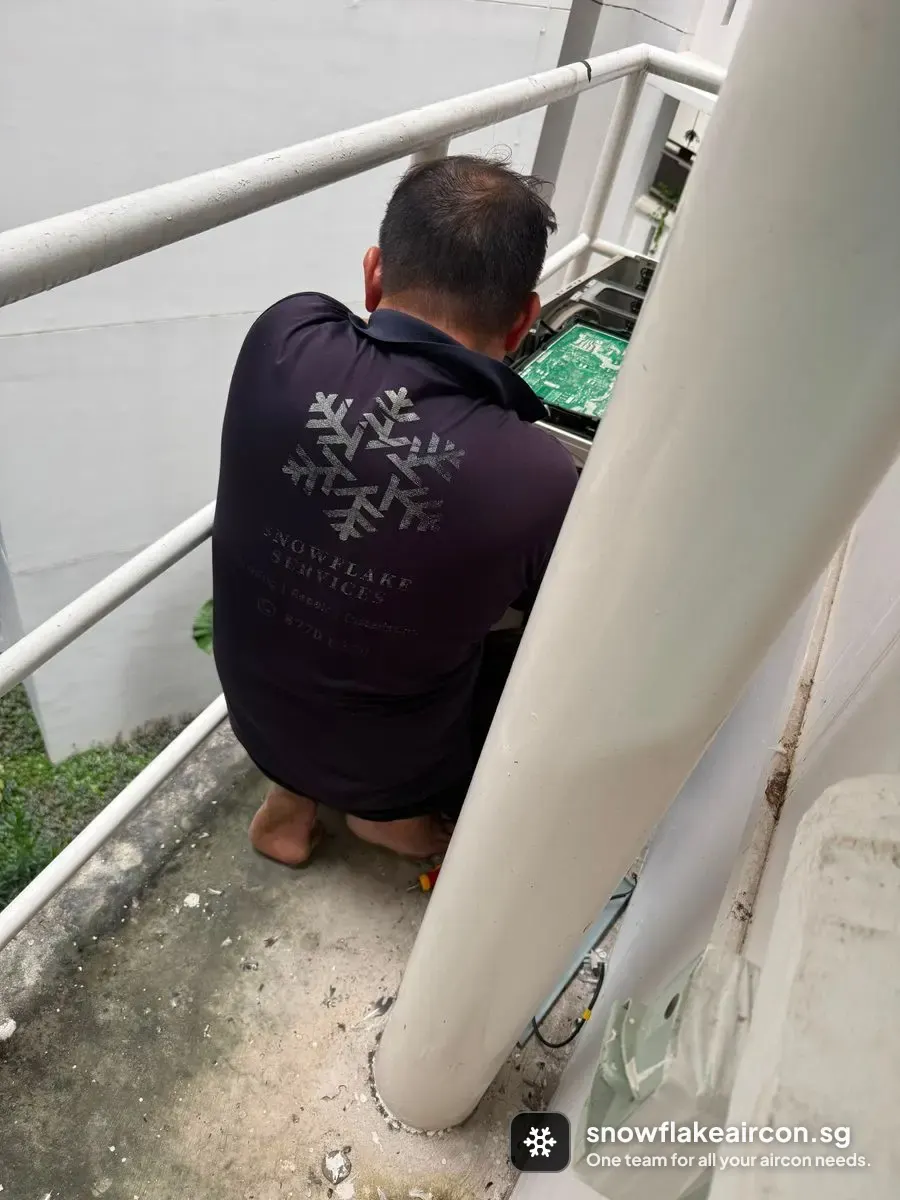
Clementi HDB Voltage Dip: Outdoor PCB, Not Compressor
Burnt power-supply rail on the outdoor inverter control board caused by a mains voltage dip while the compressor windings and all three indoor fan coils remain healthy
Check Your Diagnostic or Servicing Price
Tap your job, unit count, and home type for our published Singapore rate — then send the pre-filled message on WhatsApp.
Published Singapore estimate
$30 / visit on-site diagnostic check
Technician tests cooling output, sensors, PCB, fan motor and pressure — fee is waived if you proceed with the quoted repair.
30-day workmanship warranty on confirmed repairs. VRV commercial checks are $80 / visit.