On this page
Quick summary
An aircon that turns itself on in a Singapore flat usually picks up stray IR signals, old weekly timers, smart home scenes, or power-dip restarts. Damp manual switches behind the panel can also trigger false starts, while a 5-minute check isolates settings from PCB faults.
Why Split Aircons Switch on Without Touching the Remote
Most ghost startups happen because the indoor unit receives a valid start signal from an unexpected source. Old weekly timers, tenant WiFi schedules, or smart IR apps linked to voice speakers often wake bedrooms at 3 am.
Stray infrared light also fools open receivers. Identical-brand remotes used across narrow HDB corridors, faulty TV remotes transmitting continuous pulses, or smart IR blasters bouncing off glass doors can trigger a nearby fan coil.
Inside humid flats, damp air sneaks onto the small manual switch tucked under the front flap. Corrosion bridges that tiny contact, firing random beeps without any IR signal.
Run the 5-Minute Homeowner Isolation Check Safely
Test one variable at a time from floor level using these safe, tool-free checks before paying for circuit board replacement:
Scroll to see more columns
| 5-minute check | What it tests | Clue when ghost start happens | Recommended fix |
|---|---|---|---|
| Clear remote timer & cancel app scenes | Active schedules or WiFi automations | Unit always wakes at fixed hour | Reset remote clock and unlink old WiFi |
| Cover IR window with opaque tape | Stray neighbour, TV, or blaster IR | Ghost starts stop while window covered | Move blaster or angle window curtains |
| Remove remote batteries overnight | Stuck rubber button on handset | Starts stop once batteries stay out | Clean contacts or replace handset |
| Observe after brief power flicker | Factory auto-restart after voltage dip | Unit turns on right after breaker blink | Turn off via remote before isolator off |
| Starts with tape on and batteries out | Damp manual switch or indoor PCB relay | Random beeps or startup with no IR path | Isolate wall switch; book S$30 check |
Handle Power-Dip Auto-Restart and EMA Electrical Safety
Singapore aircons save their last run state for auto-restart after power cuts. If you flipped the wall switch off while cooling ran, any brief mains dip wakes the unit back up when power steadies.
Always turn the unit off via its handheld remote before flipping the wall isolator, and cancel active timer icons by pulling remote batteries for 60 seconds. Check WiFi modules or smart plugs left behind by former tenants in resale flats.
Under EMA electrical safety rules, keep indoor front boards shut. Flip the wall isolator off at once if the control board clicks endlessly or smells warm.
Check Repair Options and Singapore Service Rates
Once your home check points inside the casing, meter testing finds whether a sensor board or main relay failed:
- Flat S$30 testing (S$80 for VRV setups) checks IR sensors, wiring harnesses, and relays. That fee drops to zero whenever approved repairs go ahead.
- Clearing damp drains starts at S$25 per head for three-plus units. Smaller visits pay S$30 apiece for two splits or S$50 for one (14-day cover).
- Removing slime near display switches uses chemical washes starting at S$60 per split (3+ units), S$70 each (pair), or S$80 (lone unit). All chemical washes carry 60 days of cover.
- Heavy mould inside indoor casings needs full dismantle overhauls. Expect S$115 each across three or more heads, S$125 each for pairs, or S$150 for one with a 90-day warranty.
Diagnostic Cases for This Fault
Singapore jobs showing what we checked on-site before quoting parts or gas.
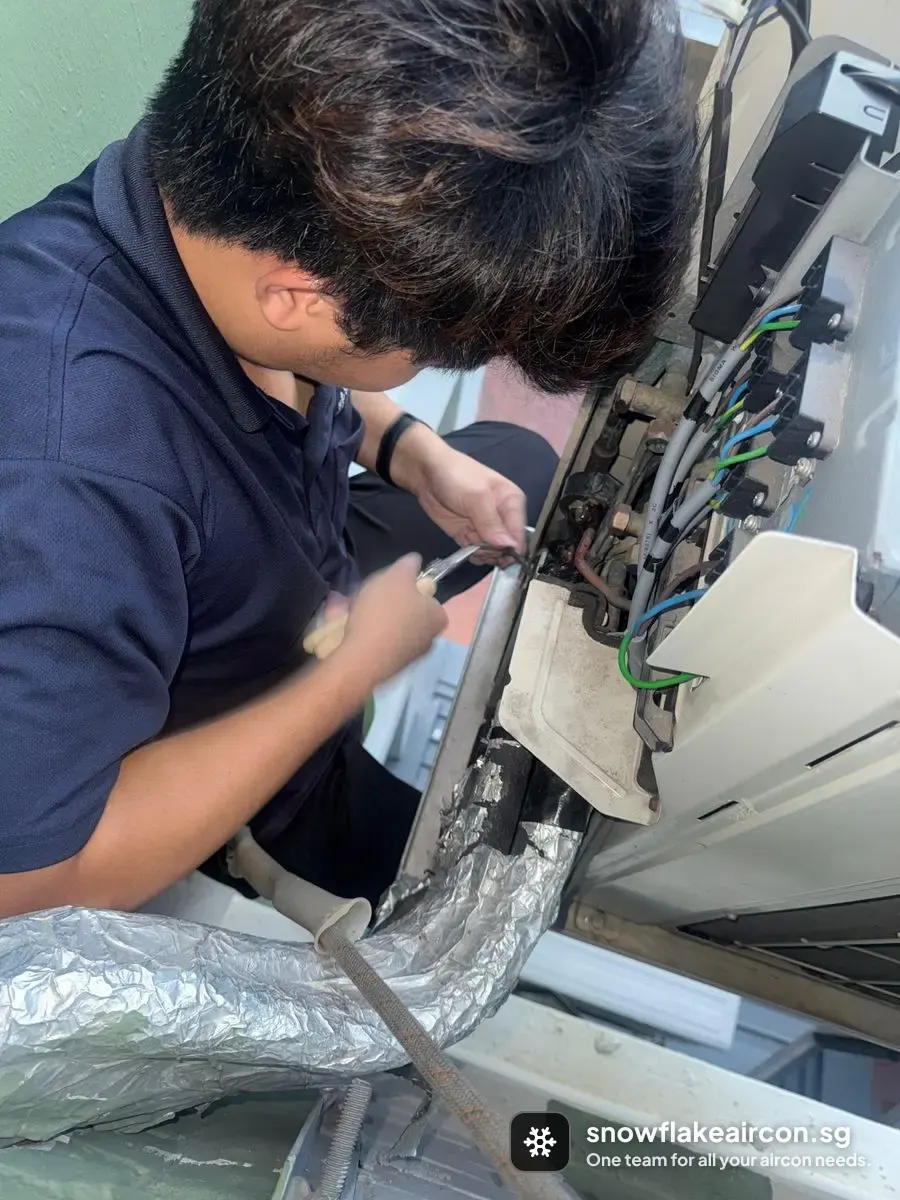
Bishan HDB · Midea
Bishan HDB Plastic Smell: Scorched Terminal, Not Board
High-resistance loose wire termination inside the indoor electrical terminal block overheating the copper strands and causing intermittent power dropouts while the indoor PCB stays intact
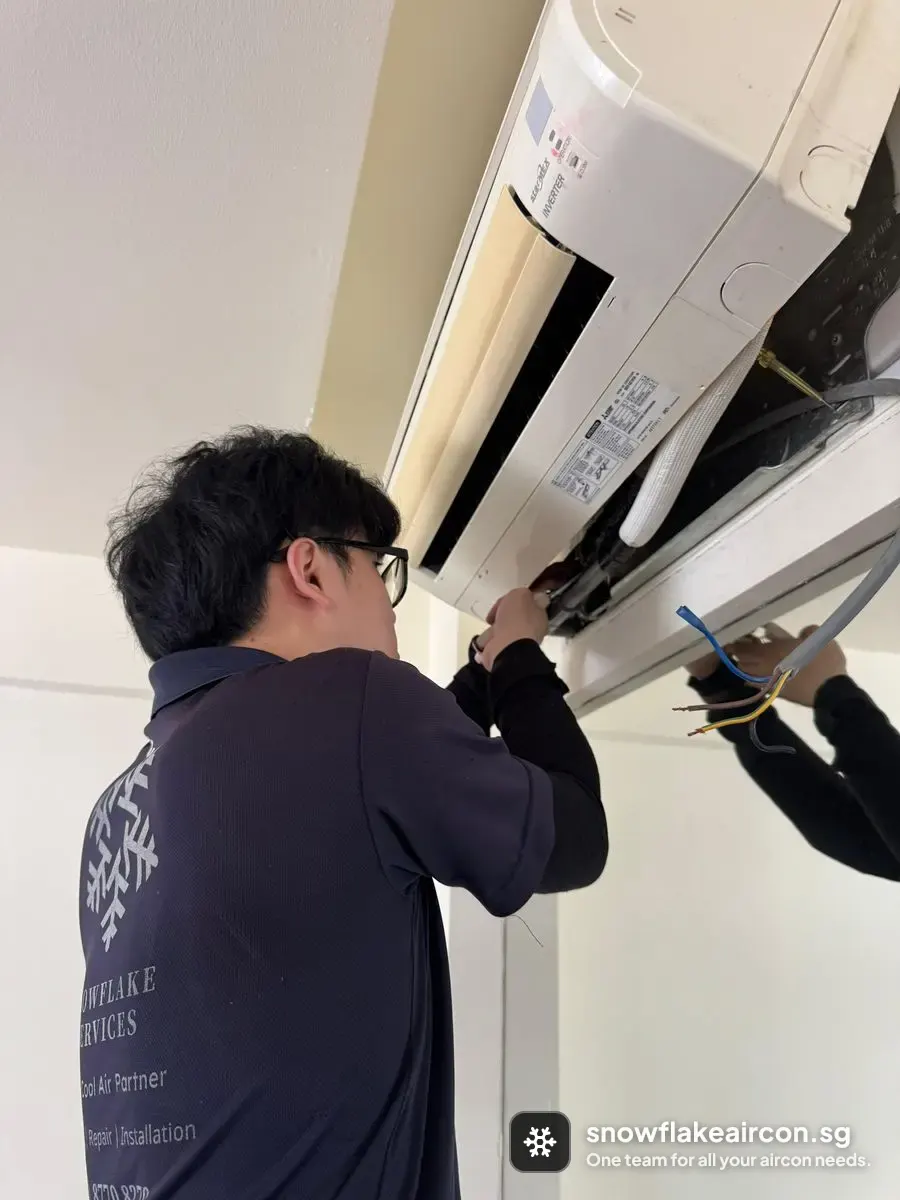
Rochor Retail · Midea
Rochor Shop Midea Dropouts: Loose Terminal Spade Lugs
Heat-loosened terminal block spade lugs beneath a Rochor shophouse retail unit arcing intermittently and causing random power dropouts while the indoor PCB stayed healthy
Check Your Diagnostic or Servicing Price
Tap your job, unit count, and home type for our published Singapore rate — then send the pre-filled message on WhatsApp.
Published Singapore estimate
$30 / visit on-site diagnostic check
Technician tests cooling output, sensors, PCB, fan motor and pressure — fee is waived if you proceed with the quoted repair.
30-day workmanship warranty on confirmed repairs. VRV commercial checks are $80 / visit.