On this page
Quick summary
Switching between quiet mode and maximum fan speed isolates why an indoor unit spits fine water droplets from its front vent. Spray appearing strictly at top speed indicates matted evaporator fins, slime-caked blower wheels, or a loose drain tray lip rather than downstream PVC pipe clogs.
System 2 installed from $2,600 (22 SWG copper) · $30 site survey waived on install · View packages
Respect EMA, HDB, and MOM Floor-Level Safety Limits First
Every homeowner self-check must remain strictly on indoor floor level inside dry rooms. EMA electrical rules forbid opening 230V terminal covers, isolator boxes, or indoor circuit boards.
HDB and MOM safety circulars equally forbid leaning out windows or stepping onto external aircon ledges. Only lift the hinged front cover from floor reach to rinse washable mesh screens.
Run the Pass or Fail Fan Speed Self-Check Safely
Shine a phone torch across the supply vane during these four floor-level checks:
Scroll to see more columns
| Floor-level test | Pass benchmark | Fail sign observed | Mandatory escalation |
|---|---|---|---|
| Quiet mode (10 mins) | Dry breeze; no droplets on floor | Water beads drop along front louvre | Fail: arrange S$30 fault check |
| High fan speed (10 mins) | Strong dry airflow across room | Fine mist sprays forward onto bed | Fail: S$30 check for choked fins |
| Washable mesh rinse | Dry mesh returns smooth steady air | Mist returns even after clean mesh | Fail: internal slime needs S$30 check |
| Lower lip inspection | Crisp seal; zero damp tray edge | Water trails behind plastic casing | Fail: pan clip fault needs S$30 check |
Why Maximum Fan Speed Rips Droplets off Choked Coils
Clean aluminium fins let condensation slide downward smoothly into the tray. When sticky lint and bio-slime bridge narrow fin channels, water beads pool across the coil face.
Quiet mode keeps air velocity gentle enough for pooled beads to cling. Speed 4 or Auto fan surge forces air through clogged gaps, flinging fine spray forward—unlike blocked PVC pipes that overflow down walls.
Verify Whether Your Unit Needs a S$30 Check or Deep Clean
Match your failed self-check row to the right fix instead of guessing:
- Failed spray checks with clean filters call for a S$30 on-site assessment (S$80 for VRV equipment). Repair bookings waive that fee and include 30-day warranty cover.
- Light surface lint clears via routine upkeep backed by 14-day protection. Booking one split costs S$50, booking two runs S$60 total (S$30/unit), and booking three or more drops to S$25/unit.
- Sticky biofilm inside fin channels responds to chemical washes with 60-day protection. Single bookings pay S$80, twin bookings pay S$70/unit, and 3+ unit bookings pay S$60/unit.
- Heavy rotor mould or warped trays need dismantled chemical overhauls under 90-day protection. Solo teardowns bill S$150, dual teardowns bill S$125/unit, and 3+ unit teardowns bill S$115/unit.
Diagnostic Cases for This Fault
Singapore jobs showing what we checked on-site before quoting parts or gas.
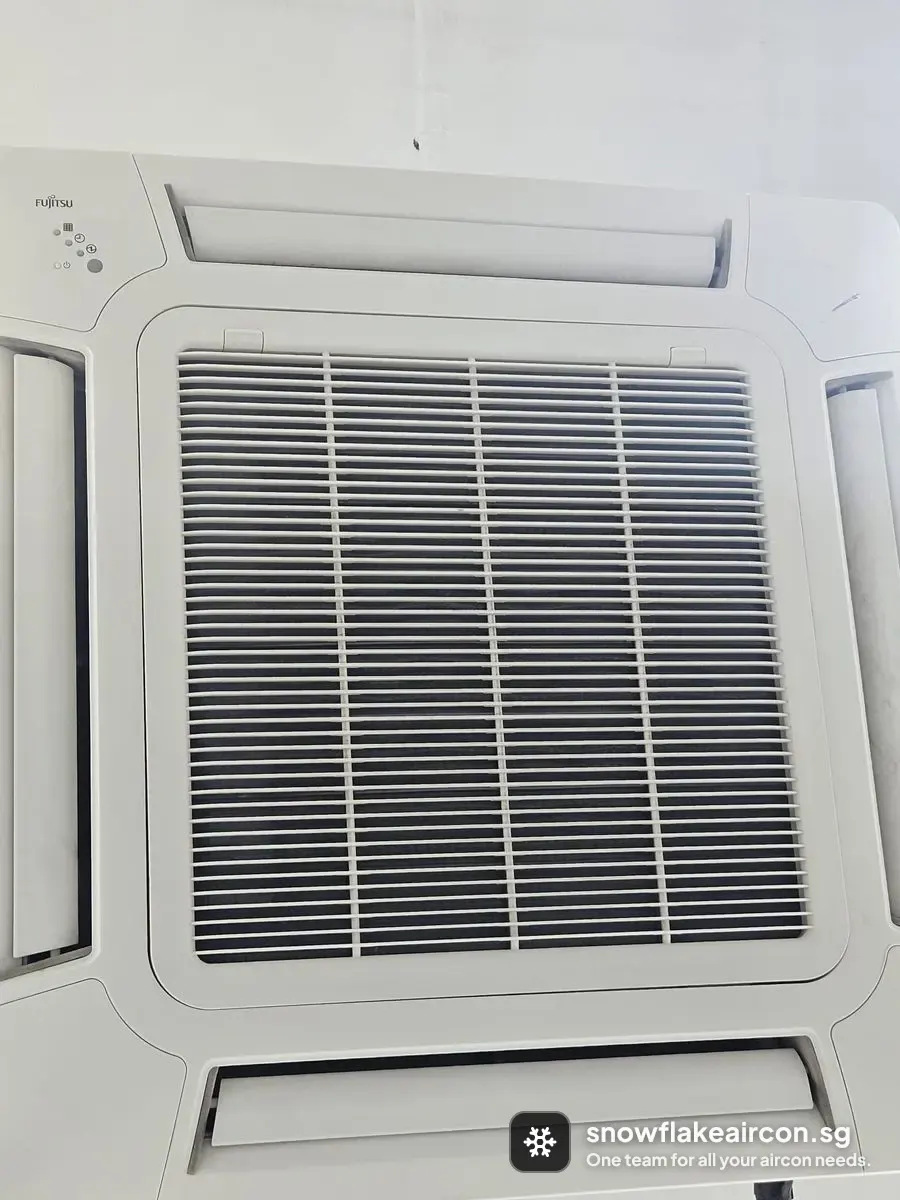
Fujitsu · Cassette
Office cassette dripping at louver: sweating from fouled coil
Surface condensation on the supply louver driven by restricted airflow across one fouled coil face
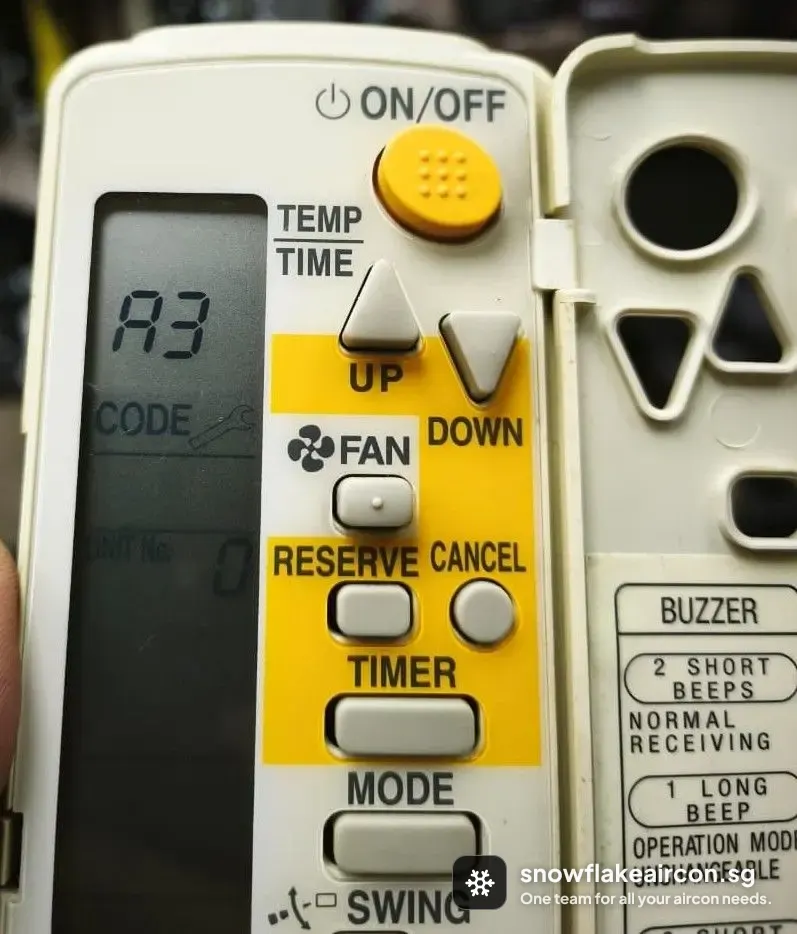
Daikin · Ceiling-concealed
Daikin A3 with ceiling drip: drain pump motor failed
A condensate pump motor at the end of its working life, leaving the pan with no outlet
Common Questions
Why does my aircon only spit water droplets on high fan speed or Auto cool?
Will vacuuming a blocked drain pipe stop front aircon mist spitting?
Can residents remove the indoor plastic shell to check fin slime themselves?
Does front mist spray ever indicate low R32 refrigerant instead of dirt?
Sources
Sources checked 27 Nov 2026