On this page
Quick summary
Small Singapore server rooms running 24/7 need two independent single-split aircons in duty-standby rotation, not a shared multi-split compressor. Continuous cooling multiplies runtime threefold, demanding monthly filter and drain checks, float-switch overflow protection, and fast action on rising rack intake heat.
Use Two Independent Single-Split Units for True Redundancy
Installing two wall heads connected to one shared multi-split outdoor condenser offers zero real redundancy. A single outdoor PCB failure, refrigerant leak, or breaker trip knocks out both indoor fan coils simultaneously, driving rack intake heat above safe thresholds within thirty minutes.
Reliable small server closets use two completely separate single-split systems fed from distinct circuit breakers. An automatic changeover timer alternates the lead and standby units weekly so compressor wear stays balanced and both units prove healthy.
Set the standby unit two degrees warmer as an automatic failover or wire a lead-lag controller that fires both machines whenever rack temperatures spike.
Compare 24/7 Server Room Fault Warnings and Response Steps
Continuous tropical operation accelerates bearing wear and drain slime far faster than standard office schedules:
Scroll to see more columns
| Early server-room clue | Likely mechanical cause | Risk to network racks | Immediate office response |
|---|---|---|---|
| Rack intake creeps up 3 degrees overnight | Clogged coil fins or fading gas charge | Gradual thermal throttling on switches | Switch load to standby unit and book check |
| Water sensor alarm or damp floor tile | Algae plug in continuous-run drain tray | Short circuit near floor-level power strips | Isolate leaking head and run wet drain flush |
| Rattling fan hum or burnt plastic smell | Worn indoor blower bearing or motor heat | Sudden airflow loss and smoke detector trip | Shut down affected isolator immediately |
| Compressor starts and stops every 5 minutes | Dirty outdoor condenser or oversized unit | High humidity swings and board stress | Wash condenser fins and test sensor readings |
Protect Live Racks Against Continuous Condensate Overflow
Mounting an indoor fan coil directly above a server cabinet invites disaster in Singapore humidity. Always position wall units on an adjacent wall blowing across the front cold aisle rather than overhanging live patch panels.
Fit an inline condensate overflow float switch inside the drain tray or pump reservoir. When algae narrows the pipe, the float cuts compressor cooling and triggers a dry-contact alert before water spills over the casing.
Because 24/7 units clock roughly 2,160 hours every quarter, monthly mesh rinsing and bi-monthly wet drain extraction keep jelly blockages from ever tripping the float.
Choose a High-Duty Servicing Cadence and Know the Cost
Servicing one unit while the standby partner cools the closet avoids downtime completely, and published flat rates keep office budgets clear:
- Servicing both duty and standby wall units together prices at S$30 per unit, whereas maintaining one lone closet unit costs S$50 and three-plus office units fall to S$25 each (14-day cover).
- Chemical coil washes for continuous-duty rooms sit at S$80 solo, S$70 per unit in a redundant pair, and S$60 apiece when grouped with three or more heads (60-day cover).
- Full dismantled overhauls cost S$150 for one closet unit, S$125 per head for a dual setup, or S$115 each across larger batches, carrying 90-day workmanship cover.
- An urgent rack-cooling fault inspection is billed at S$30 flat and offset in full if Snowflake completes the repair on the failing unit.
Diagnostic Cases for This Fault
Singapore jobs showing what we checked on-site before quoting parts or gas.
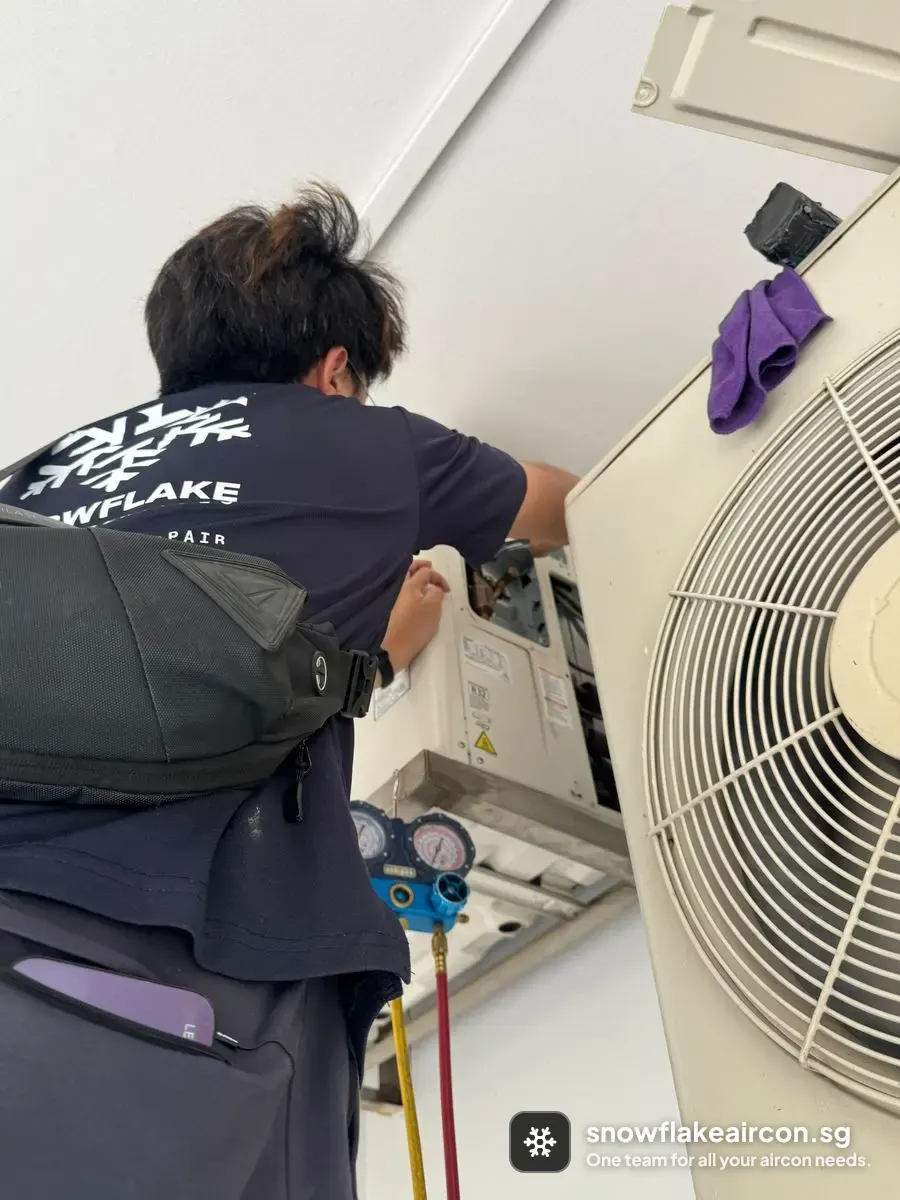
Woodlands HDB · Mitsubishi Electric
Starmex Running Non-Stop yet Warm: Dirty Blower, Not Gas
Heavily fouled indoor blower wheel and coated evaporator fins starving living-room airflow while the Starmex R32 charge holds normal operating pressure
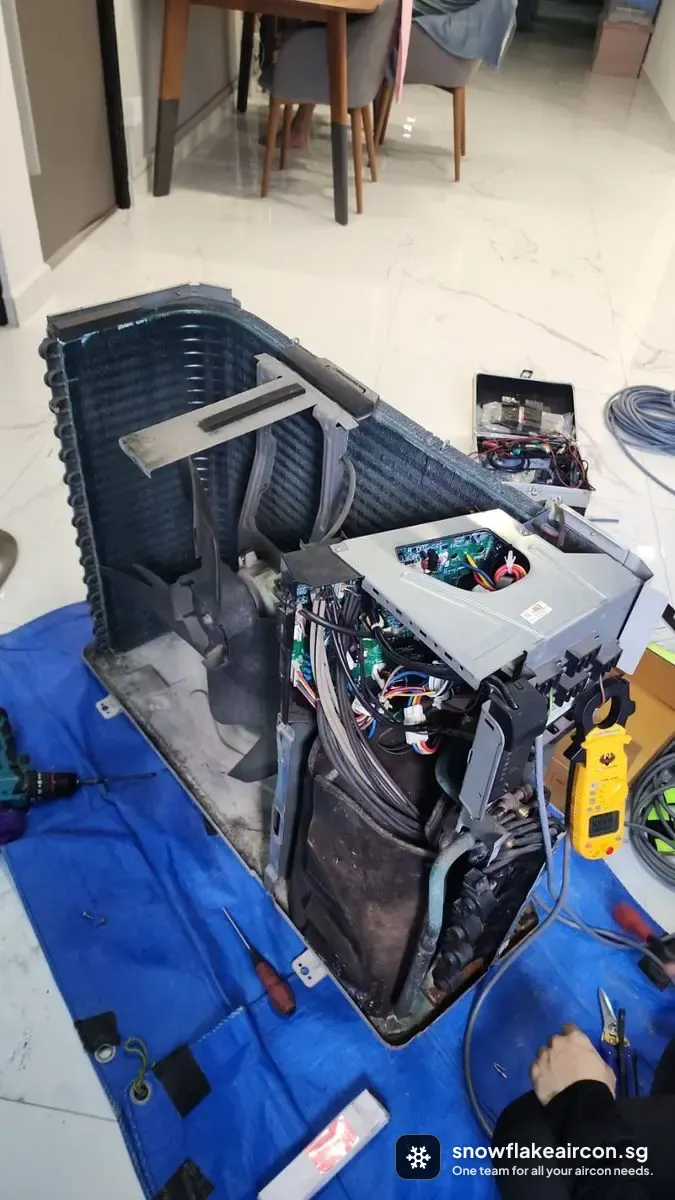
Tampines HDB · Daikin
Daikin Outdoor Unit Dead: Burnt PCB Relay, Not Condenser
House lizard bridging the outdoor Daikin PCB power relay traces, scorching the circuit track while the compressor windings and refrigerant loop remain undamaged