On this page
How This Presents
A master-bedroom wall unit inside a Jurong East flat emits a piercing metallic squeal shortly after switching on. Airflow surges unevenly across the bed, slows to a crawl, and then cuts out while the status lamp flashes. Two other bedrooms on the same System 3 stay quiet and crisp overnight.
- Setup
- Mitsubishi Electric Wall-mounted7-9 yearsHDBJurong East
- Misread as
- Paying for an unnecessary indoor control board or ripping out a working System 3 because one bedroom blower keeps grinding to a halt.
- Check first
- Measuring motor winding resistance and spinning the uncoupled blower shaft by hand to prove mechanical bearing drag before condemning the indoor board
What Else Produces This
Squealing paired with intermittent blower stalls often gets blamed on an erratic indoor control board. Direct mechanical and winding checks separate worn bearings from bad electronics immediately.
Isolating power and turning the cross-flow blower barrel by hand reveals stiff, gritty drag that stops the drum within a quarter turn.
Unplugging the indoor fan motor connector and measuring across the motor pins shows clean, intact coils with no short to ground.
Checking the indoor PCB output socket under controlled power confirms steady drive signals leaving the control board without voltage drop.
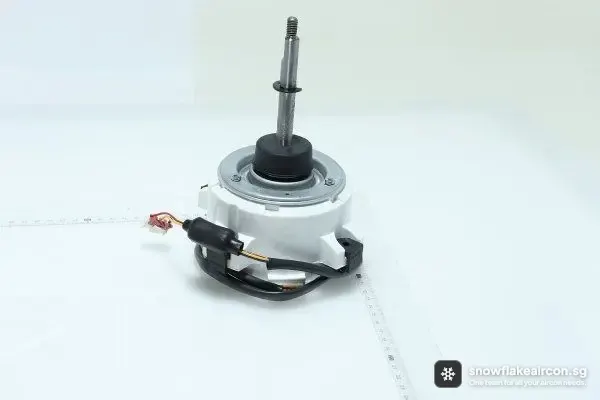
Sliding the motor assembly out from the right-hand mount exposes heat-darkened shaft collars and dry, seized ball bearings inside the sealed casing.
Why It Happens
Master-bedroom wall splits in Singapore HDB flats often run eight to ten hours every night in humid air. Across years of humid night runs, bearing grease dries out and fine bedroom lint works past the shaft seal. Once the bearing races score, rotor drag overwhelms the motor torque and triggers the board's speed-feedback protection.
What Resolution Involves
Leave the healthy indoor PCB, evaporator coil, and shared System 3 piping undisturbed. Extract the seized Mitsubishi Electric fan motor, inspect the rubber bearing bushing on the opposite end, and wipe accumulated dust off the blower drum. Fit an exact-match replacement indoor motor, align the blower wheel clearances evenly, and tighten the grub screw onto the flat shaft face.
How to Tell It Worked
Switch the bedroom circuit live again and step through quiet, medium, and high fan speeds. Listen closely beside the grille for any whine or bearing hum. Run the Jurong East HDB flat at 24°C for half an hour and confirm smooth airflow, whisper-quiet rotation, and steady cooling across all three System 3 rooms.
Before You Approve a Quote
Spin the blower shaft before blaming the indoor board
- High-pitched squealing followed by a slow shutdown signals dry motor bearings, not a bad Singapore HDB indoor PCB.
- Turning the drum manually after cutting mains power splits mechanical binding from board trouble in seconds.
- Replacing only the seized fan motor keeps the healthy evaporator coil, indoor PCB, and System 3 condenser running.