On this page
How This Presents
A ground-floor office unit in Pioneer blows lukewarm air through busy shifts even though filters and indoor fans run cleanly. Quick past top-ups briefly nudged cooling down before afternoon warmth returned across desks. Outdoor fans run steadily on the grass plinth beside the office wall while room humidity climbs noticeably.
- Setup
- Midea Wall-mounted7-9 yearsOfficePioneer
- Misread as
- Paying for repeated gas refills that overcharge the compressor when a restricted capillary line causes low running readings.
- Check first
- Recording full compressor-off static pressure before watching running suction plunge on manifold gauges alongside frosting at the outdoor capillary line
- Actual finding
- Partial oxide and oil-sludge restriction inside the outdoor capillary feeder starving evaporator refrigerant flow during warm Pioneer shifts despite intact system charge
- Scope saved
- Root cause fixed once instead of repeat call-outs
What Else Produces This
Lukewarm daytime performance with clean indoor coils often gets misread as empty gas on a single running glance. Watching resting balance versus live running pull separates metering choke from leakage before adding unnecessary charge.
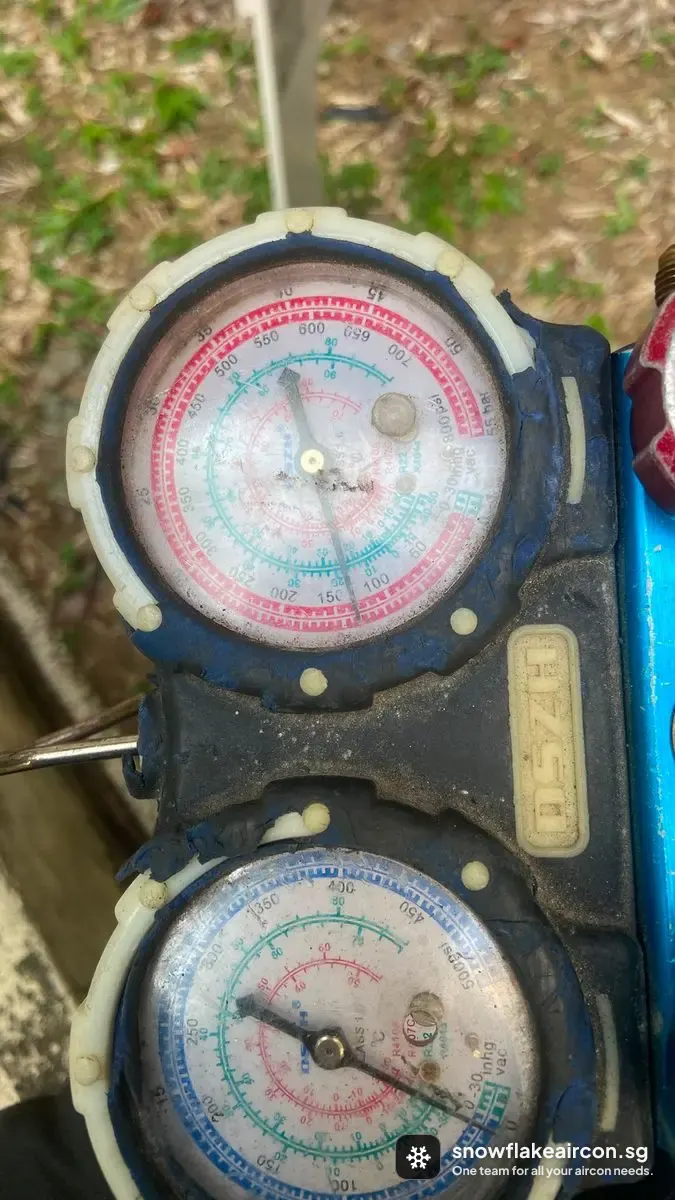
Before startup at the Pioneer plinth, manifold gauges register normal standing pressure matching warm ambient air.
Five minutes after compressor engagement, running suction plunges steeply below normal target while outlet air stays mild.
Removing the side outdoor panel exposes light frost dusting along the exit end of the small capillary metering feeder.
Checking line temperatures across the strainer shows hot liquid entering and sudden cold drop immediately downstream.
Soap-testing outdoor service valves and flare joints confirms zero gas seepage along any accessible fitting.
Why It Happens
Years of heavy Pioneer industrial shifts circulated tiny brazing oxide flakes and aged compressor oil sludge into the fine Midea capillary strainer. Although the closed loop held full charge, that internal choke starved evaporator flow whenever afternoon office heat climbed. Extra gas simply stacked behind the clogged strainer and stressed the compressor.
What Resolution Involves
Refuse another pointless gas top-up that pushes head pressure higher. Recover remaining charge cleanly and unbraze the choked Pioneer Midea strainer assembly. Nitrogen-flush internal lines clear, braze in a fresh metering feeder, and evacuate moisture to a deep vacuum before metering fresh nameplate refrigerant onto a calibrated scale.
How to Tell It Worked
Restart the Pioneer office Midea during peak afternoon cooling demand while watching manifold readings across twenty minutes. Operating suction holds firm inside factory targets, frost clears off the outdoor capillary tube, and crisp cool air fills the entire office smoothly. Indoor outlet chill drops quickly to brisk comfort.
Before You Approve a Quote
Compare resting and running circuit readings before approving another gas refill
- Low cooling pressure while the unit runs looks identical to a leak unless the resting off reading is checked first.
- Normal resting pressure paired with a steep operating drop shows refrigerant is still inside the loop but trapped behind a blockage.
- Pumping extra gas into a blocked Singapore industrial office unit stresses the compressor instead of restoring crisp cooling.