On this page
How This Presents
This Choa Chu Kang HDB master-bedroom split feels tolerable late at night yet turns frustratingly lukewarm whenever the hot afternoon sun hits the flat. Indoor airflow stays strong and clean, making a simple gas shortage look like the obvious culprit.
- Setup
- Midea Wall-mounted7-9 yearsHDBChoa Chu Kang
- Misread as
- Paying for pointless gas top-ups that overcharge the compressor when low running pressure actually comes from an internal metering blockage.
- Check first
- Comparing healthy compressor-off static pressure against a steep running suction plunge and temperature drop across the strainer on manifold gauges before adding refrigerant
- Actual finding
- Partial debris restriction inside the outdoor capillary tube strainer starving evaporator refrigerant flow under peak afternoon load even though total system charge stayed intact
- Scope saved
- Root cause fixed once instead of repeat call-outs
What Else Produces This
Weak afternoon cooling with clean indoor filters frequently triggers quick gas top-up quotes on suction pressure alone. Reading both static equilibrium and running behaviour on the manifold gauge avoids misdiagnosing a metering choke.
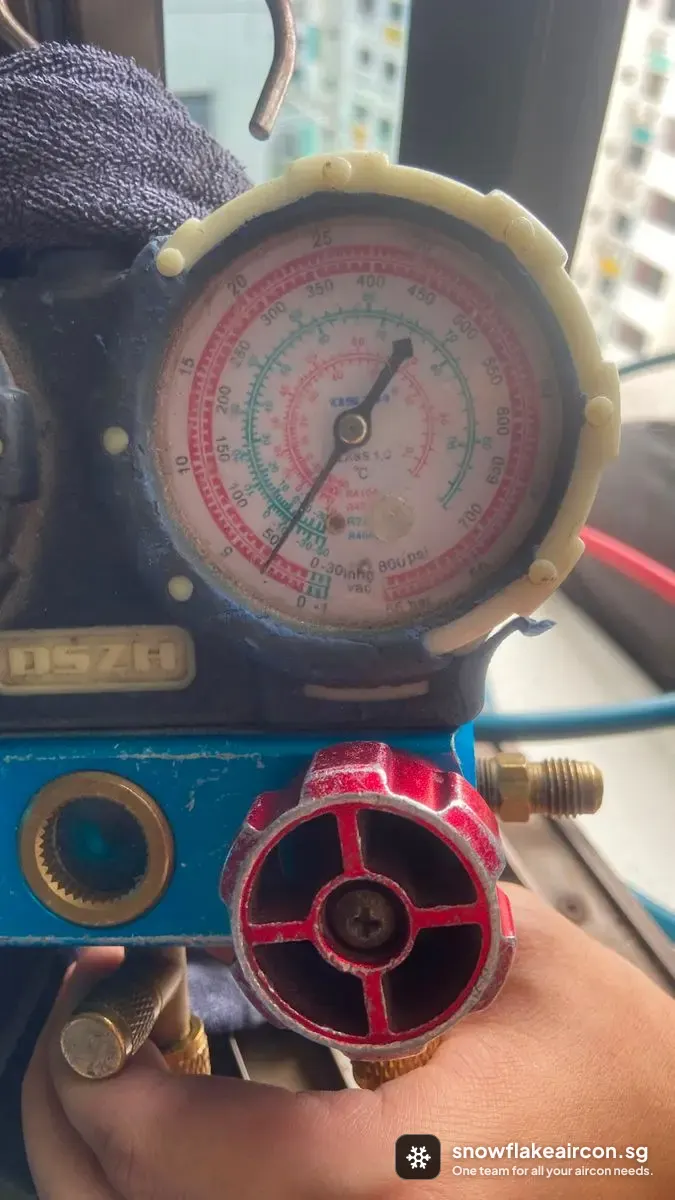
With the Choa Chu Kang Midea resting off, the DSZH manifold gauge settles squarely at normal standing pressure for Singapore afternoon ambient temperature.
Minutes after the outdoor compressor ramps up, running suction pressure plunges sharply below target while indoor air stays lukewarm.
Checking the outdoor metering section shows a distinct sudden temperature drop and light condensation right across the capillary strainer body.
Liquid-line temperature remains warm entering the strainer while compressor draw climbs slightly, confirming flow restriction rather than missing charge.
Why It Happens
Over seven to nine years of operation, microscopic brazing scale and aged oil sludge accumulated inside the fine mesh of the Midea outdoor capillary strainer. Although the sealed loop still held full charge, the partially choked metering path starved the indoor evaporator whenever afternoon heat pushed load higher.
What Resolution Involves
Avoid adding gas that would overcharge and stress the compressor. Recover the existing refrigerant cleanly, replace the restricted strainer and clear the capillary metering assembly, nitrogen-flush the circuit dry, pull a deep verified vacuum, and recharge strictly by weight to factory nameplate spec.
How to Tell It Worked
Restart the Choa Chu Kang HDB Midea during warm afternoon conditions and monitor the DSZH manifold gauge for twenty minutes. Running suction stabilises smoothly in factory range, temperature across the fresh strainer evens out, and brisk cold air fills the master bedroom.
Before You Approve a Quote
Compare standing and running pressure readings before paying for another gas refill
- A low running pressure reading by itself cannot distinguish a refrigerant leak from an internal circuit blockage.
- Normal resting pressure alongside a sharp running pressure drop points straight to an indoor flow restriction rather than missing gas.
- Topping up gas into a restricted circuit overpressures the compressor instead of restoring Singapore afternoon cooling.