On this page
Quick summary
A healthy Singapore split aircon drops supply air temperature 8°C to 12°C below top intake air after 10 minutes on high fan at 18°C. Readings under 6°C signal airflow restriction, coil fouling, or refrigerant loss. Keep checks strictly non-invasive and leave electrical panels or HDB ledges to licensed technicians.
Run the 5-Minute Intake Versus Outlet Check Safely
Set the remote to cool mode at 18°C with fan speed on high and swing stopped. Let the compressor stabilise for 10 minutes before taking any reading so inverter output reaches steady load.
Hold a household digital kitchen probe or infrared thermometer 5 cm above the top return grille and log the intake number. Next, hold the same sensor 5 cm in front of the centre discharge vane without touching moving blades.
Subtract the outlet temperature from the intake temperature to get your delta-T cooling drop. Repeat the pair once more after 2 minutes to confirm the reading stays steady.
Compare Pass or Fail Cooling Drop Bands in Singapore
High indoor humidity in HDB and condo rooms absorbs latent heat first, which keeps healthy tropical splits slightly tighter than dry climates:
Scroll to see more columns
| Measured temperature drop | Test result | Most likely condition | Recommended next step |
|---|---|---|---|
| 8°C to 12°C drop | Pass (normal cooling) | Clean coil, steady airflow, normal charge | Keep quarterly filter and routine care |
| 6°C to 7.9°C drop | Borderline weak | Dusty mesh, dirty coil fins, or humid load | Wash mesh filters; book routine or chemical wash |
| Under 6°C drop | Fail (poor cooling) | Blocked blower drum, low gas, or faulty sensor | Book S$30 on-site check before topping up gas |
| Over 14°C with weak air | Fail (airflow choked) | Clogged blower wheel or coil beginning to ice | Switch to fan mode and arrange deep cleaning |
Respect EMA, HDB, and MOM Homeowner Safety Boundaries
Stay firmly at floor level or on a stable indoor step stool while taking thermometer readings. Never lean out of an HDB service yard window or step onto an outdoor aircon ledge to check condenser warmth, as MOM and BCA safety advisories restrict ledge access to trained technicians using proper fall protection.
EMA electrical safety rules also require leaving fixed isolator switches, circuit breakers, PCB covers, and live wiring compartments untouched. Opening internal panels exposes 230V terminals and capacitor charge that stay hazardous even after switching off via remote.
If you spot frost on the indoor coil, smell burnt wiring, or hear the circuit breaker trip, turn the dedicated isolator switch off at once and stop testing.
Decide Between Servicing and a S$30 Diagnostic Visit
Match your measured split against Snowflake's published Singapore pricing so you only pay for the exact intervention needed:
- Readings below 6°C after clean filters point to a fault; book an on-site diagnostic assessment for S$30 flat, which drops off the bill completely when approved repair work goes ahead.
- Mild 6°C to 7.9°C splits with dusty coils respond to standard general servicing at S$50 for a solo fan coil, S$30 per head on two units, or S$25 per head across three or more units (14-day workmanship warranty).
- Greasy coil buildup or musty discharge calls for in-place chemical servicing billed at S$80 single, S$70 each for two heads, or S$60 each from three heads up (60-day workmanship warranty).
- Severe airflow choke showing a 14°C-plus split with trickling wind needs a full dismantled chemical overhaul at S$150 solo, S$125 each for two, or S$115 each for three-plus heads (90-day workmanship warranty).
Diagnostic Cases for This Fault
Singapore jobs showing what we checked on-site before quoting parts or gas.
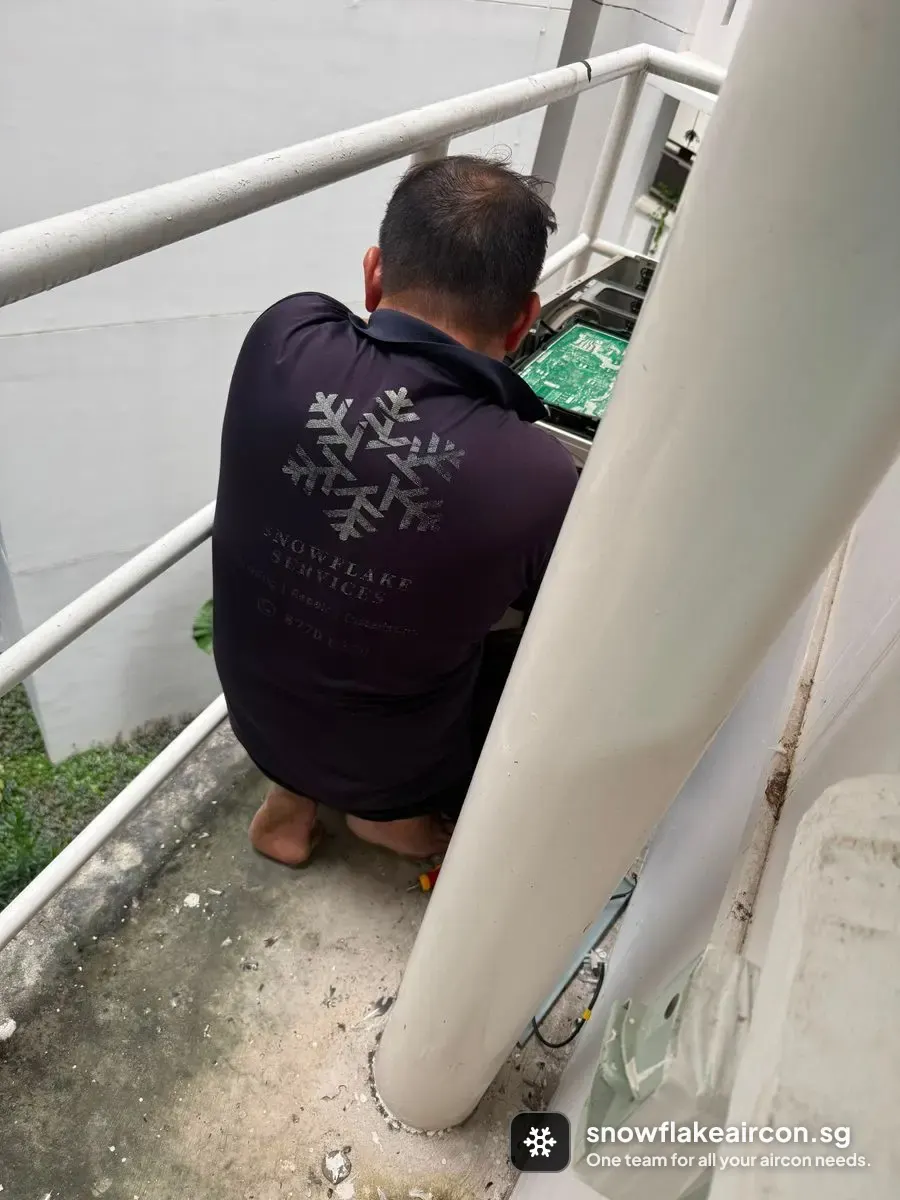
Clementi HDB · Daikin
Clementi HDB Voltage Dip: Outdoor PCB, Not Compressor
Burnt power-supply rail on the outdoor inverter control board caused by a mains voltage dip while the compressor windings and all three indoor fan coils remain healthy
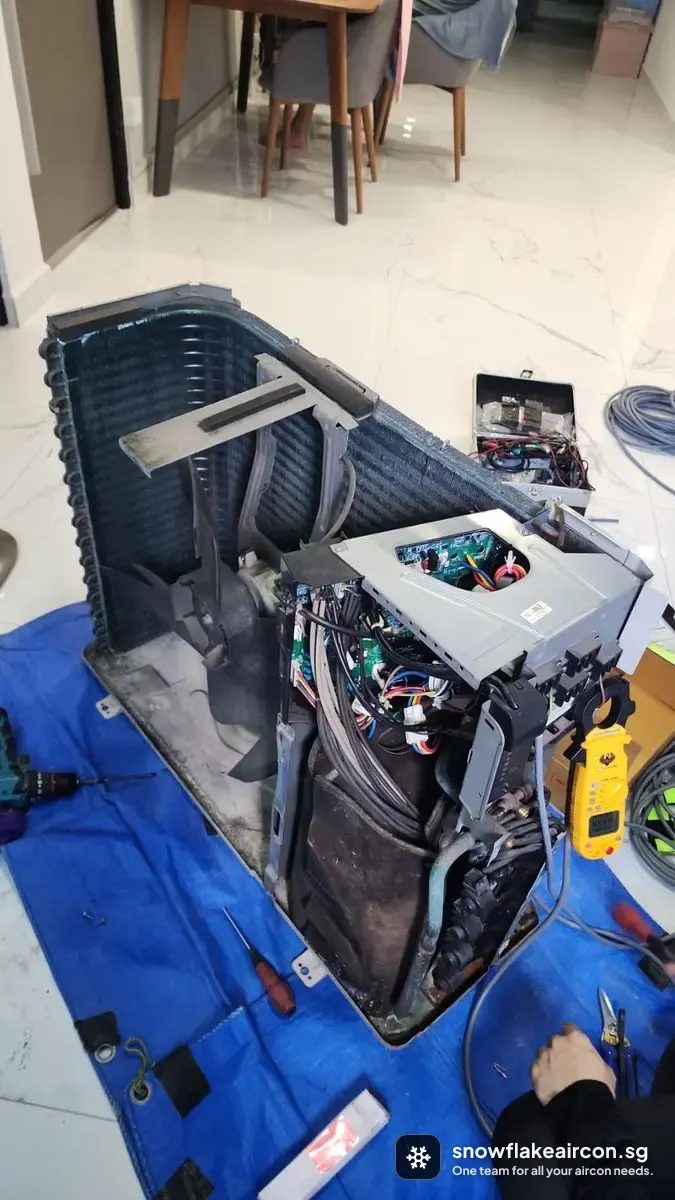
Tampines HDB · Daikin
Daikin Outdoor Unit Dead: Burnt PCB Relay, Not Condenser
House lizard bridging the outdoor Daikin PCB power relay traces, scorching the circuit track while the compressor windings and refrigerant loop remain undamaged