On this page
Quick summary
Clean B1 electronics assembly labs in Singapore must hold 45 to 55 percent humidity to stop static ESD damage while clearing sticky solder-flux residues from evaporator fins. Scheduled chemical washes, VRV or split checks, and SME Energy Efficiency Grant upgrades preserve board yield and lower utility bills.
Wall-mounted general servicing $25–$50/unit · chemical wash $60–$80/unit · View servicing rates
Balance Static Safety and Solder Residue Inside Assembly Bays
Clean assembly bays run tight production tolerances daily. Steady humidity and spotless fins protect sensitive electronics components reliably. Overcooling assembly lines below 40 percent relative humidity raises electrostatic discharge (ESD) spikes across unprotected PCB trays. Conversely, letting moisture climb past 60 percent accelerates solder-paste absorption.
Soldering irons, rework stations, and ultrasonic board washes also release airborne rosin vapours continuously. Coarse nylon filters pass fine aerosols onto cold evaporator fins. Sticky acid-tainted film then insulates aluminium coils and drives energy draw upward.
Compare Workshop Humidity Targets and Coil Fault Symptoms
Monitor bay hygrometers alongside supply temperatures weekly across clean benches to catch drifting setpoints:
Scroll to see more columns
| Lab cooling condition | Observed bench or coil clue | Operational impact | Recommended commercial step |
|---|---|---|---|
| Humidity under 40% RH | Cold 19C setpoint on continuous run | Static ESD risk to live PCBs | Raise setpoint to 24-25C; check sensors |
| Rosin glaze on coil fins | Sticky yellow film, rising bay temps | Blocked heat transfer, higher bills | Book chemical wash or coil teardown |
| Condensate slime backup | Sour odour, damp ceiling tray | Risk of bench drip contamination | Flush drain pan; check pump switch |
| Aged inefficient plant | Climbing SP Group kWh draw | Heavy B1 commercial overheads | Assess EEG-supported 5-tick upgrade |
Protect Assembly Air Quality and Explore EEG Efficiency Upgrades
Pair return grilles with denser replaceable pre-filter media checked bi-weekly. Solder aerosols load screens cleanly before reaching chilled fins. Never shut off fume extractors while running cooling units.
Local firms running aged industrial splits can review GoBusiness Energy Efficiency Grant (EEG) terms before replacing worn cooling plants. Always engage licensed electrical workers under EMA safety rules for commercial isolator changes. Track monthly utility logs carefully to spot dirty-coil energy spikes before production downtime hits.
Schedule Commercial Coil Washes and Humidity Checks
Booking off-hour cleaning keeps clean benches dry, ESD-compliant, and operating inside target humidity bands:
- Commercial VRV troubleshooting carries an S$80 diagnostic fee while light-industrial splits cost S$30. Approved repairs credit that charge under a 30-day warranty.
- Monthly lint vacuuming and pan flushing keep static airflow steady. One unit charges S$50, two cost S$30 per fan coil, and three-plus assembly bay units cost S$25 each (14-day warranty).
- Rosin-glazed coils need chemical treatment to strip flux film. Lone bay coils bill S$80, two bays bill S$70 each, and three-plus bookings charge S$60 per bay unit (60-day protection).
- Baked flux deposits require full dismantled overhauls. A single bay unit costs S$150, two bays run S$125 per unit, and three or more cost S$115 each (90-day warranty).
Diagnostic Cases for This Fault
Singapore jobs showing what we checked on-site before quoting parts or gas.
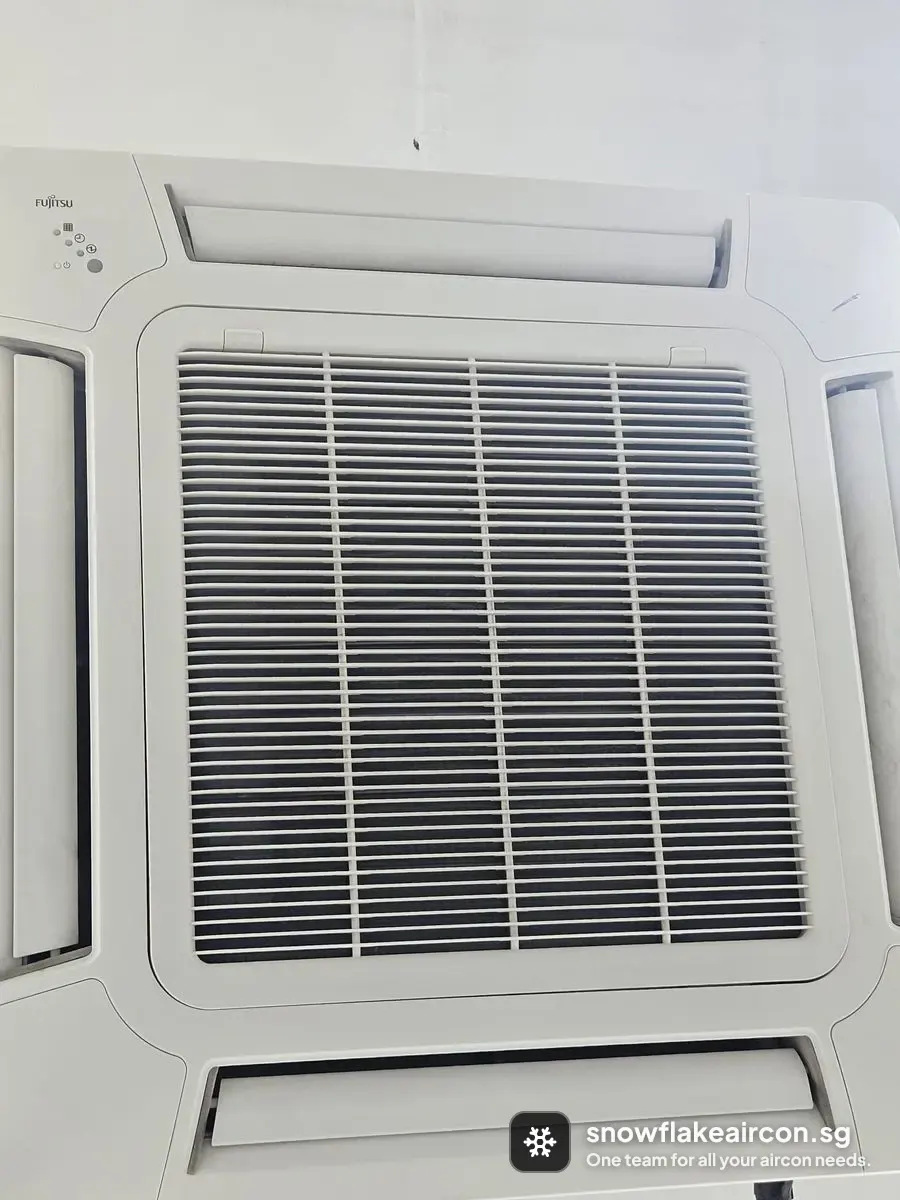
Fujitsu · Cassette
Office cassette dripping at louver: sweating from fouled coil
Surface condensation on the supply louver driven by restricted airflow across one fouled coil face
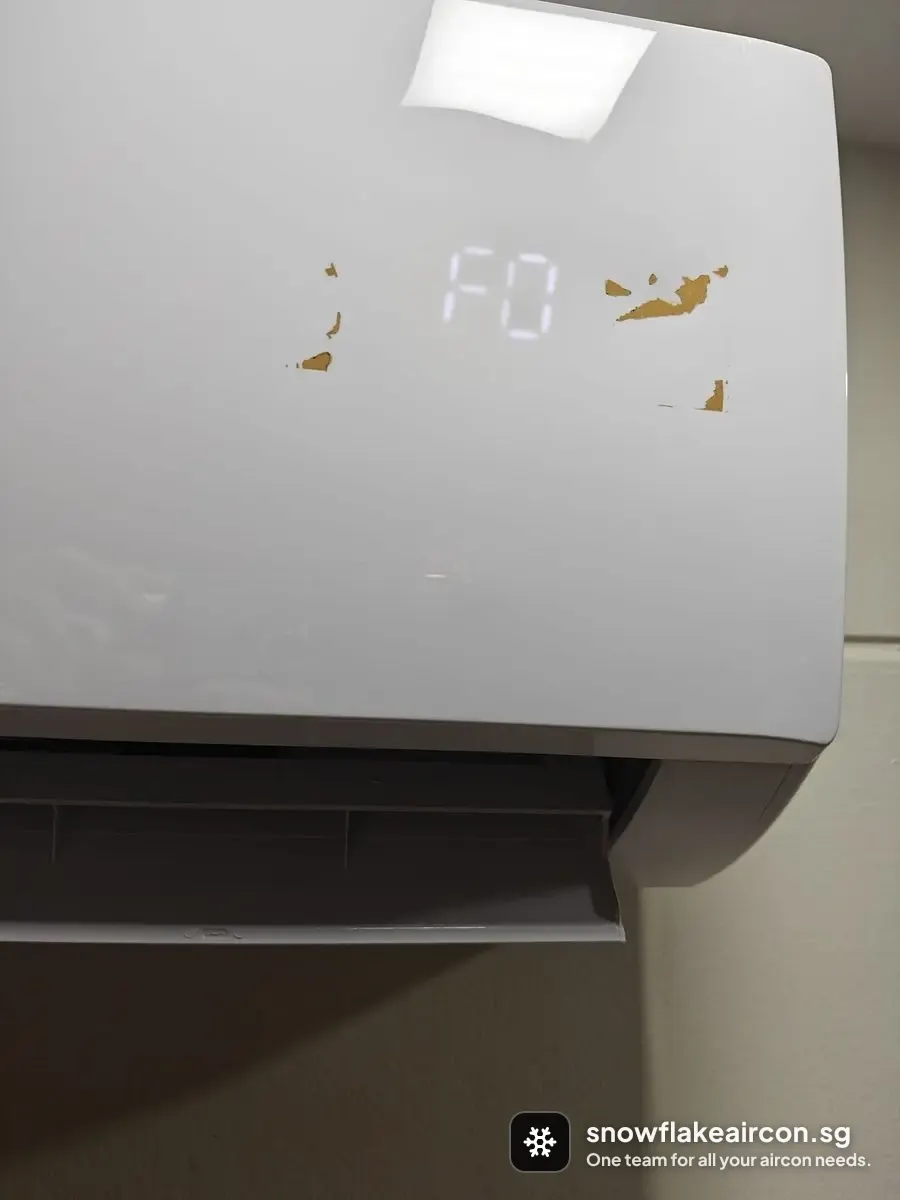
Gree · Wall-mounted
Gree F0 on a rusted condenser: refrigerant shortage
R32 refrigerant shortage triggering Gree F0 protection from corroded evaporator return bends