On this page
Quick summary
Bedroom window fogging on rainy Singapore mornings comes from warm humid room air hitting cold glass, whereas aircon drain tray overflows soak drywall directly beneath the indoor casing or trunking joints. Dry-tissue floor checks tell both apart quickly.
System 2 installed from $2,600 (22 SWG copper) · $30 site survey waived on install · View packages
Separate Monsoon Glass Sweat from Aircon Drain Tray Leaks
Heavy monsoon rain drives Singapore humidity above eighty percent. Overnight aircon cooling drops bedroom glass temperatures sharply. Moisture then forms across window corners, aluminium frames, and wardrobe mirrors even on healthy aircons.
Drain tray overflows behave differently. Water drips straight beneath the indoor blower bezel or along horizontal PVC trunking joints. A standalone dehumidifier clears room glass mist quickly, while blocked trays keep dripping.
Stay Within EMA, HDB, and MOM Floor-Level Safety Boundaries
Stay firmly on bedroom tiles throughout every moisture check. EMA electrical rules forbid opening 230V wall switches, isolator faceplates, or indoor circuit covers.
HDB, BCA, and MOM fall-prevention rules also warn against climbing onto stools, chairs, or exterior ledges. Wipe only reachable casing plastics and lower glass corners using dry tissue paper.
Run the Pass or Fail Condensation Self-Check at Floor Level
Cool the bedroom at 25 degrees for twenty minutes first. Then inspect these four spots from floor height with dry kitchen tissue:
Scroll to see more columns
| Observation point | Floor-level tissue method | Pass (room humidity only) | Fail (book S$30 check) |
|---|---|---|---|
| Window glass and frame | Wipe lower glass corners dry | Mist dries when dehumidifier runs | Water pools along nearby wall trunking |
| Indoor blower bottom lip | Trace tissue below casing | Plastic stays dry and clean | Fresh beads drip beneath louvres |
| Wall trunking underside | Run finger along PVC seam | Cover feels cool yet dry | Wet seam tracks toward corner |
| Balcony or floor-trap end | Listen during cooling cycle | Steady trickle reaches floor trap | Zero drip outside while indoor leaks |
Choose Room Humidity Control or Schedule Drain Servicing
Match each wet zone to the proper next step so wall paint stays dry and bills stay modest:
- Use a room dehumidifier, try dry mode briefly, or widen window vents once tissue wipes show dampness only on glass panes.
- Snowflake bills S$30 for on-site checks whenever casing lips or PVC trunking turn wet. Approved repair work zeroes that check charge with a 30-day warranty.
- Routine washes clear light tray film early. Standard servicing charges S$50 for a single unit, S$30 per unit in twin visits, or S$25 each across three rooms (14-day warranty).
- Chemical washes remove sticky algae slime. Rates run S$80 for one indoor head, S$70 apiece for two heads, or S$60 apiece when booking three heads (60-day cover).
- Full dismantled overhauls fix stubborn leaks. One unit costs S$150, two-unit bookings run S$125 per room, and three-room overhauls cost S$115 per head with a 90-day cover.
Diagnostic Cases for This Fault
Singapore jobs showing what we checked on-site before quoting parts or gas.
Mitsubishi Electric · Multi-split
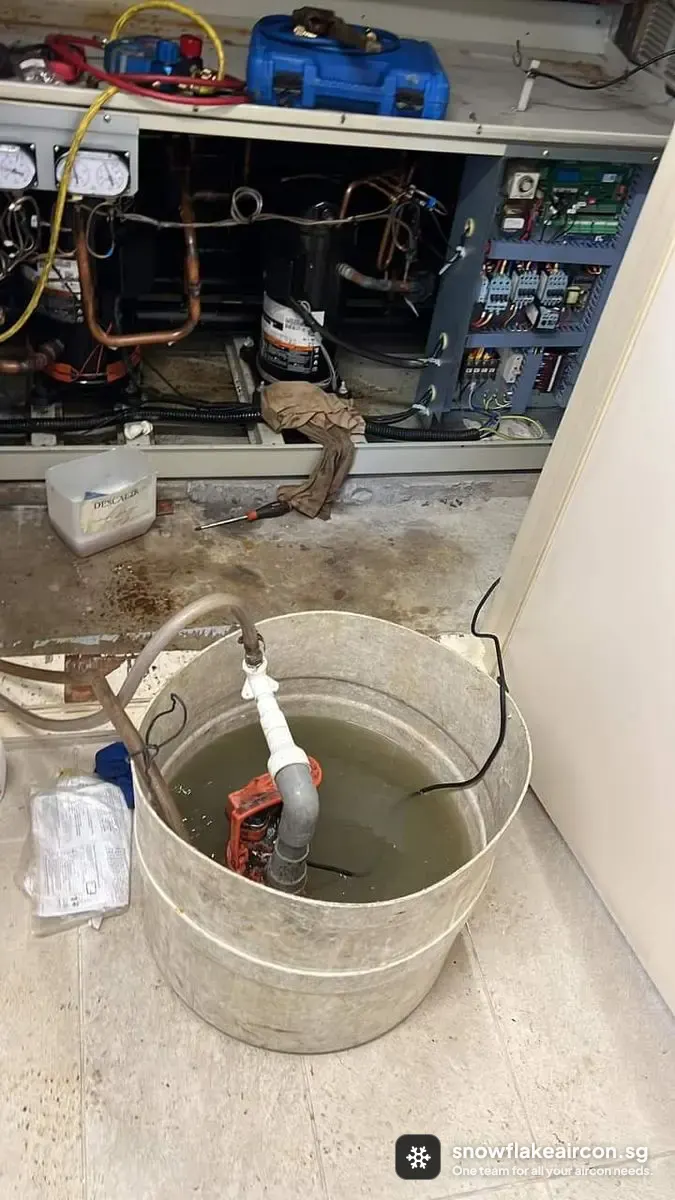
Outdoor ledge dripping downstairs: split drain pipe stub
Split outdoor PVC condensate drain stub spilling backed-up water across the ledge
Daikin · Wall-mounted
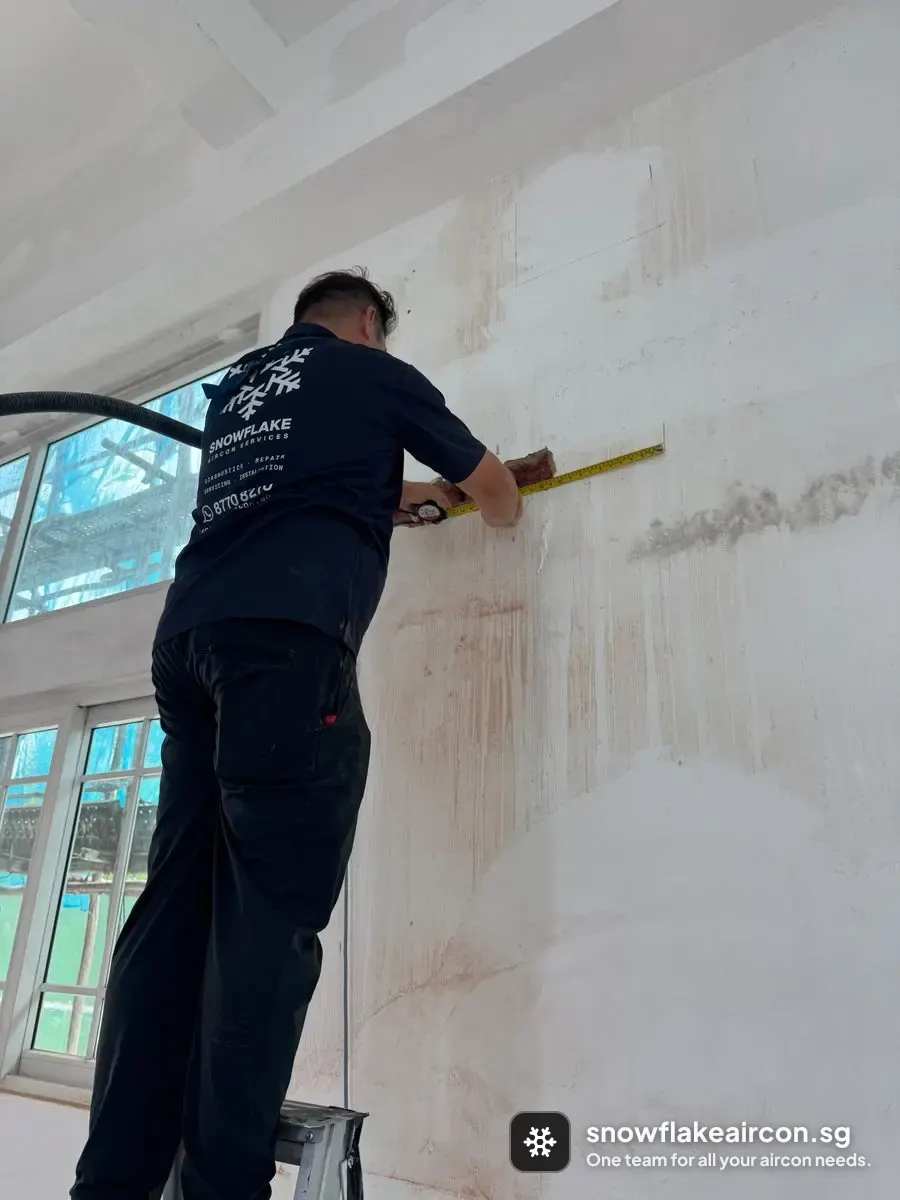
Water stain down the wall: blocked rear drain trough
Biofilm jelly choking the hidden rear auxiliary drain trough behind the evaporator coil, spilling condensate down the plastered wall while the main trunking pipe stayed intact
Common Questions
Why do bedroom windows fog up in Singapore even when the aircon drain is clear?
Can running a dehumidifier stop wet drips underneath my wall aircon casing?
How do residents inspect wet wall trunking safely without opening electrical covers?
When does monsoon condensation point toward missing pipe insulation inside trunking?
Sources
Sources checked 27 Nov 2026