On this page
Quick summary
Condo fan coil units blow warm air when motorized cooling valves stick shut or wall thermostats lose switching voltage. Stepping fan speeds at floor level tests indoor airflow safely. Listening for a soft actuator click separates flat FCU faults from MCST chiller problems before calling technicians.
Wall-mounted general servicing $25–$50/unit · chemical wash $60–$80/unit · View servicing rates
Separate Wall Thermostat Signals from Central Chiller Supply
Central condo systems circulate cold chilled water through riser pipes while your wall thermostat commands each indoor fan coil unit. Lowering target temperature triggers an electric valve actuator to open cold water flow across indoor cooling coils.
When the blower runs smoothly yet discharge air feels lukewarm, either the valve actuator stayed shut or central riser water warmed up. Neighbours sharing your block stack feel warm vents simultaneously whenever MCST plant water drifts.
Follow EMA, HDB, and MOM Floor-Level Safety Boundaries
Keep every resident self-check strictly at floor level inside living spaces. Never climb ladders to open ceiling access hatches, touch insulated chiller valves, or probe damp drip trays above false ceilings.
Obey EMA electrical safety rules by keeping 230V thermostat backplates, isolator boxes, and control panels closed at all times. Under MOM and BCA ledge rules, residents must also stay off exterior ledges and leave valve-body wiring to trained specialists.
Run the Pass or Fail FCU Valve and Fan Self-Check
Step through these four floor-level checks sequentially before escalating to MCST management or booking a S$30 diagnostic visit:
Scroll to see more columns
| Floor-level check | What resident observes | Pass outcome | Fail outcome and next move |
|---|---|---|---|
| Fan speed steps | Switch low, medium, high on wall pad | Three clear airflow jumps at grille | Flat speed; book S$30 check |
| Cool mode relay | Drop setpoint from 28 to 20 degrees | Crisp relay click at wall thermostat | Blank screen or silent; S$30 check |
| Valve actuator click | Listen quietly 15s below ceiling FCU | Soft hum or click then cooler air | Zero click or warm air; S$30 check |
| Adjacent FCU rooms | Test bedroom and living FCU together | Both zones stay warm on cool mode | Stack-wide warm supply; alert MCST |
Decide When to Alert MCST or Book a Technician
Match your pass-or-fail test results clearly so building staff and aircon technicians resolve the right fault:
- Contact condo MCST staff at once when every FCU blows warm alongside neighbouring flats. Building chiller pumps or shared riser valves need central attention.
- Book a S$30 diagnostic check (30-day warranty) if one FCU stays warm despite clear switch clicks. Snowflake waives that fee when valve repairs go ahead.
- Dusty condo blowers respond quickly to general servicing. Solo FCU visits bill S$50, twin FCU bookings run S$60 combined, and three-room suites pay S$25 each (14-day cover).
- Sour odours clear via chemical washes at S$80 once, S$70 each on two FCUs, while three-FCU suites pay S$60 per unit (60-day cover). Stripped teardowns cost S$150, S$125 per pair, or S$115 per FCU in three-room condos (90-day cover).
Diagnostic Cases for This Fault
Singapore jobs showing what we checked on-site before quoting parts or gas.
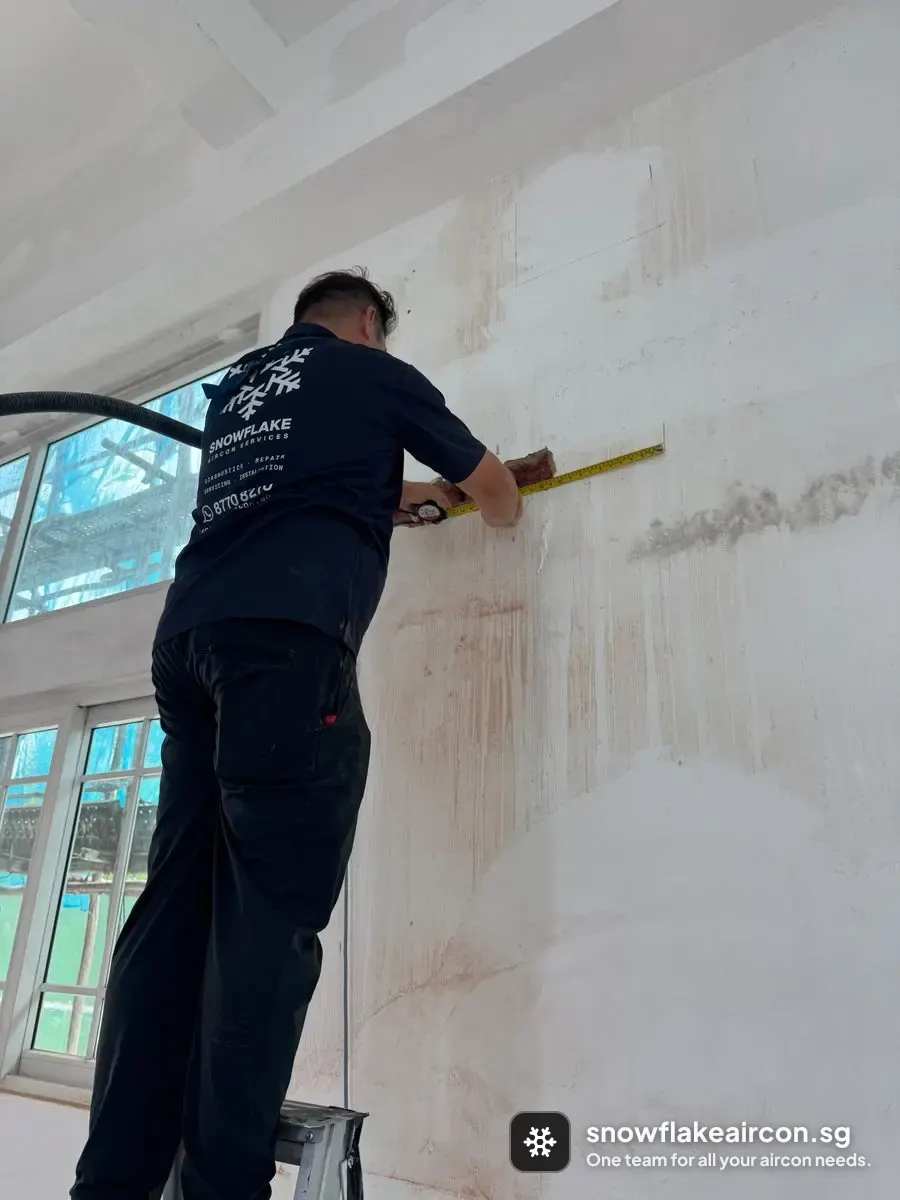
Daikin · Wall-mounted
Water stain down the wall: blocked rear drain trough
Biofilm jelly choking the hidden rear auxiliary drain trough behind the evaporator coil, spilling condensate down the plastered wall while the main trunking pipe stayed intact
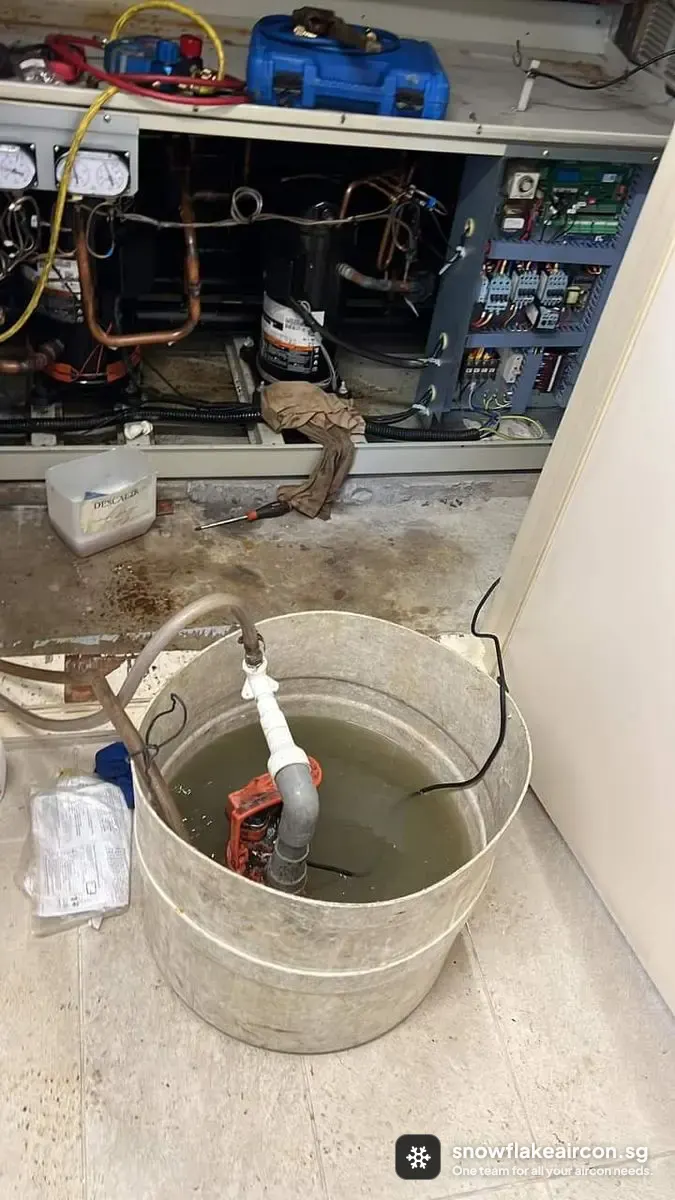
Mitsubishi Electric · Multi-split
Outdoor ledge dripping downstairs: split drain pipe stub
Split outdoor PVC condensate drain stub spilling backed-up water across the ledge
Common Questions
What does the quiet click inside a condo FCU after lowering the thermostat mean?
How can condo residents tell an indoor FCU fault from an MCST chiller plant issue?
Is it safe for homeowners to open ceiling hatches and bleed condo chilled-water valves?
When should a condo owner pay S$30 for an on-site check instead of calling MCST?
Sources
Sources checked 27 Nov 2026