On this page
Quick summary
Turning off the second bedroom during a warm night isolates whether weak Singapore multi-split cooling stems from low R32 charge, stuck electronic expansion valves, or crossed piping. A safe floor-level remote test catches shared valve starvation before booking a S$30 diagnostic check.
Wall-mounted general servicing $25–$50/unit · chemical wash $60–$80/unit · View servicing rates
Follow EMA, HDB, and MOM Floor-Level Safety Rules
Perform this bedroom self-check strictly indoors at floor level using handheld remotes only. EMA, HDB, and MOM regulations strictly forbid residents from stepping onto ledges or leaning out windows. Stay well clear of balcony railings and external brackets.
Keep every trunking cover, isolator switch, and 230V indoor electrical terminal box shut tight. Switch off the wall controller and call licensed technicians whenever breakers trip or burnt smells appear. Never open outdoor valves or flare nuts yourself.
Run the Solo Versus Twin Bedroom Comparison Test
First rinse removable dust screens cleanly in the bathroom so lint never skews your result. Set both bedrooms to cool mode at 22 degrees with medium fan airflow for 15 minutes. Feel each discharge vent by hand and listen near the side trunking for liquid hissing.
Turn the second bedroom off completely and observe the first bedroom for 15 more minutes. Next, switch the first bedroom off and run the second bedroom alone to isolate each line. Write down how fast each vent chills during solo versus twin cycles. Keep bedroom doors shut throughout both timed intervals.
Check Pass and Fail Outcomes Before Booking Help
Match what happens across both bedrooms against these pass and fail checks before requesting service. Save these notes for technician handover:
Scroll to see more columns
| Test observation | Pass benchmark | Fail indicator | Action (S$30 diagnosis) |
|---|---|---|---|
| Both bedrooms running together | Steady crisp air in both rooms | Room 1 warms when Room 2 runs | Book S$30 valve priority check |
| Second room switched off | Room 1 cooling stays steady | Room 1 suddenly blows icy cold | Book S$30 gas and EEV test |
| Only Room 2 turned on | Room 2 cools while Room 1 stays idle | Room 1 chills while Room 2 stays warm | Log crossed pipes for S$30 visit |
| Sound near trunking tee | Quiet uniform airflow sweep | Loud whistling or bubbling hiss | Schedule S$30 leak pressure test |
Decide When Fault Diagnosis Beats Routine Coil Washing
Washing indoor coils alone cannot cure electronic expansion valve drift, low refrigerant, or crossed communication wires. Accurate remote test logs help technicians isolate faulty manifolds rapidly on arrival:
- Any fail row above warrants our S$30 diagnostic inspection, or S$80 for VRV estates. Inspection charges drop off repair bills backed by 30-day warranty.
- Equal sluggish airflow on solo and twin tests signals matted lint. Standard servicing charges S$50 (1 head), S$30/unit (2 heads), and S$25/unit (3+ heads) carrying 14-day warranty.
- Oily indoor coil buildup clears cleanly through chemical treatments. Pricing runs S$80 single, S$70/unit for two, and S$60/unit across three-plus rooms with 60-day warranty.
- Thick slime sealing rotor blades requires full dismantled chemical overhauls. Complete teardown pricing sets S$150 for one room, S$125 each for two rooms, and S$115 each across three or more rooms (90-day warranty).
Diagnostic Cases for This Fault
Singapore jobs showing what we checked on-site before quoting parts or gas.
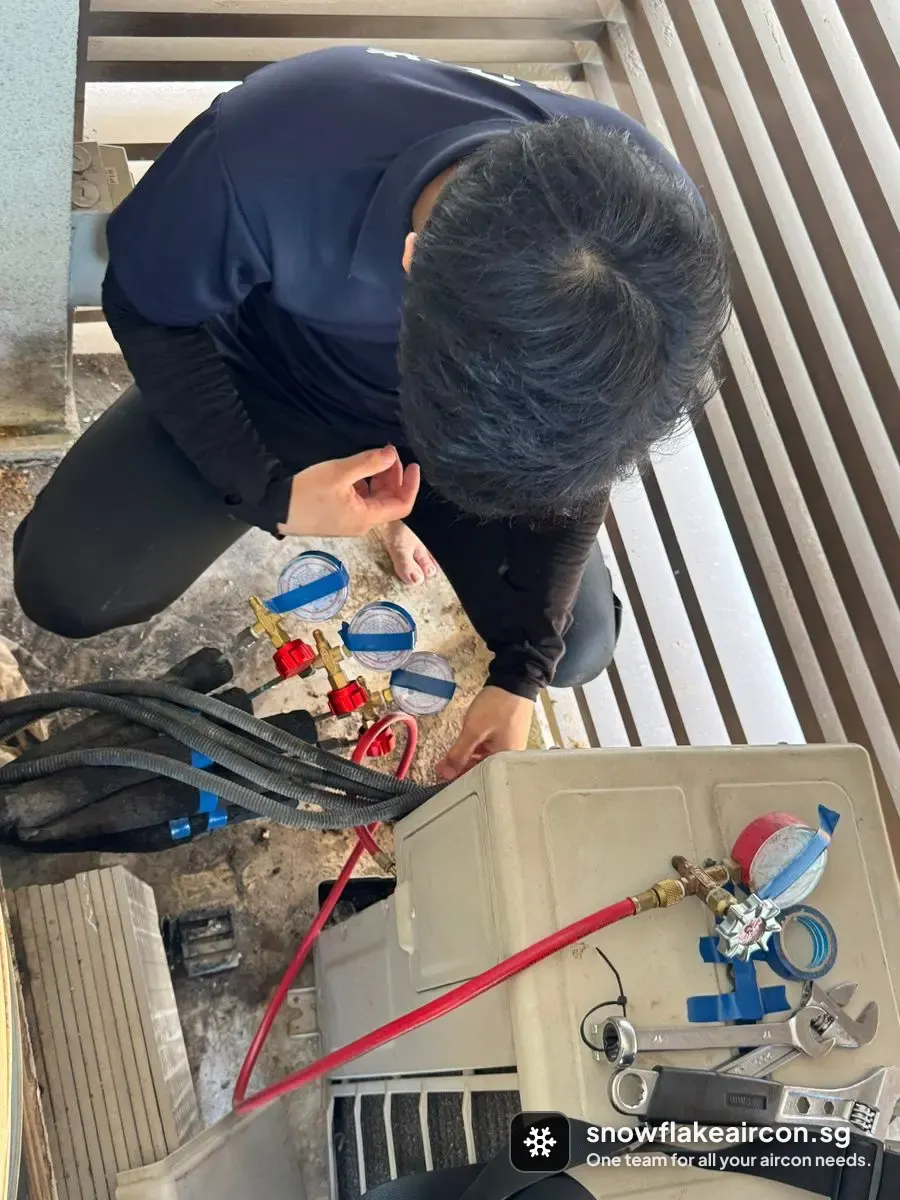
Mitsubishi Electric · Wall-mounted
Warm air with normal gas pressure: fouled coil, not low gas
Grease-choked indoor evaporator coil and dust-packed blower wheel causing poor temperature drop while refrigerant pressure stayed full
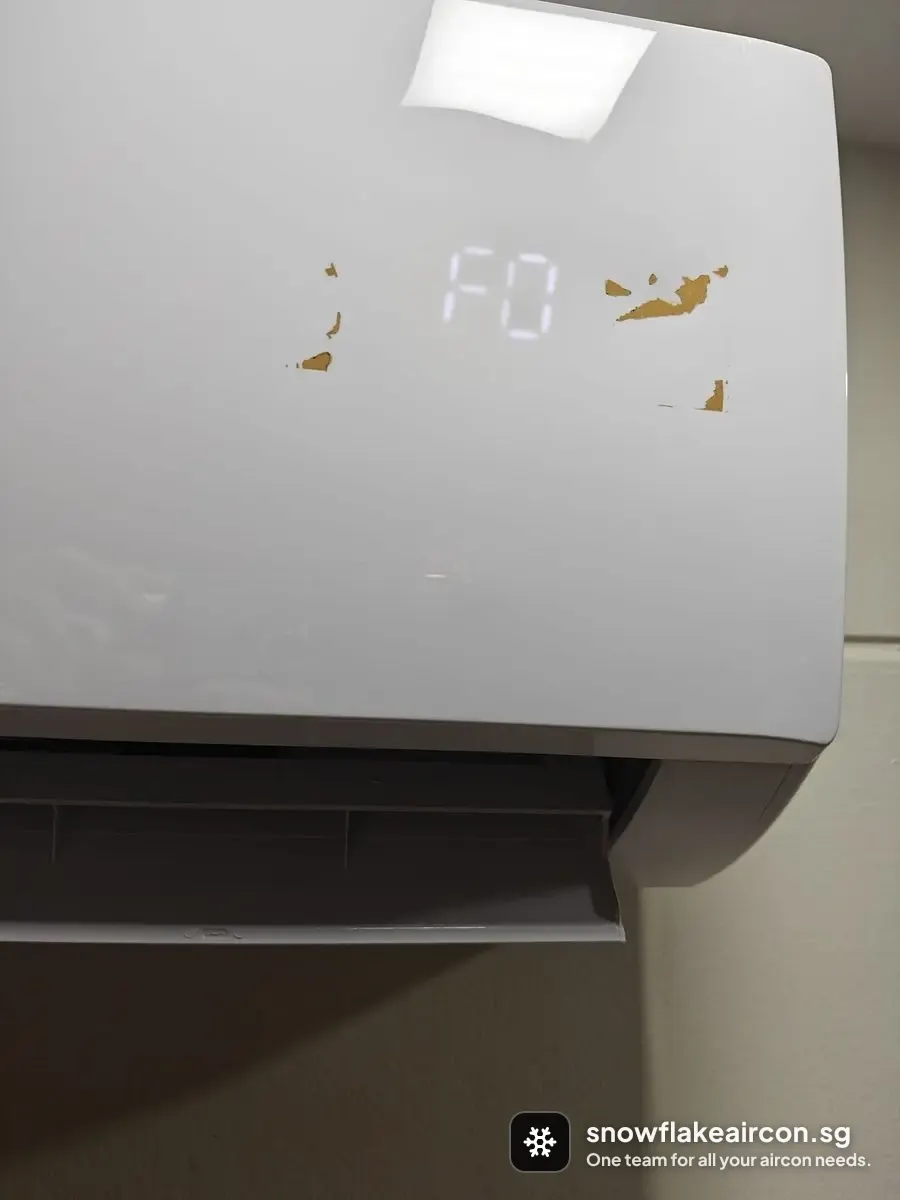
Gree · Wall-mounted
Gree F0 on a rusted condenser: refrigerant shortage
R32 refrigerant shortage triggering Gree F0 protection from corroded evaporator return bends
Common Questions
Why does one HDB bedroom go freezing cold only after the second room shuts off?
Can dust-clogged indoor filters mimic a multi-split expansion valve fault?
How do installers accidentally cross pipes and signal cables between adjacent bedrooms?
What does a S$30 technician inspection verify after a failed twin-bedroom test?
Sources
Sources checked 27 Nov 2026