On this page
Quick summary
Singapore's March and April inter-monsoon peak regularly pushes outdoor ambient air toward 35 degrees, raising condenser pressure and triggering thermal shutdowns on dusty coils. Pre-season servicing clears heat-rejection blockages and indoor drain slime before peak queues slow technician visits.
Wall-mounted general servicing $25–$50/unit · chemical wash $60–$80/unit · View servicing rates
Why 35-Degree Inter-Monsoon Afternoons Trip Compressors
Light winds during March and April leave west-facing HDB ledges and sunlit condo alcoves radiating past 35 degrees. Outdoor condenser fins coated in road grit and lint struggle to shed thermal load. Shaded utility recesses heat up fast when afternoon sun hits adjoining walls.
Rising refrigerant discharge pressure forces inverter boards to throttle cooling speed or shut compressors off completely. Midday bedrooms stall near 27 degrees even when the wall remote shows 21. Early afternoon compressor cycling also spikes daytime power draw sharply. Restoring fin airflow prevents sudden high-pressure trips.
Compare Heatwave Strain Signs Against Service Actions
Spot early inter-monsoon stress symptoms before compressors lock out on a hot weekend afternoon. Run this quick check across every cooled room inside your flat:
Scroll to see more columns
| Afternoon strain sign | Likely heat bottleneck | Safe indoor action | Technician remedy |
|---|---|---|---|
| Room hovers near 27 degrees | High condenser head pressure | Rinse mesh screens inside | Wash indoor and outdoor coils |
| Outdoor fan stops after 20 min | Thermal overload cutoff | Clear drying racks near window | Run S$30 diagnostic check |
| Water streaks under casing | Heavy afternoon humidity load | Check floor-trap trickle | Vac flush and chemical wash |
| Weak throw despite high fan | Grease-coated blower wheel | Verify remote cool mode | Complete dismantled overhaul |
Verify Safe Indoor Prep Steps Before Afternoon Peaks
Wash removable indoor mesh screens every two weeks at floor level. Keep service-yard laundry racks clear of window exhaust louvers so hot air escapes freely. Setting bedrooms to 25 degrees with medium fan slows compressor overload. Draw sunlit blackout curtains early before western heat peaks indoors.
Residents must remain indoors at floor level under HDB, BCA, and MOM ledge rules. Never lean outside windows or spray hose water near live 230V outdoor units. Trained technicians carry safety anchors for exterior condenser rinsing.
Schedule Pre-Season Washing Before Peak Heatwave Queues
Booking preventive maintenance in February skips mid-March waitlists and preserves steady afternoon cooling across hot weeks:
- Routine maintenance clears screens, drip pans, and vacuum drains: 1 indoor unit bills S$50, 2 units bill S$30 per head, and 3+ units cost S$25 each, backed by a 14-day guarantee.
- Sticky grease across indoor fins lowers cooling output during humid evenings. Chemical servicing charges S$80 (1 unit), S$70 each (2 units), and S$60 apiece (3+ units) with a 60-day guarantee.
- Mould-packed fan wheels need complete dismantled overhauls. Full teardowns price at S$150 solo, S$125 per room in pairs, and S$115 per room across three-plus rooms carrying 90-day guarantee.
- Afternoon breaker trips call for testing before topping up refrigerant. On-site fault visits charge S$30 (S$80 on VRV), credited back toward repairs under 30-day guarantee.
Diagnostic Cases for This Fault
Singapore jobs showing what we checked on-site before quoting parts or gas.
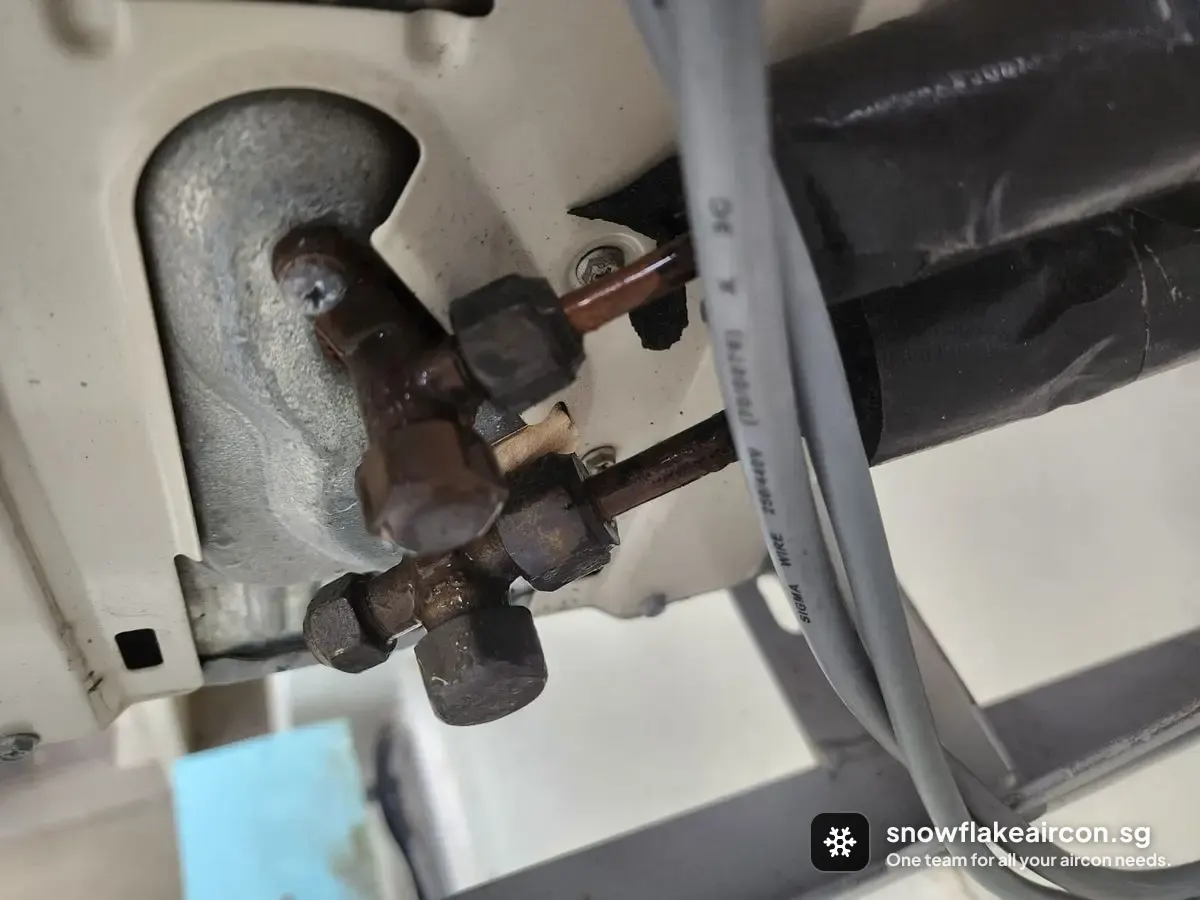
Samsung · Wall-mounted
Coastal unit losing gas again: salt ate the pipe fitting
A corroded outdoor fitting thinned past the point where it can seal
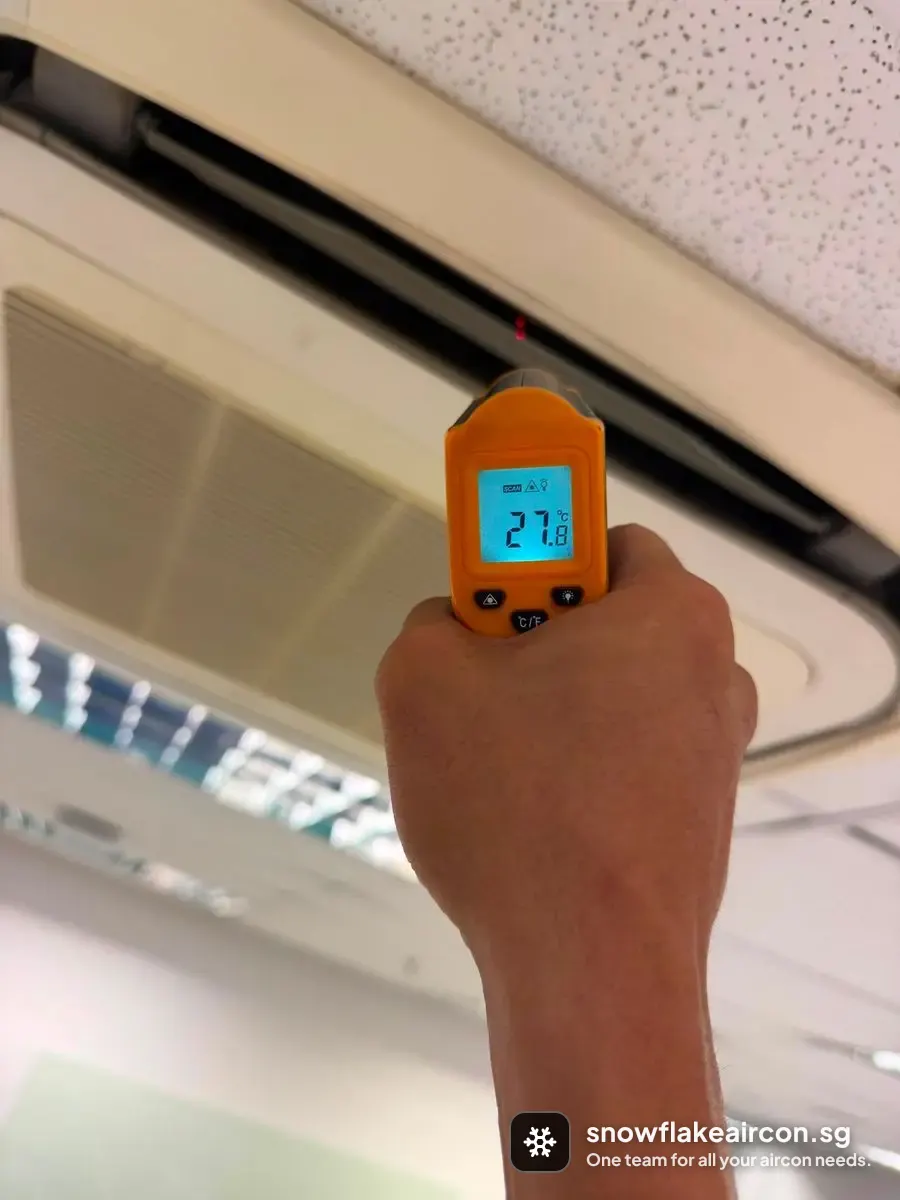
Daikin · Cassette
Cassette not cooling: stuck gas-flow valve, not compressor
A flow-control valve stuck part-closed, restricting refrigerant to the indoor coil
Common Questions
When should Singapore homeowners book servicing ahead of the March and April heat?
Why does an aircon cool well at midnight yet blow lukewarm air at 2 pm in April?
Can residents hose down a dusty outdoor condenser from a kitchen service yard?
Which thermostat setting prevents overloaded compressors from tripping on hot afternoons?
Sources
Sources checked 27 Nov 2026