On this page
Quick summary
Hold the Panasonic handset CHECK pinhole for 5 seconds until two dashes appear, then cycle timer keys until one unbroken tone locks the stored H or F fault code. H00 confirms clean memory, while H11, H21, H99, F91, or F96 warrant metered inspection.
Use the Panasonic CHECK Pinhole Without Clearing Fault Logs
Keep bedroom wall switches powered before starting. Killing mains power deletes stored diagnostic records on older CS circuit boards. Fit fresh AAA batteries inside the genuine Panasonic handset first, since aftermarket controllers omit service-scan firmware.
Stand below the indoor unit on the floor and push a paperclip tip into the tiny CHECK hole. Hold it steady for roughly five seconds until double dashes flash on the LCD. Point straight at the receiver window and tap the timer arrow slowly.
Short chirps mean that step is clear. Stop once an unbroken multi-second beep sounds while green and orange lamps blink together. Hold CHECK again to exit. Never use the AC RESET pinhole hoping to clear compressor trips.
Compare Panasonic H11 to F96 Codes in Pass or Fail Results
Match the code locked by the long beep against official Panasonic diagnostic groups across HDB and condo systems:
Scroll to see more columns
| Locked code and chime | Check verdict | Verified Panasonic subsystem | Appropriate Singapore step |
|---|---|---|---|
| H00 or short pips only | Pass (memory clear) | No fault stored; weak chill points to dust or settings | Rinse mesh screens, dry in shade, and re-test |
| H11 on continuous beep | Fail (stop DIY) | Indoor-to-outdoor abnormal communication path | Switch unit off by remote; book wiring and PCB check |
| H14 or H21 locked | Fail (stop DIY) | Intake sensor (H14) or indoor float switch (H21) | Halt unit immediately on H21 to avoid ceiling drips |
| H98 or H99 locked | Fail (stop DIY) | High-pressure protection (H98) or coil freeze protection (H99) | Turn off to thaw frost; check airflow and charge |
| F91 or F96 locked | Fail (stop DIY) | Refrigerant cycle fault (F91) or power transistor overheat (F96) | Leave isolator alone; schedule metered outdoor testing |
Obey Singapore EMA and MOM Ledge Safety Limits
Stop all home checks once the LCD locks onto H11, H21, H98, H99, F91, or F96. MOM and BCA circulars bar residents from stepping onto HDB aircon ledges. Never stretch past yard grilles to peer at outdoor CU fans.
EMA safety rules also forbid opening 230V terminal lids, indoor control boxes, or wall isolator housings. Stored capacitor voltage inside inverter boards stays hazardous even after handset shutdown.
Decide Between Servicing and a Panasonic Diagnostic Check
Match your scan result to Snowflake Aircon Services rates so clean coils get simple care while active breakdowns receive proper testing:
- Locked H or F alerts need metered diagnosis. Snowflake bills S$30 per diagnostic visit and waives that charge upon repair.
- Clear H00 logs with dusty mesh suit routine cleaning: single rooms run S$50, twin bookings drop to S$30 per blower, and 3+ room bookings drop to S$25 per blower (14-day warranty).
- Sour odours on H00-clear coils need chemical servicing: S$80 for 1 coil, S$70 apiece for 2 coils, or S$60 apiece for 3+ coils, carrying a 60-day warranty.
- Sludged wheels causing H99 icing call for chemical overhauls: S$150 on 1 fan-coil, S$125 each on 2 fan-coils, or S$115 each on 3+ fan-coils, carrying a 90-day warranty.
Diagnostic Cases for This Fault
Singapore jobs showing what we checked on-site before quoting parts or gas.
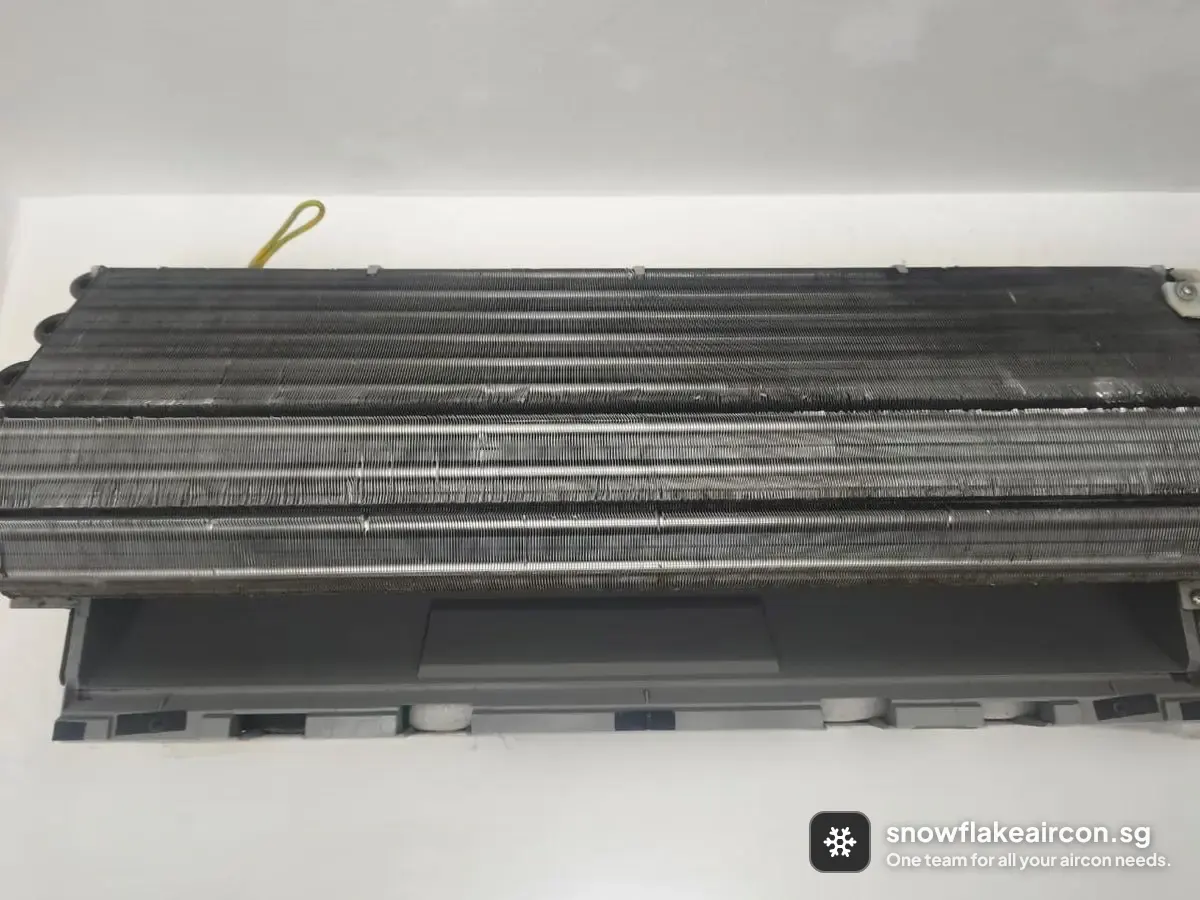
Jurong West HDB · Panasonic
Panasonic Weak Breeze and Warm Room: Grimy Coil Overhaul
Dense household grease and lint wedged deep inside the aluminium evaporator fin banks and blower blades, choking room airflow while the refrigerant charge stays full
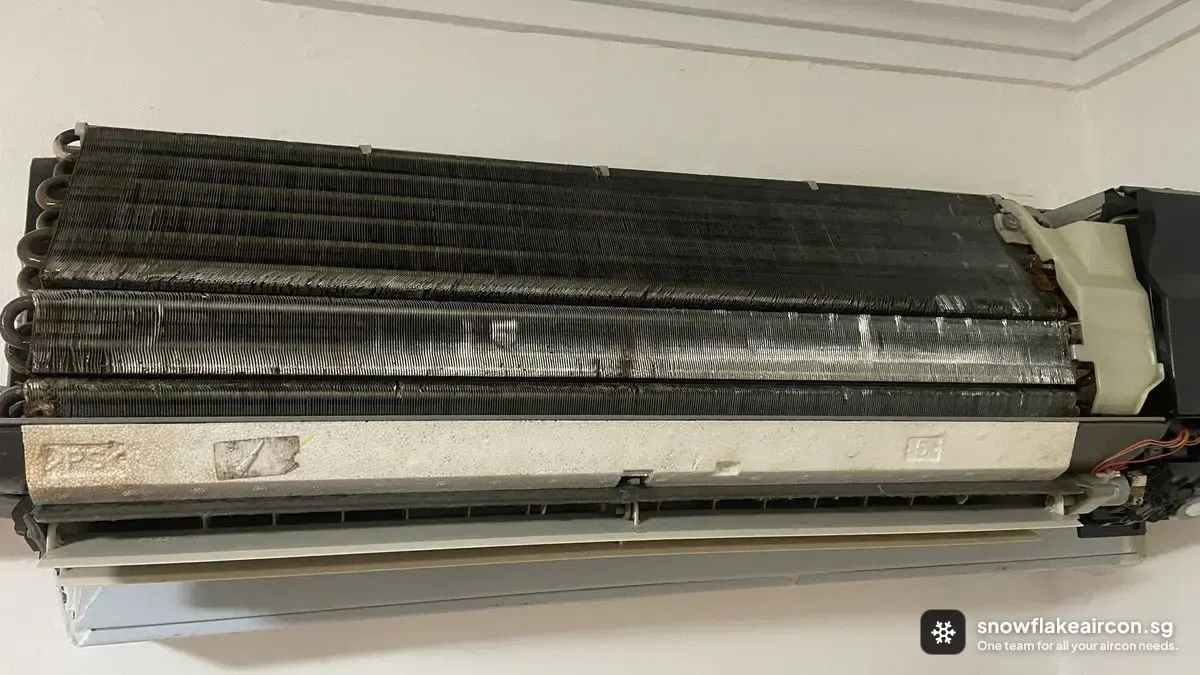
Sengkang HDB · Panasonic
Sengkang HDB Weak Airflow: Lint Packed Inside Coil Fins
Compacted grey lint sealed deep between the aluminium evaporator fins where routine mesh filter rinsing cannot clear it
Check Your Diagnostic or Servicing Price
Tap your job, unit count, and home type for our published Singapore rate — then send the pre-filled message on WhatsApp.
Published Singapore estimate
$30 / visit on-site diagnostic check
Technician tests cooling output, sensors, PCB, fan motor and pressure — fee is waived if you proceed with the quoted repair.
30-day workmanship warranty on confirmed repairs. VRV commercial checks are $80 / visit.