On this page
Quick summary
Steady inverter cooling at 24 degrees across an eight-hour Singapore night uses roughly 2.9 to 3.6 kWh, saving 25 to 35 percent over repeated on-off compressor restarts. At SP Group late-2026 31.16 cents per kWh, continuous part-load running trims monthly bedroom power bills.
System 2 installed from $2,600 (22 SWG copper) · $30 site survey waived on install · View packages
How Inverter Modulation Cuts Surge Draw in Bedrooms
Every fresh startup forces a bedroom inverter near maximum compressor speed to pull down heat and moisture. During those opening twenty to thirty minutes, typical 9,000 BTU bedroom splits draw roughly 0.9 to 1.1 kW.
Once indoor air stabilizes near 24 degrees, variable-speed drives throttle back to quiet 0.25 to 0.40 kW maintenance draw. Toggling the remote off lets concrete HDB walls radiate heat inward, triggering another costly pull-down surge upon restart.
Compare Steady 24 Degrees vs Cycling On-Off Electricity Bills
Billed at 31.16 cents per kWh including GST under the late-2026 SP Group domestic rate, overnight bedroom operating patterns show clear gaps:
Scroll to see more columns
| Nightly bedroom mode | Compressor load behaviour | Estimated 8-hour energy use | 30-night bill at 31.16 cents |
|---|---|---|---|
| Steady 24 degrees inverter | One startup then low modulation | 2.9 to 3.6 kWh per night | S$27 to S$34 monthly |
| Steady 25 degrees with wall fan | Shorter pull-down; deeper cruise | 2.3 to 2.9 kWh per night | S$22 to S$27 monthly |
| Three manual on-off restarts | Repeated full-amp heat pull-downs | 4.4 to 5.2 kWh per night | S$41 to S$49 monthly |
| Dirty coil forcing short cycles | Iced or choked high-head running | 4.8 to 6.0 kWh per night | S$45 to S$56 monthly |
Why Dirty Coils Force Healthy Inverters to Cycle
Dust-matted blower blades and choked outdoor fins trap heat inside the refrigeration loop, blocking smooth low-speed cruising. Even an efficient 5-tick unit then behaves like a noisy fixed-speed compressor cycling hard all night.
Turning power off saves money only when nobody occupies the bedroom for two hours or longer. Shutting bedroom doors tight and selecting 25 degrees overnight cuts kWh without sticky humidity.
Always confirm filter cleanliness indoors at floor level before blaming your meter. Clean heat transfer allows rapid pull-down followed by stable low-amp sleep cruising. Keep outdoor condenser ledges free of laundry racks so exhaust air escapes freely.
Decide Your Overnight Setpoint and Servicing Plan
Lower monthly SP Group bills by pairing steady sleep settings with clean indoor and outdoor coils:
- Keep occupied bedrooms gliding smoothly at 24 or 25 degrees on quiet fan speed instead of waking up to toggle power.
- Clear light dust buildup via quarterly servicing. Booking one room is S$50, two rooms total S$60, and three-plus rooms average S$25 per head (14-day warranty).
- Remove thick coil grease restricting efficiency with chemical cleaning at S$80 solo, S$70 each on dual systems, or S$60 per unit on three-plus systems (60-day cover).
- Deeply fouled fan drums need strip-down overhauls at S$150 for one room, S$250 for two rooms, or S$115 per room across three-plus rooms (90-day cover).
- Schedule a S$30 clamp-meter check, waived when repairs proceed, if bills jump unexpectedly. HDB upgrades to 5-tick splits also tap S$400 vouchers through December 2027.
Diagnostic Cases for This Fault
Singapore jobs showing what we checked on-site before quoting parts or gas.
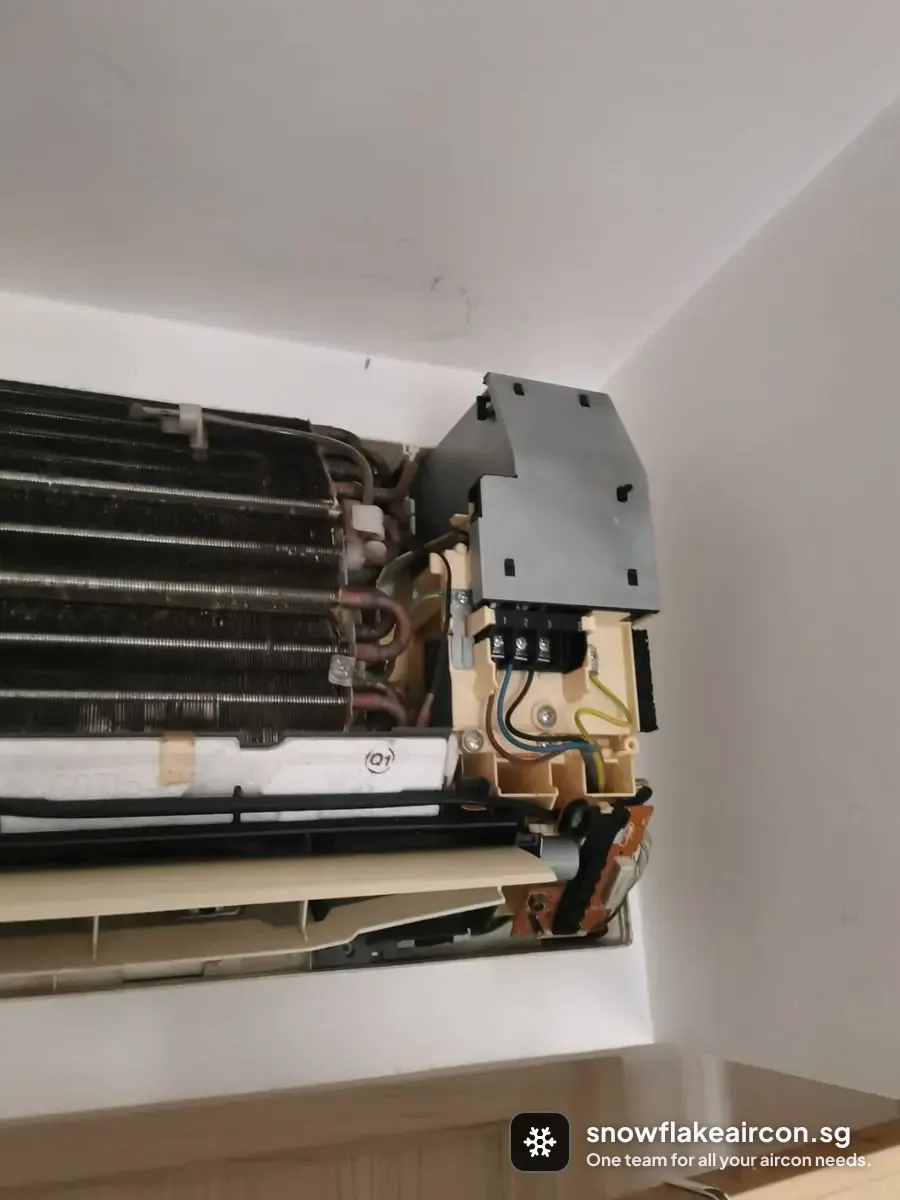
Samsung · Wall-mounted
Outdoor unit running with no indoor air: burnt fan motor
An indoor fan motor failed internally, with correct supply reaching its terminals
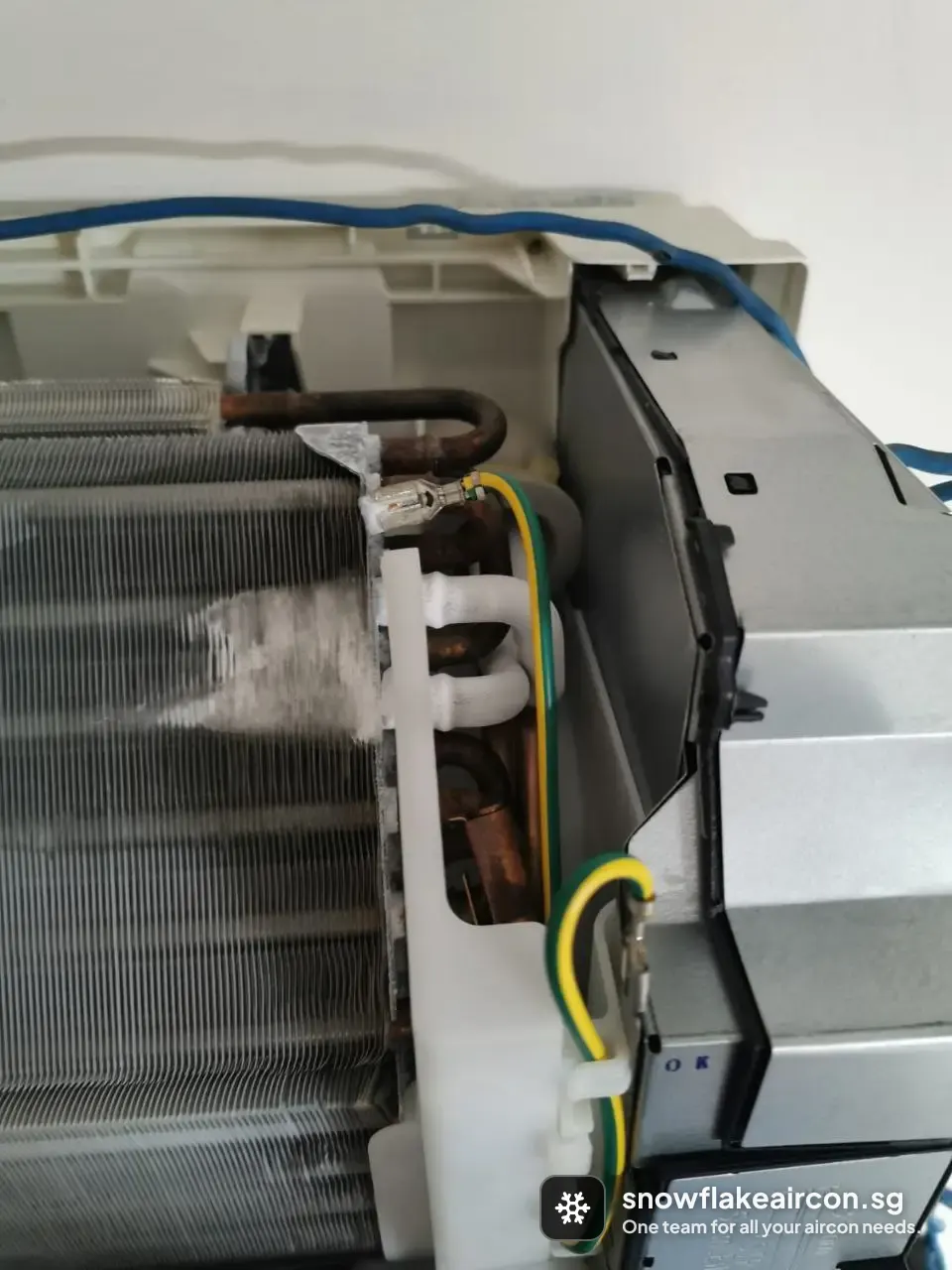
Wall-mounted
Ice forming on the copper pipe: airflow blocked, not gas
Airflow restriction from blower wheel and coil buildup, freezing the coil
Common Questions
Is leaving an inverter aircon on 24 hours cheaper than turning it off during work?
How much does one degree higher at 25 degrees save at 31.16 cents per kWh?
Why does my inverter aircon still cycle on and off like an old unit?
Can NEA Climate Vouchers reduce electricity costs when replacing an old non-inverter?
Sources
Sources checked 27 Nov 2026