On this page
Quick summary
Chemical overhauls strip thick biofilm from evaporator fins and blower drums, letting inverter compressors cool bedrooms faster and throttle down early. Tracking 14-day SP Group smart-meter kWh logs alongside probe temperature drops before and after dismantling quantifies annual electricity savings reliably.
Wall-mounted general servicing $25–$50/unit · chemical wash $60–$80/unit · View servicing rates
Why Slimy Evaporator Coils Erase Inverter Efficiency Gains
Dust restricts airflow, while damp bedroom humidity turns lint into thick biofilm inside rear fin rows. Once air speed stalls, rooms warm up.
Instead of cruising gently at part-load wattage, your outdoor compressor runs hard until sunrise. Neglected multi-splits routinely lose 15 to 25 percent efficiency.
Compare Before-and-After Metrics Around a Chemical Overhaul
Log these four simple benchmarks across two weeks pre-clean and two weeks post-clean:
Scroll to see more columns
| Tracked parameter | Fouled coil baseline | Post-overhaul recovery | Verification tool |
|---|---|---|---|
| Intake-to-outlet delta-T | Sluggish 4 to 6 degree spread | Crisp 8 to 12 degree cooling drop | Digital thermometer at 5 cm |
| Blower throw velocity | Weak noisy surge near louvres | Even quiet reach across bed | Same fan notch comparison |
| Overnight SP kWh profile | Flat high plateau past midnight | Sharp step-down after 45 minutes | SP Group half-hourly app chart |
| Annualised tariff savings | Inflated multi-room base load | Multiply daily drop by 365 days | Apply 31.16c/kWh GST-incl. rate |
Measure 14-Day SP Group kWh Under Identical Room Settings
Random bill comparisons mislead whenever weather or household schedules shift. Keep thermostats fixed at 25 degrees and hold fan speeds steady across both windows.
Inspect SP Group's half-hourly chart after midnight when other loads sleep. Multiply daily saved kWh by 365 nights and the Q4 regulated 31.16 cents/kWh tariff (GST included) for annual savings.
Decide When Chemical Overhaul Beats Surface Washing on Power Payback
Select the cleaning depth matching your coil condition so power drops justify service fees:
- Full dismantled overhaul strips blower wheels and back trays clean. Carrying 90-day workmanship assurance, overhauls run S$150 for 1 unit, S$125/unit across 2 units, or S$115/unit on 3+ units.
- Moderate odour without rear sludge clears via chemical washing with 60-day cover. Pricing stands at S$80 solo, S$70/unit for two, or S$60/unit when servicing three or more units.
- Quarterly maintenance protects clean coil airflow under 14-day warranty. One unit costs S$50, two units cost S$30/unit, and three or more cost S$25/unit.
- Stubborn kWh usage or weak delta-T post-overhaul needs a S$30 diagnostic visit (S$80 VRV), waived on repair, to rule out gas leaks or drifted thermistors.
Diagnostic Cases for This Fault
Singapore jobs showing what we checked on-site before quoting parts or gas.
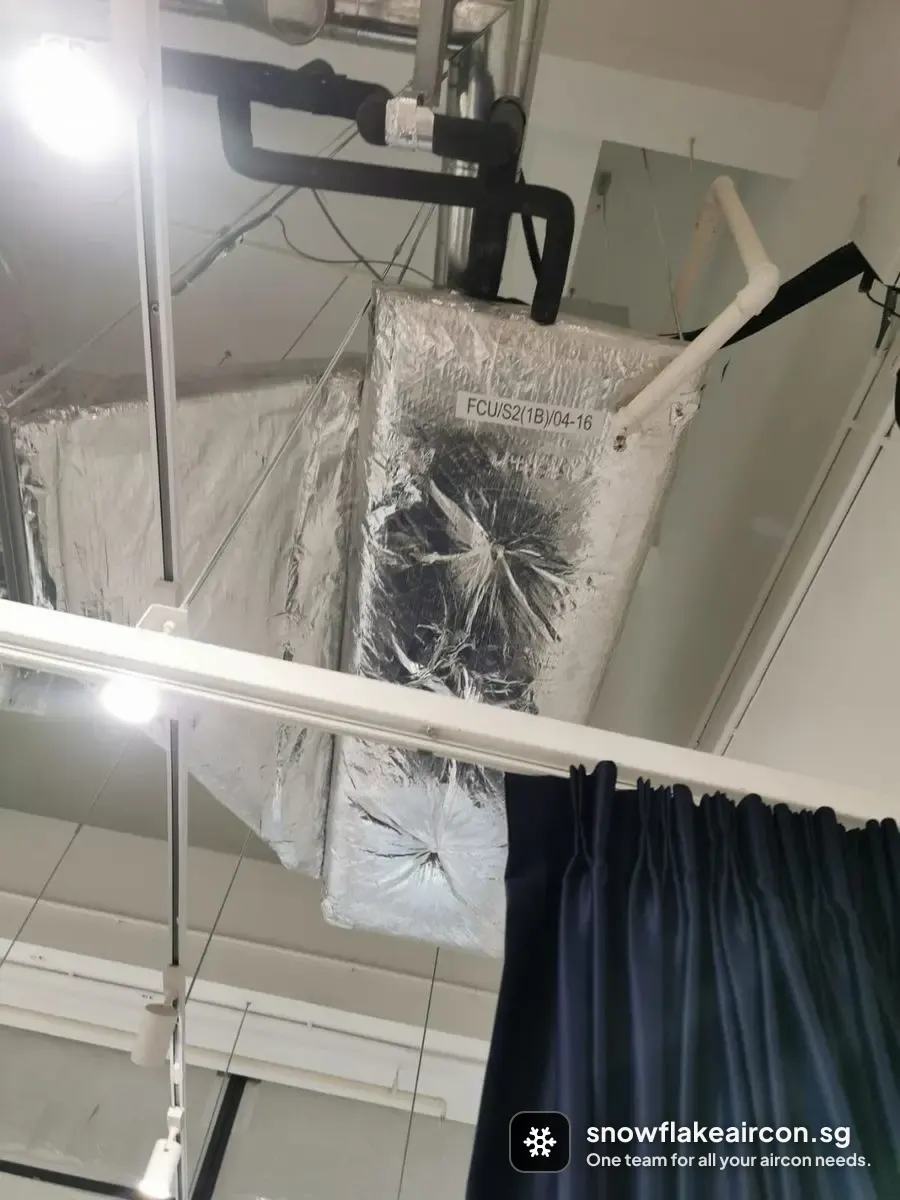
Carrier · Ducted
Shop ducted FCU losing airflow: lint-choked coil
Apparel textile lint compacted across the concealed ducted FCU coil face and blower blades
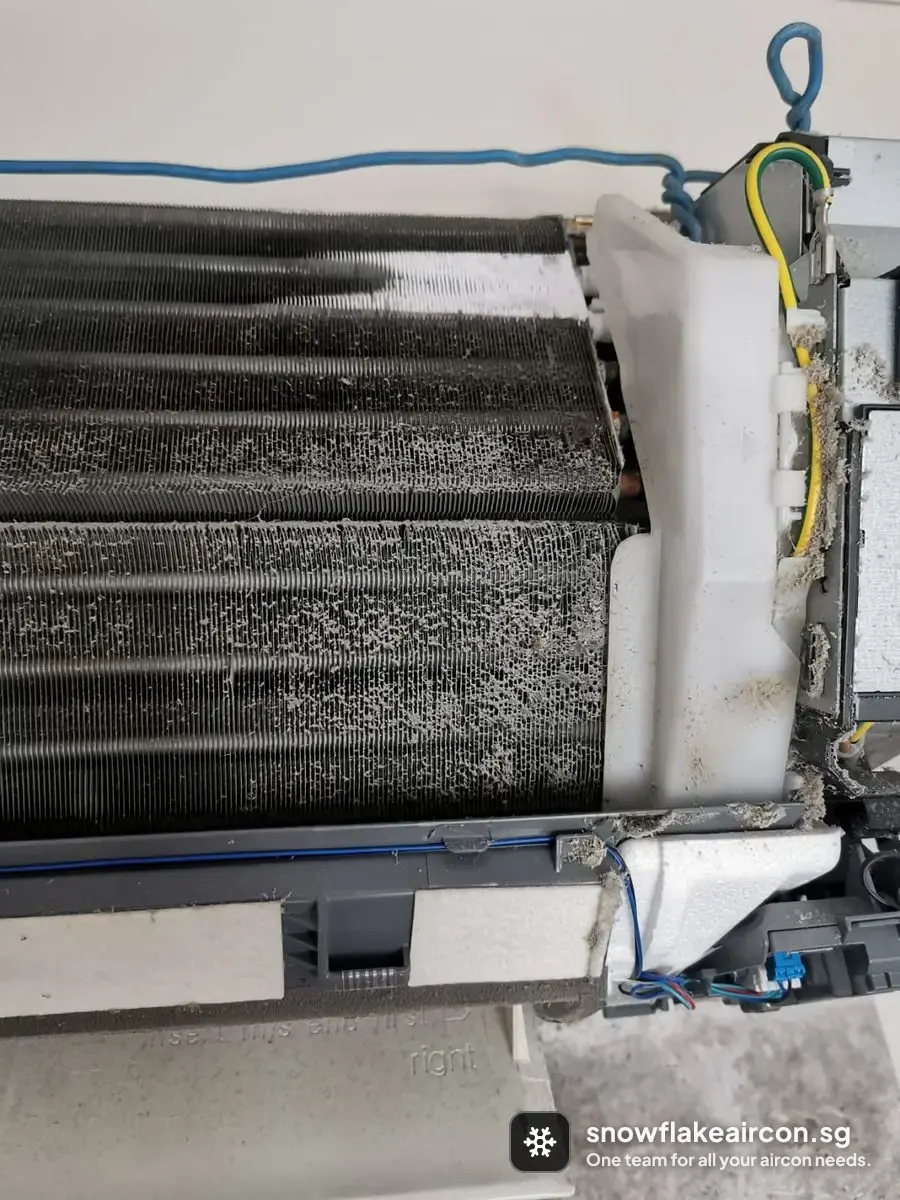
Mitsubishi Heavy Industries · Wall-mounted
One room warm on a multi-split: coil buildup, not low gas
Coil and airflow restriction confined to the single affected indoor unit
Common Questions
How fast do electricity bills drop after an aircon chemical overhaul?
How much annual kWh can a badly choked multi-split waste in Singapore?
Should homeowners run an electricity tracking test with Auto fan or fixed speed?
What if kWh draw stays elevated right after a full chemical overhaul?
Sources
Sources checked 27 Nov 2026