On this page
Summary
Likely Causes
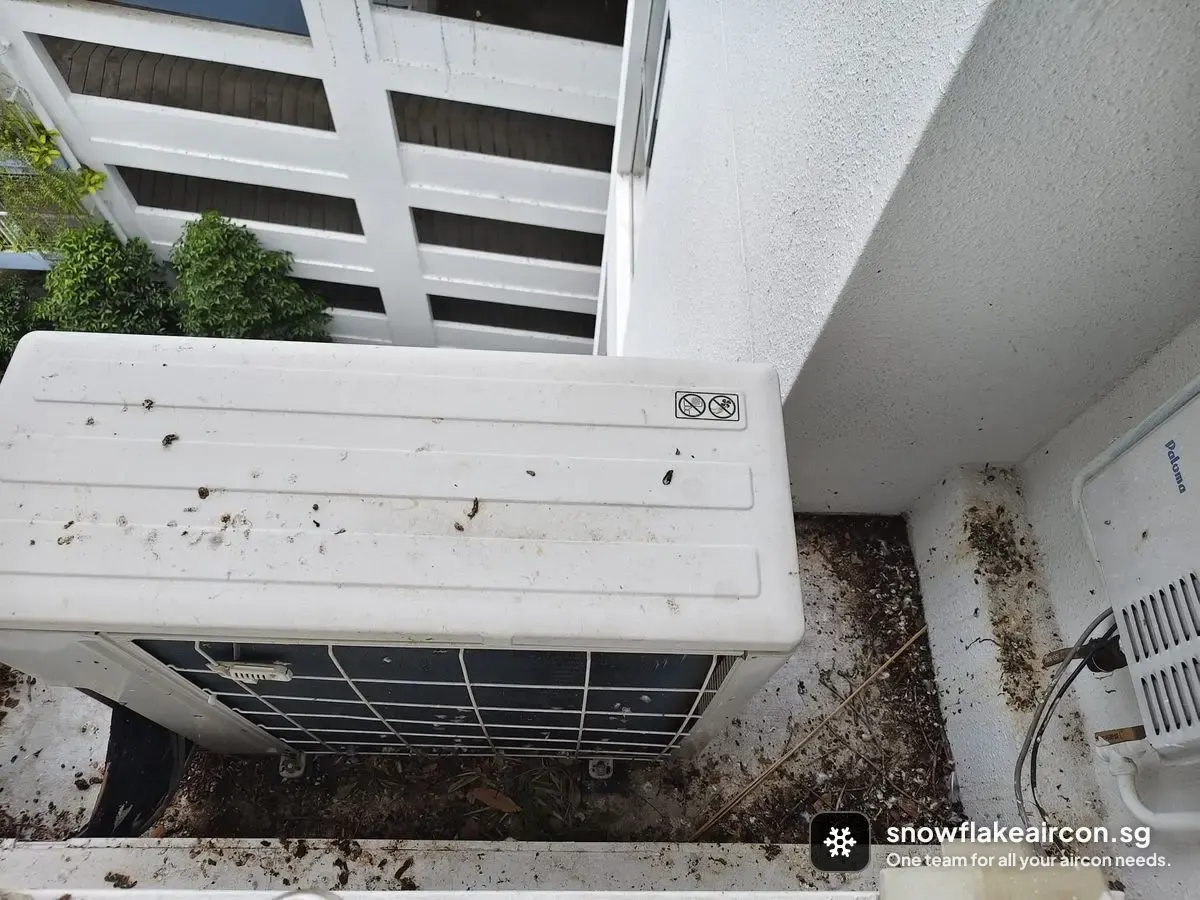
- Debris blown into the outdoor unit scrapes the fan guard.
- Wind flexing the unit closes the clearance around the fan blade.
- Loose brackets or pipe clips are driven by wind against the wall.
Quick Fault Summary
| Likely cause | What to check | Typical next step |
|---|---|---|
| Debris blown into the outdoor unit | The noise began right after a windy or stormy day. | A technician isolates the unit and clears the debris from the fan path and guard, then runs it to confirm the noise has gone and the blade is undamaged. |
| Fan clearance closes when the unit flexes | A steady metallic buzz that tracks the strength of the gusts. | A technician checks blade centring and guard clearance while the unit runs. |
| Mounting or pipework driven by the wind | The noise continues with the aircon switched off. | A technician checks every bracket fixing and pipe clip along the run. |
- Likely cause
- Debris blown into the outdoor unit
- What to check
- The noise began right after a windy or stormy day.
- Typical next step
- A technician isolates the unit and clears the debris from the fan path and guard, then runs it to confirm the noise has gone and the blade is undamaged.
- Likely cause
- Fan clearance closes when the unit flexes
- What to check
- A steady metallic buzz that tracks the strength of the gusts.
- Typical next step
- A technician checks blade centring and guard clearance while the unit runs.
- Likely cause
- Mounting or pipework driven by the wind
- What to check
- The noise continues with the aircon switched off.
- Typical next step
- A technician checks every bracket fixing and pipe clip along the run.
1. Debris Blown into the Outdoor Unit
Sharp scraping right after heavy rain or wind means dry leaves or corridor litter blew onto the HDB or condo ledge and pressed against the fan guard.
How to Tell
The fan must turn for this noise to happen, so it stops dead the moment the unit switches off. A loose scrape, not a steady metallic buzz, separates it from a closing blade clearance.
- The noise began right after a windy or stormy day.
- It is a sharp scrape or rattle, not a hum.
- It stops the moment the aircon is switched off.
- Leaves or litter are visible through the outdoor grille.
How We Confirm It
A technician isolates the unit and clears the debris from the fan path and guard, then runs it to confirm the noise has gone and the blade is undamaged.
A new fan motor does not remove an obstruction, so debris inside the guard needs checking before any motor replacement.
Related Cases
2. Fan Clearance Closes When the Unit Flexes
A steady metallic buzz that rises and falls with the gusts means the blade tip is brushing its guard. Wind flexes the unit or its support and closes the gap.
How to Tell
Blade-to-guard contact gives an even buzz rather than a loose scrape, and nothing is visible in the grille. It needs the fan spinning to appear.
- A steady metallic buzz that tracks the strength of the gusts.
- Nothing rattles when the wind drops, even with the unit running.
- It stops when the aircon is switched off.
- The unit sits high up, on a ledge, or somewhere exposed.
How We Confirm It
A technician checks blade centring and guard clearance while the unit runs. The alignment or the mounting that lets it flex is corrected, then retested so the clearance holds under load.
A blade touching its guard keeps wearing: repeated contact wears the blade edge and throws it out of balance, which turns a clearance problem into a fan replacement.
Related Cases
3. Mounting or Pipework Driven by the Wind
Rattling that continues with the aircon off comes from metalwork, not the fan. Exposed brackets, rusted wall anchors or loose trunking clips chatter when wind hits the ledge.
How to Tell
Nothing here depends on the aircon running. The noise carries on with the unit switched off, which is the single test that separates it from both fan-related paths. The source is the mounting or the pipe run rather than anything spinning.
- The noise continues with the aircon switched off.
- It seems to come from the wall or the pipe run, not the unit.
- Wind through an airwell or between blocks makes it worse.
- The bracket or pipe clips look rusted, or one edge stands proud of the wall.
How We Confirm It
A technician checks every bracket fixing and pipe clip along the run. Anything not sitting flush is packed out or refastened, and corroded fixings are replaced.
A corroded mounting bolt is a load-bearing fixing, not a rattle. If the bracket shifts or looks badly rusted, stop using the unit and keep clear until it is inspected.