On this page
Likely causes
- Drain water or pipe sweat runs over a rusty bracket and streaks the wall below.
- A bracket rusting through at its welds or wall bolts stops holding the unit safely.
- Salt air near the coast corrodes the outdoor casing, fins and pipe joints.
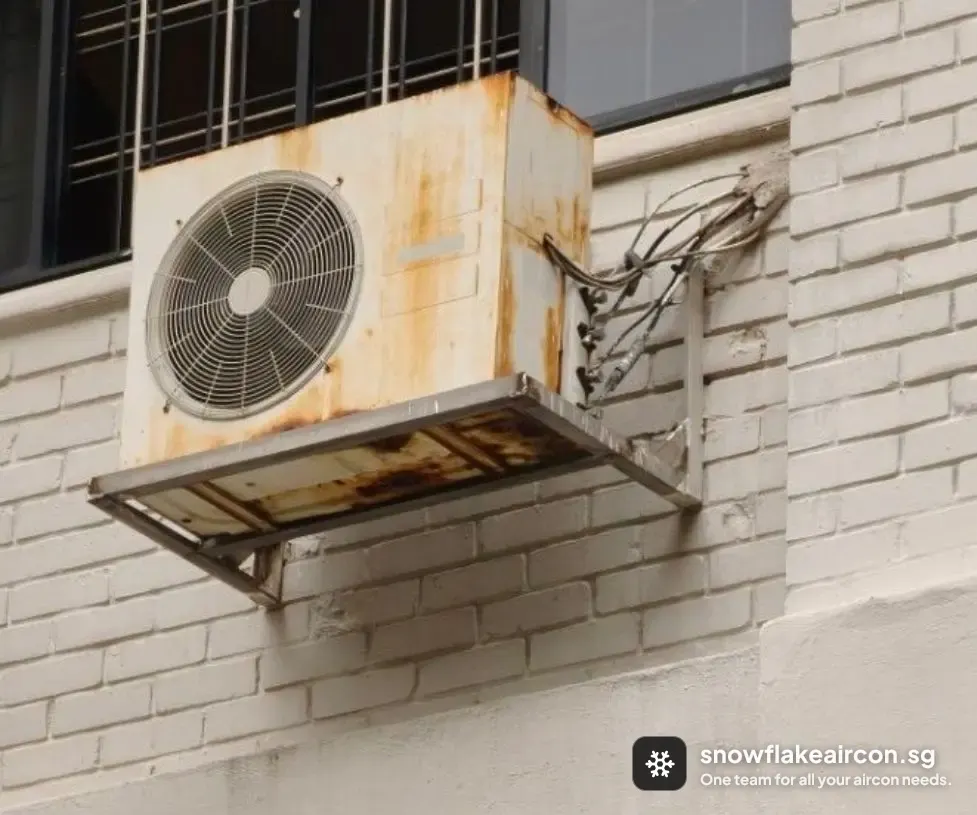
1. Water carrying rust down the wall
Water from a drain outlet or a sweating pipe drips onto the bracket or casing below. It picks up rust from screws, welds and painted steel, then runs down the wall. The stain grows only while that water keeps flowing.
How to tell
Water is the cause here, not a failing bracket. The stain is wet after a run, and the steel under the surface rust is still solid.
- The streak starts under a drain outlet, a pipe joint or the base of the outdoor unit.
- The wall is wet or darker after the aircon has been running.
- The bracket has surface rust, but its welds and bolts look intact.
How we confirm it
A technician finds the water source: a drain outlet aimed at the bracket, a sweating pipe or a gap in the insulation. The drain is rerouted or the insulation closed, and the stain stops growing.
Repainting the wall without stopping the water misses the source, and the streak comes back.
2. Bracket rusting through
A bracket rusts through at its welds, bolts and wall anchors first. Once the steel thins, the bracket bends or pulls out of the wall under the unit's weight. On a ledge or a high floor, that weight hangs over the space below.
How to tell
Flaking, not staining, marks this path. Steel coming away in layers, or a unit dropped on one side, is a failing support rather than surface rust.
- Rust flakes off in layers at the welds, bolt heads or where the bracket meets the wall.
- The outdoor unit sits lower on one side or rattles more at start-up.
- Cracks or crumbling plaster show around the wall anchors.
How we confirm it
A trained installer with safe ledge access checks the bracket arms, welds and wall anchors. A bracket that has lost steel is replaced with the unit supported, and the anchors are set in sound wall.
Do not lean out, climb onto the ledge or touch the bracket. Keep the aircon off and people clear of the space below until the support is checked.
Related cases
3. Salt-air corrosion on the outdoor unit
Salt in coastal air settles on the outdoor unit and holds moisture against the metal. The casing, base pan and screws rust, and the aluminium fins turn white and crumble. Corrosion at the pipe joints and valves eventually lets refrigerant escape.
How to tell
Spread is the tell. Rust across the whole casing and crumbling white fins point to salt air, instead of one wet streak.
- The home is near the sea or faces open water.
- Rust covers the casing panels and screws, with white powder on the coil fins.
- Cooling has weakened alongside the visible corrosion.
How we confirm it
A technician checks how far corrosion has spread across the fins, base pan and casing. The valves and pipe joints are leak-tested, and any leak is found and sealed before refrigerant goes in. A coil whose fins crumble is weighed for replacement rather than washed.
A gas top-up is not the fix for a corroded unit. A leak at a corroded joint keeps losing the new charge until it is sealed.