On this page
How This Presents
A bedroom split in a Clementi HDB flat cools normally for fifteen minutes, then drops to room-temperature fan mode even though the bedroom still reads 28°C. Switching off and restarting repeats the exact fifteen-minute cycle, making mainboard failure look certain.
- Setup
- Mitsubishi Electric Wall-mounted7-9 yearsHDBClementi
- Misread as
- Paying S$180 to S$320 for an indoor PCB replacement when a bedroom split shuts cooling down every fifteen minutes with no visible ice.
- Check first
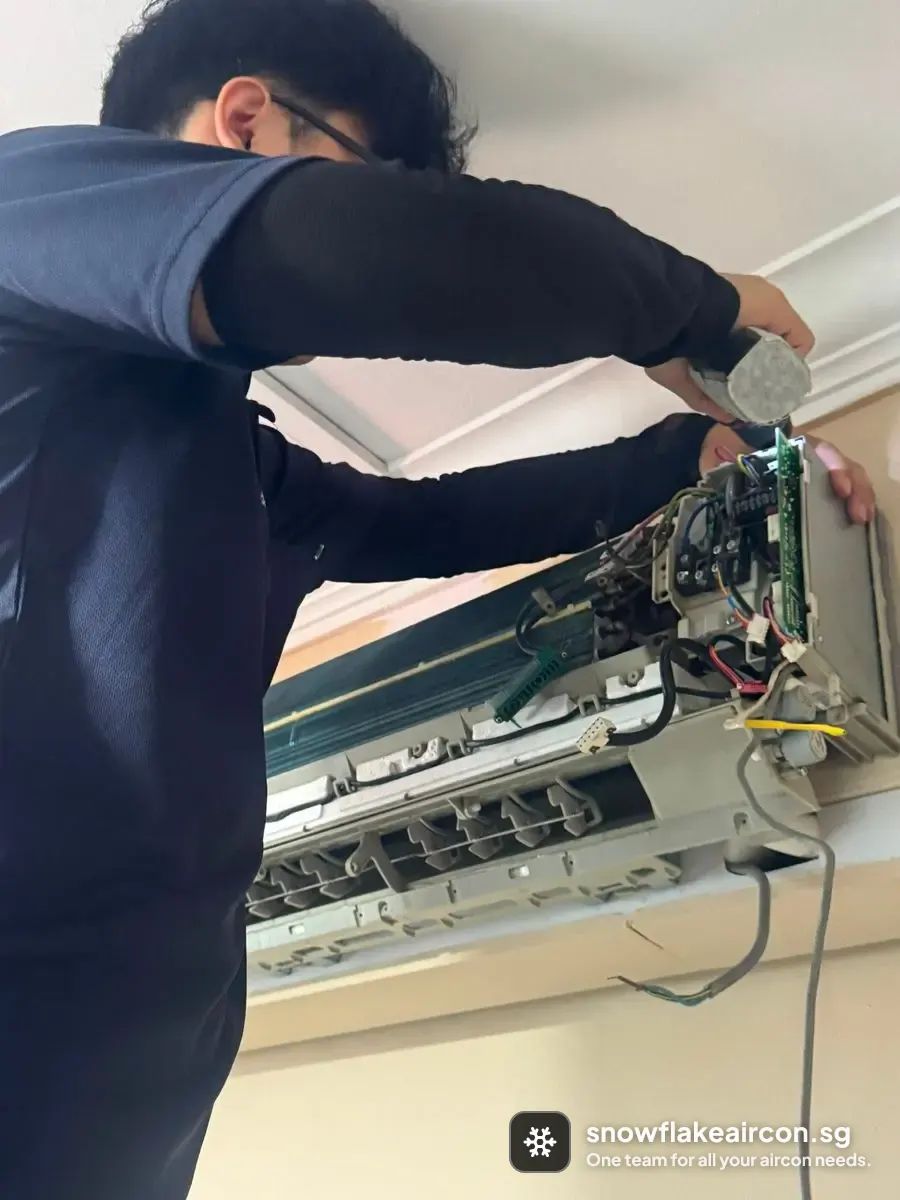
- Stripping the front casing to unplug and ohm-test the thermistor harness directly at the exposed indoor PCB header before condemning the board
- Actual finding
- Drifted indoor coil pipe thermistor feeding false near-freezing readings to the Starmex PCB, triggering premature cooling cutoffs at 28°C
- Scope saved
- Targeted repair instead of full replacement
What Else Produces This
Short, repeatable fifteen-minute cooling cutoffs without frost or airflow blockage point to false sensor feedback rather than board logic collapse. Measuring resistance at the PCB header separates the two cleanly.
Checking airflow, filter cleanliness, and coil surface confirms warm, dry fins with zero ice formation when cooling cuts out.
Isolating power and removing the casing exposes the right-hand indoor PCB with clean solder joints, sound capacitors, and dry connectors.
Unplugging the coil thermistor lead at the PCB header and testing resistance with a multimeter reveals a reading far off ambient spec.
Warming the sensor bulb gently by hand produces sluggish, erratic resistance movement instead of a smooth factory curve.
Why It Happens
Years of nightly condensation cycles inside a humid Clementi bedroom allow moisture creep around the sealed thermistor tip. Internal resistance drifts high, convincing the healthy Mitsubishi Electric control board that the evaporator coil is freezing over and forcing protective compressor cutoffs.
What Resolution Involves
Leave the undamaged indoor PCB installed. Slide the drifted Starmex probe out of its brass clip, lay the replacement cable back to the board header, seat the plug firmly, and clip the sensing bulb tight against clean copper.
How to Tell It Worked
Refit the front cover, restore isolator power, and test the Clementi room on 24°C cool mode for forty minutes. Cooling holds continuously past the fifteen-minute mark, bedroom temperature pulls down smoothly to setpoint, and the compressor cycles only when the room cools.
Before You Approve a Quote
Test the pipe sensor at the board plug before buying a new PCB
- A sound indoor control board will stop cooling early whenever a tired sensor falsely tells it the coil is about to freeze.
- Opening the front cover lets technicians check the sensor plug directly and prove whether the probe or the board is misreading.
- Swapping a drifted bedroom sensor costs less than a full board replacement and restores steady Singapore HDB overnight cooling.