On this page
Quick summary
Co-working phone booths and two-person meeting pods turn freezing and clammy when oversized office diffusers blast directly onto a single wall thermostat. Balancing supply dampers, relocating return-air sensors, and adjusting fan airflow restores dry comfort without sweating glass partitions or bothering callers.
Wall-mounted general servicing $25–$50/unit · chemical wash $60–$80/unit · View servicing rates
Why Small Meeting Booths Become Icy yet Humid
Two-person booths hold barely four to six cubic metres of air. Yet fit-outs often mount oversized ceiling diffusers or 9,000 BTU splits inside. Cold supply rebounds off acoustic foam and trips the thermostat prematurely.
Callers suffer chilly drafts alongside sweaty glass walls and humidity above 65 percent. Rapid short-cycling also wastes office electricity bills.
Compare Booth Balancing and Sensor Tuning Options
Pinpoint the exact airflow or thermostat mismatch before replacing functioning office aircon equipment:
Scroll to see more columns
| Booth issue | Underlying aircon fault | Corrective tuning step | Result for pod users |
|---|---|---|---|
| Direct neck draft | Excess diffuser airflow | Throttle branch volume damper | Gentle steady circulation |
| Clammy cold air | Short cycles miss latent drying | Lower fan, tune setpoint | Dry comfort without chills |
| Premature unit shutoff | Sensor sits in supply stream | Relocate probe to return side | Tracks true room heat load |
| Stale humid odour | Sealed booth plus fouled tray | Door undercut plus coil wash | Crisp scent across bookings |
Balance Supply Dampers and Relocate Booth Thermostats
Ducted pods off floor AHUs or VRV boxes stabilise once volume dampers throttle branch airflow. Angled slot diffusers keep cold streams off shoulders. On mini-split pods, moving wall sensors into return air prevents premature cut-offs.
Add door-sweep undercuts or quiet transfer vents to clear stale air smoothly. Trained technicians handle ceiling-void tuning safely under BCA rules.
Schedule Commercial Booth Assessments and Coil Upkeep
Tuning airflow alongside regular commercial coil hygiene lowers wasted kWh across busy co-working floors:
- Book a dedicated diagnostic survey for S$30 on split booths or S$80 on VRV offices, credited back on approved tuning (30-day warranty).
- Routine pod coil cleaning bills S$50 for a solo aircon, S$30 each on twin booths, or S$25 per booth across three-plus rows (14-day cover).
- Chemical tray flushing removes musty odours: one booth runs S$80, pairs bill S$140 combined, and three-plus banks drop to S$60 per booth (60-day cover).
- Full dismantled teardowns restore clogged pods for S$150 (1 unit), S$125 per pod (2 units), or S$115 per pod (3+ units) with 90-day cover. SMEs upgrading pods can check GoBusiness Energy Efficiency Grant support against Q4 tariffs.
Diagnostic Cases for This Fault
Singapore jobs showing what we checked on-site before quoting parts or gas.
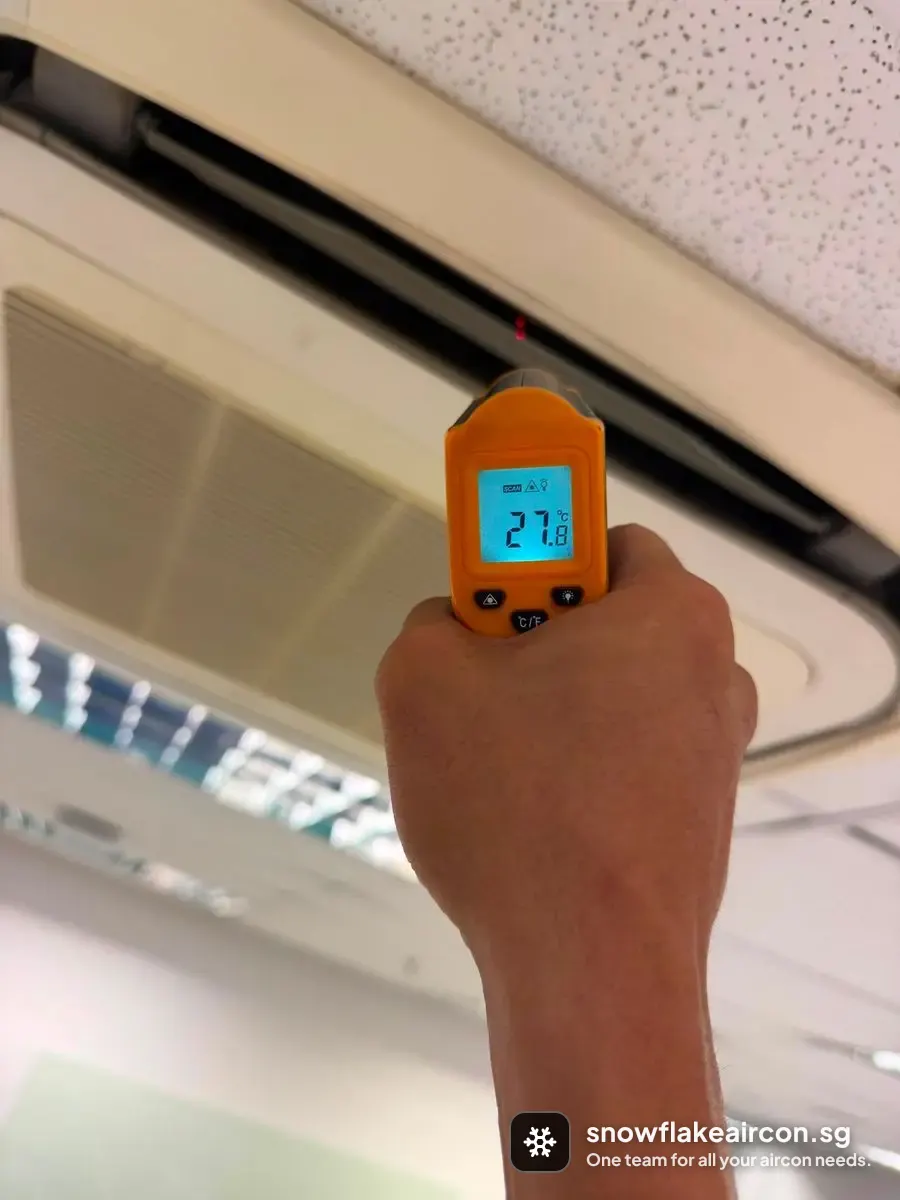
Daikin · Cassette
Cassette not cooling: stuck gas-flow valve, not compressor
A flow-control valve stuck part-closed, restricting refrigerant to the indoor coil
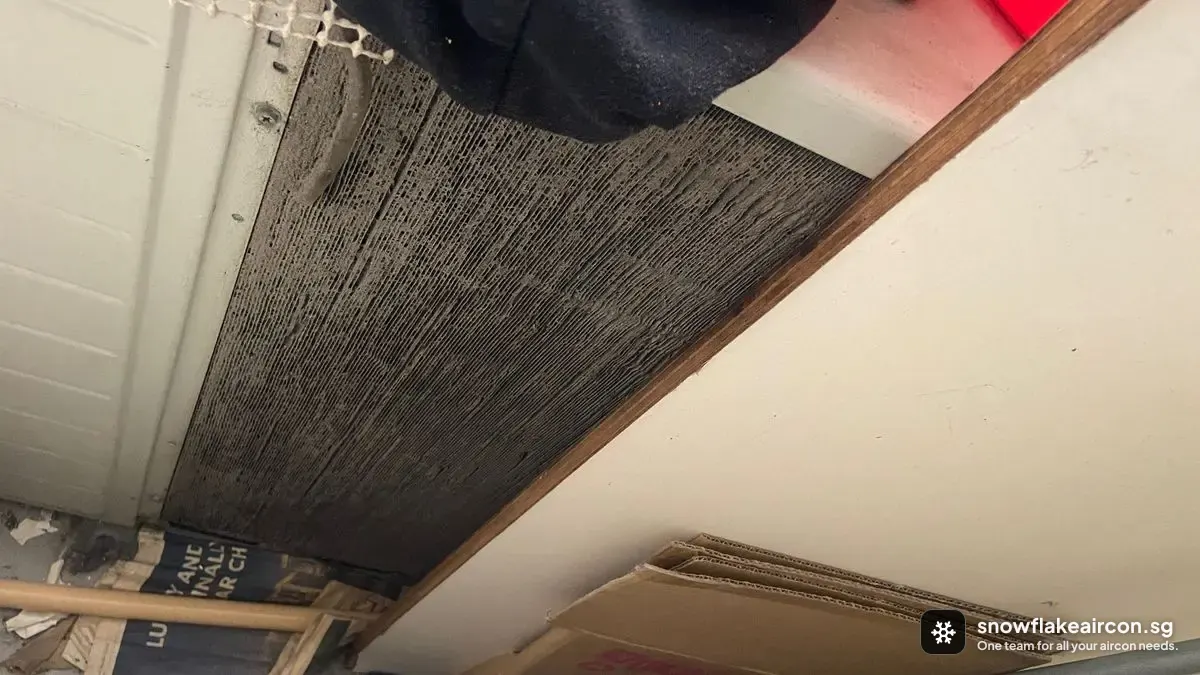
Midea · Cassette
Weak airflow over a kitchen line: grease-bound coil needs overhaul
Hardened cooking grease bound through the full fin depth and packed across the blower