On this page
Quick summary
Sanding skim coat and spraying primer fill flats with fine alkaline dust that slips straight through dry mesh filters onto coils. Switching cooling on turns powder into hard chalk crust inside fins and drain pans, so floor-level checks before startup prevent costly water leaks.
Wall-mounted general servicing $25–$50/unit · chemical wash $60–$80/unit · View servicing rates
Why Plaster Chalk Ruins Coils If Switched On Too Early
Sanding wall plaster and spraying primer release ultra-fine particles far smaller than household lint. Drywall sanding creates fine gypsum clouds that cling statically onto curved plastic louvres and return grilles. Coarse mesh filters catch loose fuzz while letting white cement dust settle directly onto evaporator aluminum.
Running cool mode right after contractor handover coats that dry dust with cold condensate water. Within days, damp plaster hardens into stubborn pale scale. That crust restricts airflow, corrodes metal fins, and chokes narrow drain outlets.
Follow EMA and HDB Floor-Level Safety Boundaries
Every homeowner check must stay safely at flat floor level on a firm indoor step-stool. Never open 230V wiring covers, probe circuit boards, or climb onto external HDB aircon ledges.
Switch off the dedicated wall aircon isolator before unlatching front plastic panels. Keep fingers away from delicate aluminum fins so sharp edges never slice skin or fold flat. Always confirm fan blades sit motionless before shining a torch upward through outlet vents. Any musty cement odour or stiff swing motor points straight toward contractor dust contamination.
Run a Pass or Fail Check Before Powering Cooling
Compare four safe visual checkpoints from indoor floor level before engaging cool mode. Record clear phone photos of grey fin patches before booking technician cleaning:
Scroll to see more columns
| Inspection zone | Floor-level check step | Pass result | Fail result and next step |
|---|---|---|---|
| Mesh pre-filters | Hold cleaned screen toward daylight | Dry loose grey lint rinses off clean | White chalk haze stays — halt startup |
| Intake aluminum fins | Shine torch gently past filter frame | Clean silver ribs with zero powder | Pale cement film — book S$30 diagnosis |
| Blower drum blades | Peer upward with wall isolator off | Smooth dark vane edges free of grit | Caked white ridges — stop motor run |
| Drain tray and pipe | Check tray lip and brief fan-only run | Dry casing lip, clean clear runoff | Milky water or drips — arrange technician |
Decide When Filter Rinsing Works or Deep Cleaning Is Needed
Let visual coil cleanliness settle whether plain washing suffices or technician intervention protects your unit:
- Passing all four checks means safe home upkeep works. Brush off loose dry grit, rinse screens in plain cool water, and shade-dry fully before refitting.
- Any fail sign on inner fins or blower blades warrants an immediate S$30 check (waived once cleaning starts). Leaving cool mode switched off avoids cementing lime dust inside drain lines.
- Caked cement or primer buildup calls for dismantled chemical overhauls backed by 90-day coverage. Expect S$150 for single units, S$125 per head on pairs, and S$115 per indoor blower when three-plus systems need deep stripping.
- Light coil dust without heavy fan caking clears via chemical servicing at S$80 single, S$70 per unit for two, or S$60 per unit on larger flats (60-day warranty; routine maintenance S$50/S$30/S$25, 14-day warranty).
Diagnostic Cases for This Fault
Singapore jobs showing what we checked on-site before quoting parts or gas.
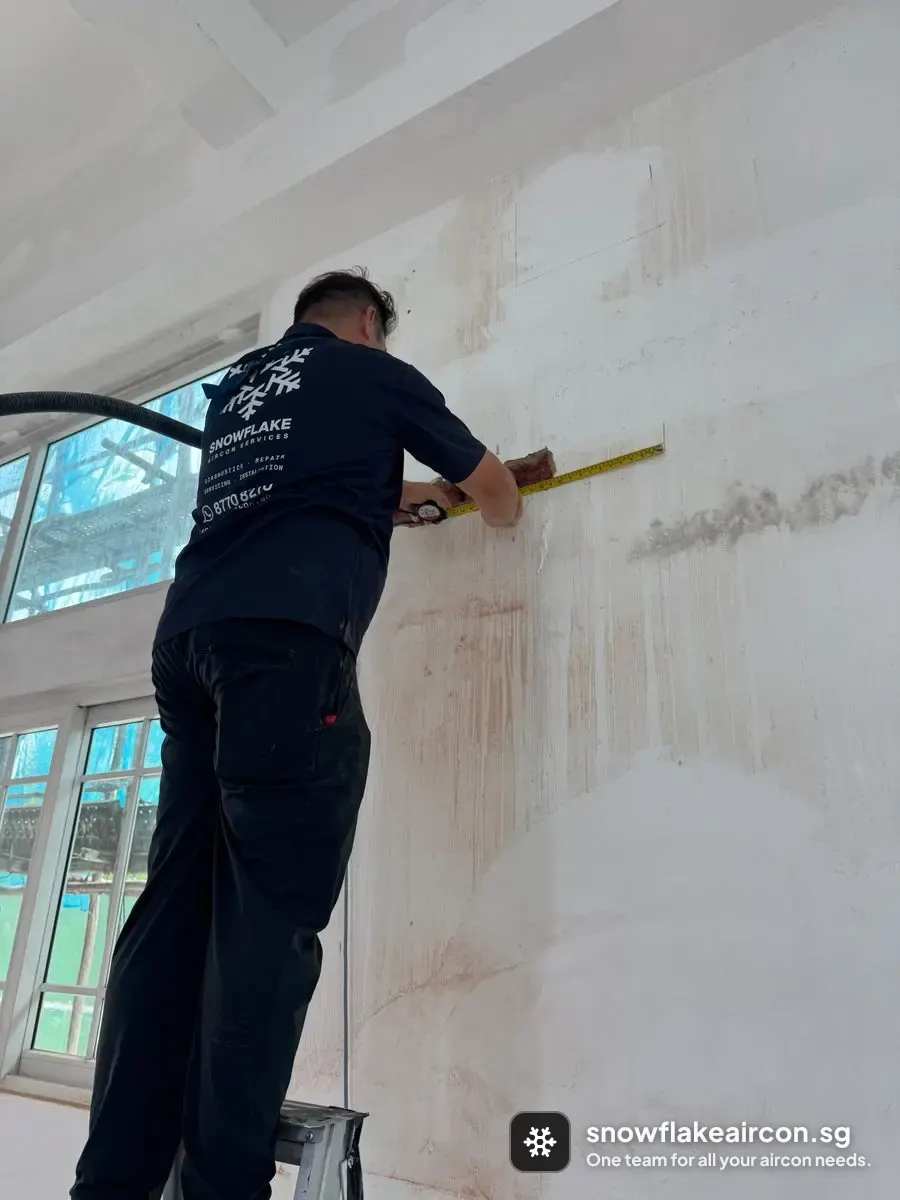
Daikin · Wall-mounted
Water stain down the wall: blocked rear drain trough
Biofilm jelly choking the hidden rear auxiliary drain trough behind the evaporator coil, spilling condensate down the plastered wall while the main trunking pipe stayed intact
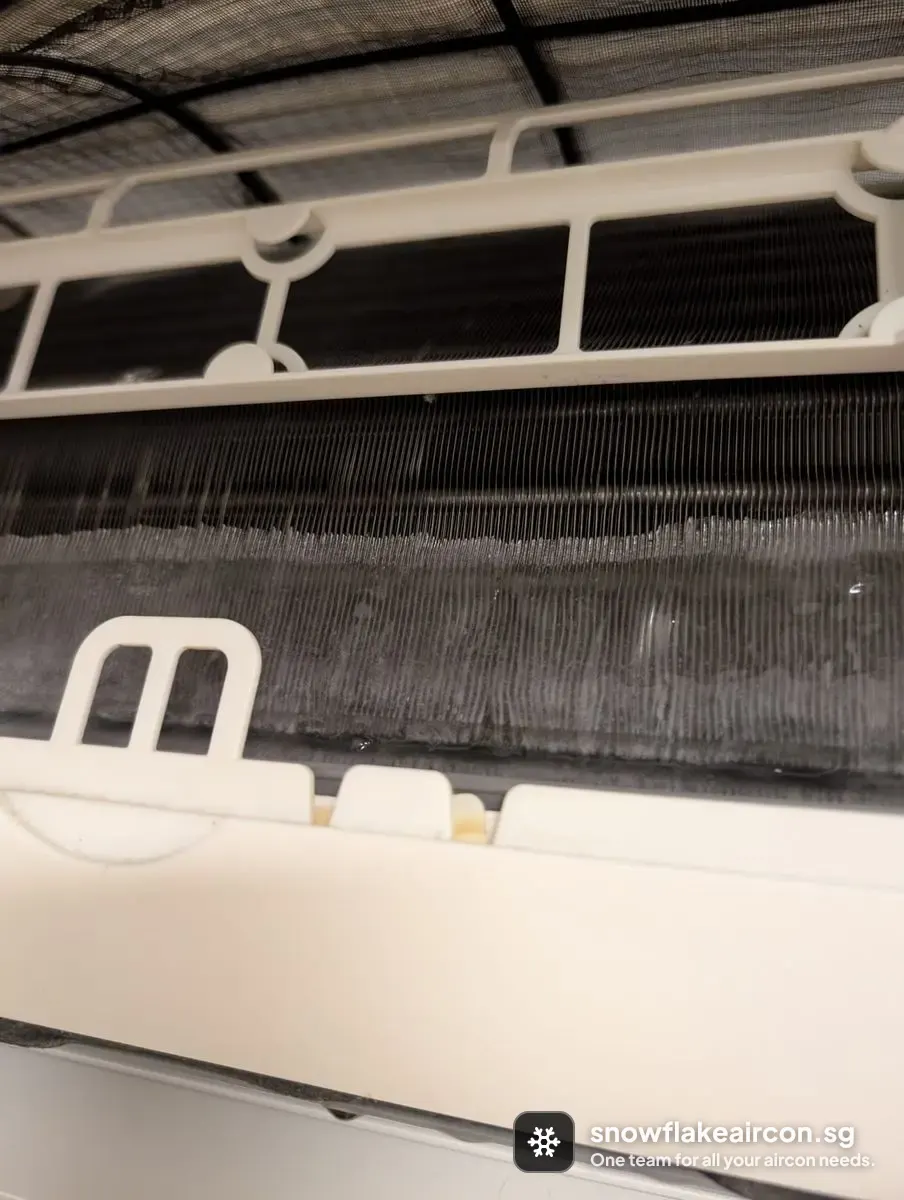
Mitsubishi Electric · Wall-mounted
Musty smell on start-up: on-wall wash, not overhaul
Biofilm across the lower evaporator fins and the drain pan, all within reach of an on-wall wash
Common Questions
Why can simple water rinsing fail to remove renovation dust from aircon filters?
What happens if contractors run a new aircon while painting or sanding walls?
Is it safe for homeowners to unscrew indoor casings to scrub dusty coils?
Should newly renovated flats book general servicing or a chemical overhaul?
Sources
Sources checked 27 Nov 2026