On this page
Quick summary
Clammy bedroom air often feels warm in Singapore even when an inverter still cools properly. Measuring room relative humidity (RH) and indoor intake-to-vent temperature drops at floor level separates moisture buildup from true compressor faults before paying for gas refills.
System 2 installed from $2,600 (22 SWG copper) · $30 site survey waived on install · View packages
Separate High Bedroom Humidity from Lost Cooling Capacity
Singapore bedrooms sit near 80 percent outdoor humidity most evenings. High fan speed or fan-only mode blows moisture back off wet evaporator fins before condensate drains away.
True refrigerant leaks or dead outdoor compressors behave very differently. Supply air leaves near room temperature while indoor relative humidity climbs steadily past fifteen minutes of cooling.
Run the Four-Step Pass and Fail Check at Floor Level
Run cool mode at 24 degrees on low fan speed for fifteen minutes with windows closed. Check each indoor reading below before requesting a gas refill:
Scroll to see more columns
| Indoor test step | Pass reading | Fail symptom | Next floor-level step |
|---|---|---|---|
| Intake to vent temperature | 8 to 12 degree air drop | Under 5 degree difference | Book S$30 diagnostic check |
| Tabletop hygrometer RH | Drops below 60 percent | Stays above 72 percent | Verify cool mode; check filters |
| Mesh filter airflow | Clean screen and steady breeze | Matted lint or weak gust | Rinse mesh screen gently |
| Bathroom floor-trap drain | Slow steady water drip | Bone dry pipe or gurgling | Schedule S$30 fault inspection |
Respect HDB, MOM, and EMA Boundaries on Indoor Checks
Stand strictly on flat indoor flooring during every inspection step. Residents must avoid stepping onto stools beside open windows or climbing onto exterior aircon ledges under MOM and BCA rules.
Keep every 230V junction box, condenser panel, and indoor circuit board sealed under EMA electrical safety guidelines. Limit hands-on checks strictly to rinsing nylon filters and checking floor-trap drips.
Book a Diagnostic Check or Coil Clean Once Airflow Fails
Match your self-check results to Snowflake Aircon Services flat rates instead of guessing at spare parts:
- Readings below 5 degrees warrant a S$30 diagnostic check. Snowflake waives that fee on approved repairs and includes 30-day repair cover.
- Dust-choked blowers puffing damp odours clear up via general servicing. Pricing stays at S$50 solo, S$30 each for pairs, or S$25 across three-plus units with 14-day warranty.
- Biofilm coating evaporator fins needs chemical servicing to strip trapped moisture. One unit costs S$80, two units run S$70 each, and three-plus run S$60 each with 60-day cover.
- Frozen coils or jelly-blocked pans demand a dismantled chemical overhaul. Rates sit at S$150 single, S$125 per twin unit, or S$115 for three-plus blowers carrying 90-day coverage.
Diagnostic Cases for This Fault
Singapore jobs showing what we checked on-site before quoting parts or gas.
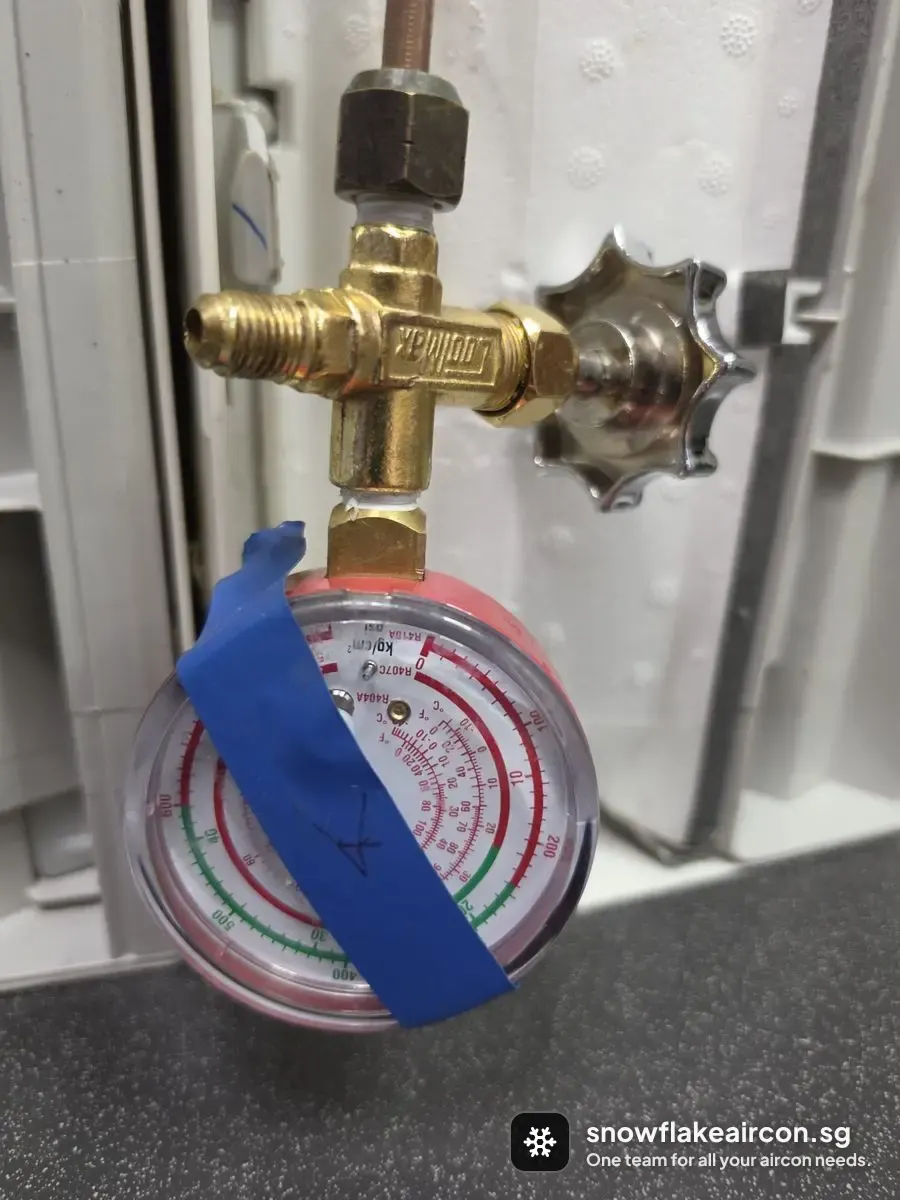
Panasonic · Wall-mounted
Warm air after gas top-up: leaking Schrader valve core
Weeping Schrader valve core behind a finger-loose outdoor brass flare cap slowly venting R32 charge over six months while the concealed copper pipe run stays intact
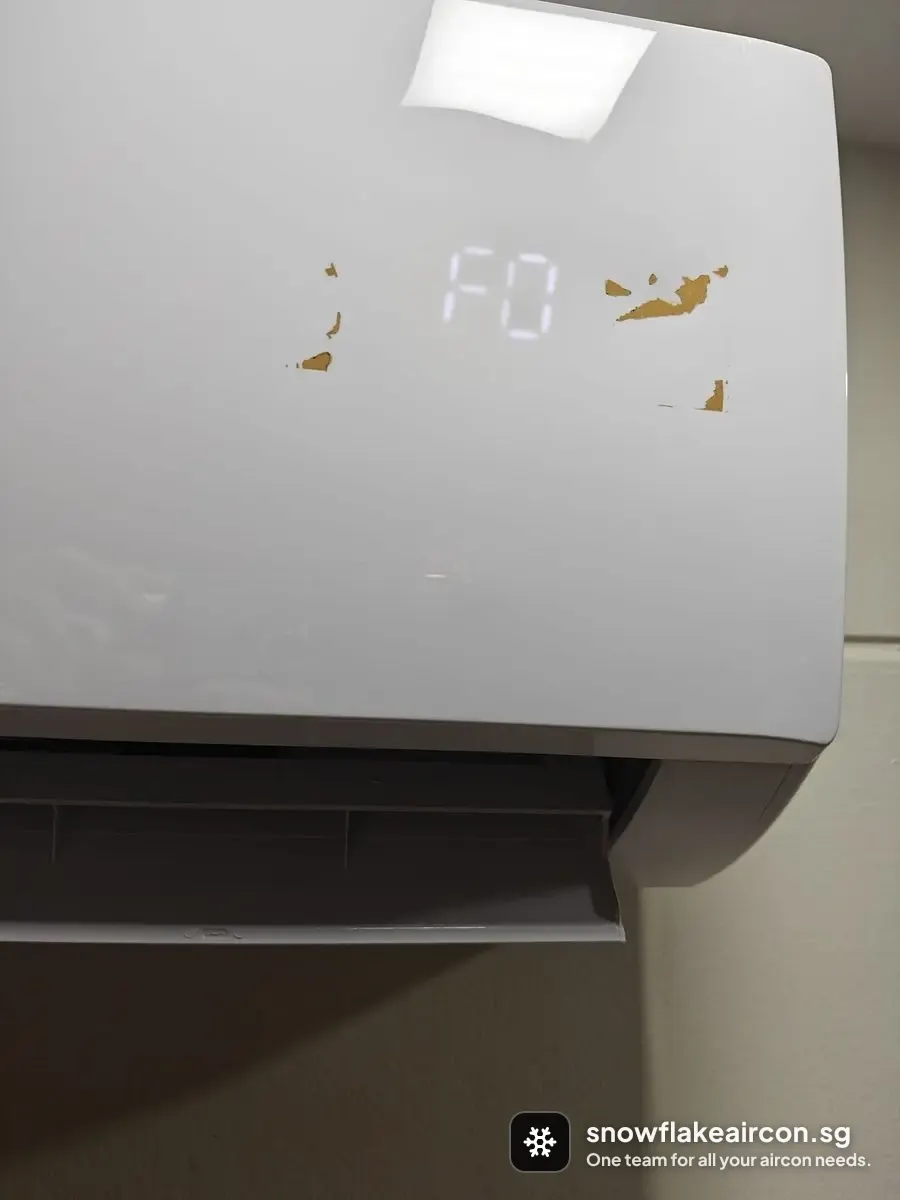
Gree · Wall-mounted
Gree F0 on a rusted condenser: refrigerant shortage
R32 refrigerant shortage triggering Gree F0 protection from corroded evaporator return bends
Common Questions
Why does my bedroom aircon feel damp at 25 degrees even though the vent blows cold?
Does clammy bedroom air always mean my Singapore aircon needs an R32 gas top-up?
How long should a wall unit run before reading an indoor hygrometer and outlet thermometer?
Which parts of an aircon self-check are unsafe for Singapore homeowners to touch?
Sources
Sources checked 27 Nov 2026