On this page
Quick summary
Timing a 10-minute bedroom cool-down from 28 degrees to 24 degrees on high fan shows if weak night cooling comes from clogged filters or a true fault. Floor-level checks meet EMA, HDB, and MOM safety rules before booking a S$30 inspection.
Wall-mounted general servicing $25–$50/unit · chemical wash $60–$80/unit · View servicing rates
Run the Evening Cool-Down Check from Floor Level
Wait until west sun fades, close doors and windows, and place a small thermometer on the bed away from direct wind. Set Cool mode, 18 degrees target, and top fan speed. Time the pull-down for exactly ten minutes.
Follow EMA, HDB, and MOM safety rules strictly during every check. Stand solely on indoor floor level inside the room. Never step onto HDB ledges, lean past casements, or open 230V covers and wall isolators.
Compare Pass and Fail Bedroom Test Readings
Record four simple pass-or-fail clues at minute ten before calling for repair:
Scroll to see more columns
| Self-check observation | Pass benchmark | Fail reading | Recommended action |
|---|---|---|---|
| Room temperature pull-down | Drops 3 to 4 degrees steadily | Stays near 27 or 28 degrees | Rinse mesh then book S$30 check |
| Supply louvre airflow | Crisp steady stream across bed | Faint breeze or uneven gust | Clean filter or deep coil wash |
| Intake versus outlet delta-T | 8 to 12 degree cooler vent air | Under 6 degree drop across fin | Schedule S$30 diagnostic visit |
| Panel LED indicators | Steady power light only | Flashing timer code or trip | Halt resets; book S$30 check |
Why Slow Cooling Rarely Means Immediate Compressor Failure
Dust-choked mesh screens, sticky fan wheels, and warm curtains cause most sluggish bedroom pull-downs in Singapore. Blocked fins trap cold refrigerant inside the indoor coil instead of blowing chilled air outward. Washing dry dust off front screens often restores cool speed right away. Clean rooms also prevent ice from forming on copper lines.
Multi-split units also split outdoor power whenever living-room blowers run at the same time. Turn off spare rooms during your ten-minute test. Single-room isolation shows whether one weak fan or thermistor needs S$30 checking.
Decide When to Stop Testing and Book S$30 Diagnosis
Wash front screens once from floor level, retest ten minutes, and stop immediately if blinking codes, frost, or warm gusts persist:
- On-site fault tests cost S$30 upfront and include 30-day repair cover. That fee waives completely whenever servicing or repair work proceeds.
- Routine general servicing bills S$50 on one split unit. Pairs cost S$30 per room, while three-room bookings settle at S$25 per split (14-day cover).
- In-place chemical washes cost S$80 for a single split. Two splits run S$70 each, dropping to S$60 per room on bigger sets (60-day cover).
- Full stripped chemical overhauls bill S$150 for one room blower. Two blowers pay S$125 apiece, while bigger multi-room jobs run S$115 each under 90-day cover.
Diagnostic Cases for This Fault
Singapore jobs showing what we checked on-site before quoting parts or gas.
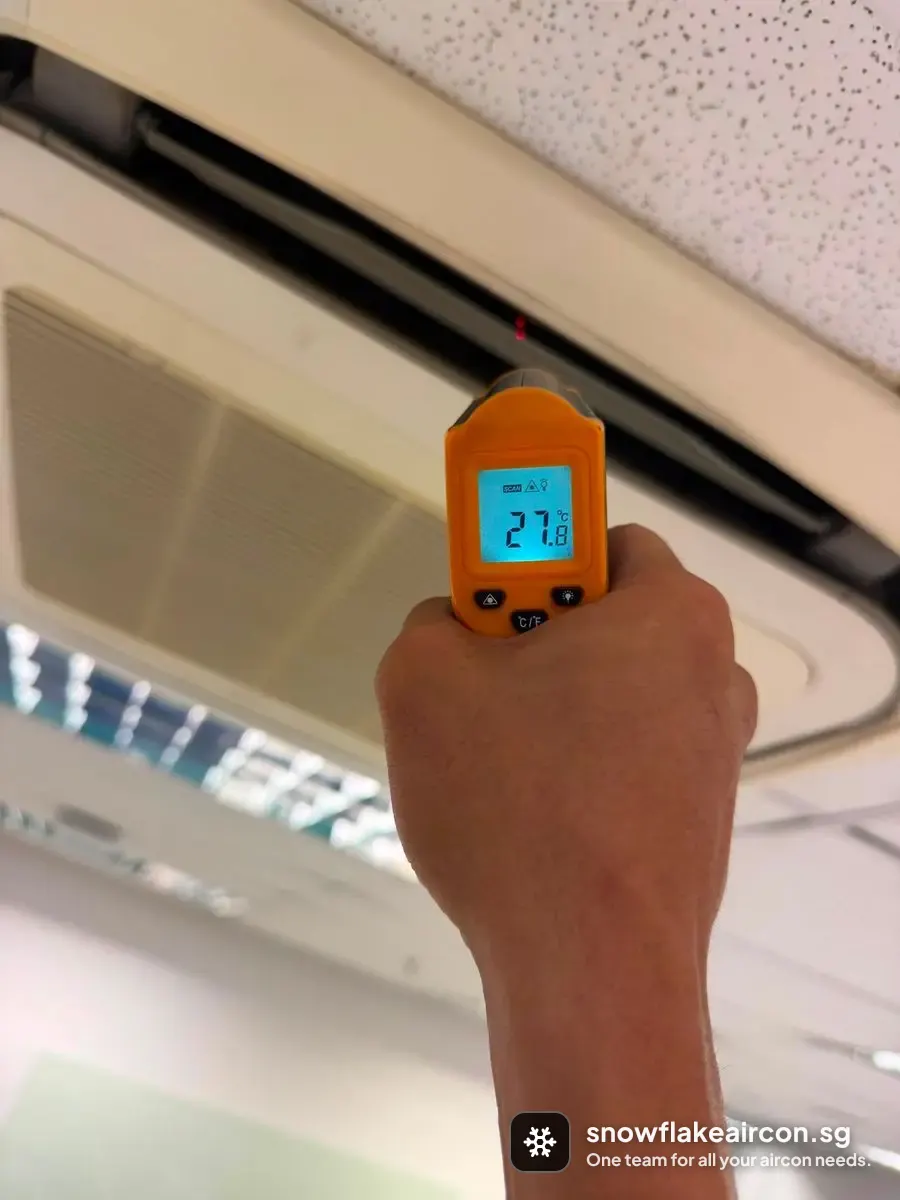
Daikin · Cassette
Cassette not cooling: stuck gas-flow valve, not compressor
A flow-control valve stuck part-closed, restricting refrigerant to the indoor coil
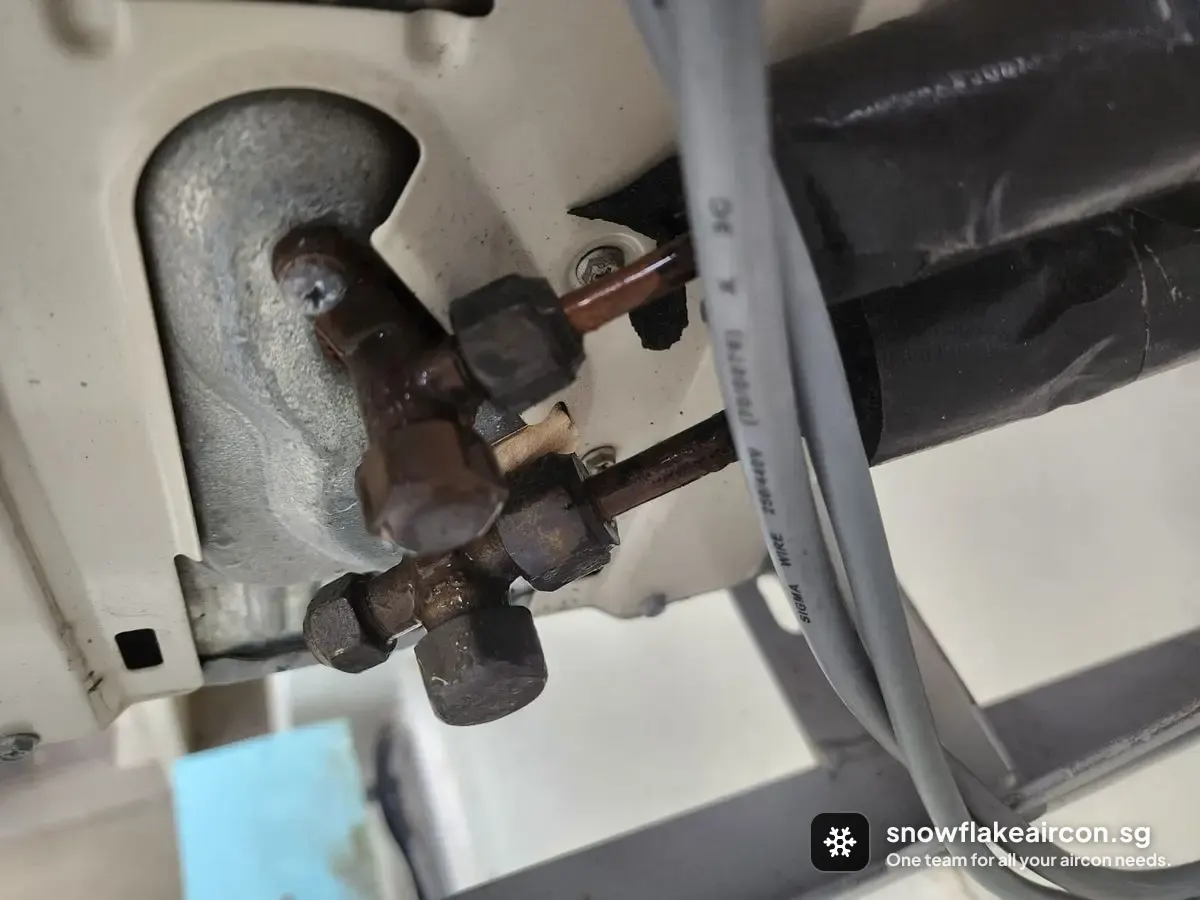
Samsung · Wall-mounted
Coastal unit losing gas again: salt ate the pipe fitting
A corroded outdoor fitting thinned past the point where it can seal
Common Questions
Why use high fan speed instead of low fan during a 10-minute bedroom test?
How can residents tell dirty coils from refrigerant leaks without opening covers?
Is stepping onto an HDB ledge safe to check if the outdoor fan spins?
When does a failed 10-minute test move straight to a S$30 on-site check?
Sources
Sources checked 27 Nov 2026