On this page
Quick summary
Slanted wall backing plates let condensate water pool away from the drain exit, causing bedroom leaks even when PVC pipes remain clear. Calibrating a phone spirit-level app flat and checking indoor casing ribs from floor level spots plate sag safely within two minutes.
On-site fault check: $30 ($80 VRV), waived if you proceed with repair · See diagnosis & repair
Why a Slanted Backing Plate Traps Condensate Drain Water
Every wall-mounted evaporator collects chilled water inside a sloped tray feeding one outlet corner. Installers mount steel rear plates dead flat or angled slightly toward the drain exit. Gravity pulls condensed moisture smoothly whenever wall anchors stay tight.
Years of fan vibration or loose anchors on hollow BTO partitions can pull the opposite side downward two degrees. Once that blind corner dips, stagnant water swells with slime and spills behind bedroom curtains even when PVC pipes stay unobstructed.
Run a Safe Floor-Level Phone Spirit-Level Test Indoors
Follow EMA, HDB, and MOM residential rules strictly by staying indoors on floor level. Never climb stools near open windows, venture onto outside ledges, or unscrew mains power plates:
- Calibrate your smartphone spirit-level app on a flat dining table first. Zeroing out camera bump bias keeps casing measurements accurate.
- Confirm which side houses your PVC trunking exit from the floor. Rest the flat phone edge gently along an accessible horizontal casing rib or lower bezel at standing reach.
- Check whether the bubble or degree angle stays flat or pitches slightly toward the drain outlet. Flag any dip sloping toward the blind corner.
Review Pass or Fail Wall Tilt Results Before Booking
Compare your floor-level angle measurement and wall moisture clues against this pass-fail guide. Watch the bathroom floor-trap discharge concurrently:
Scroll to see more columns
| Inspection point | Safe indoor observation | Pass condition | Fail action for S$30 check |
|---|---|---|---|
| Casing angle readout | Phone level along top rib or bottom lip | 0.0 to 1.0 degree pitch toward drain | Tilted away from exit needs re-anchoring |
| Drip entry location | Torch beam along underside casing seam | Dry plastic edges across whole width | Water weeping from non-drain corner |
| Wall bracket gap | Visual glance at left and right rear edges | Flush contact against painted plaster | Visible gap or loose rocking casing |
| PVC trap discharge | Check bathroom floor trap while running | Steady droplets exiting drain pipe | Stalled flow plus high tray splash |
Decide When Slanted Plates Need Re-Anchoring or a Drain Wash
Avoid shimming hot plastic casings with cardboard or yanking live mounting plates yourself. Pick the matching service level below:
- Request a S$30 on-site evaluation (S$80 for VRV gear) if tilt exceeds one degree or wall anchors pull free. Fees waive upon repair under 30-day workmanship protection.
- General servicing clears clean trays at S$50 for one room, S$60 for two rooms combined, and S$25 per room across larger homes (14-day workmanship protection).
- Chemical servicing removes jelly slime alongside minor pitch issues at S$80 when cleaning a single evaporator, S$140 total for twin evaporators, or S$180 combined for three indoor units (60-day workmanship protection).
- Full dismantled overhauls let technicians re-anchor rear brackets and scrub hidden trays from S$150 for a lone FCU, S$125 apiece for two FCUs, or S$115 per FCU in multi-room packages (90-day workmanship protection).
Diagnostic Cases for This Fault
Singapore jobs showing what we checked on-site before quoting parts or gas.
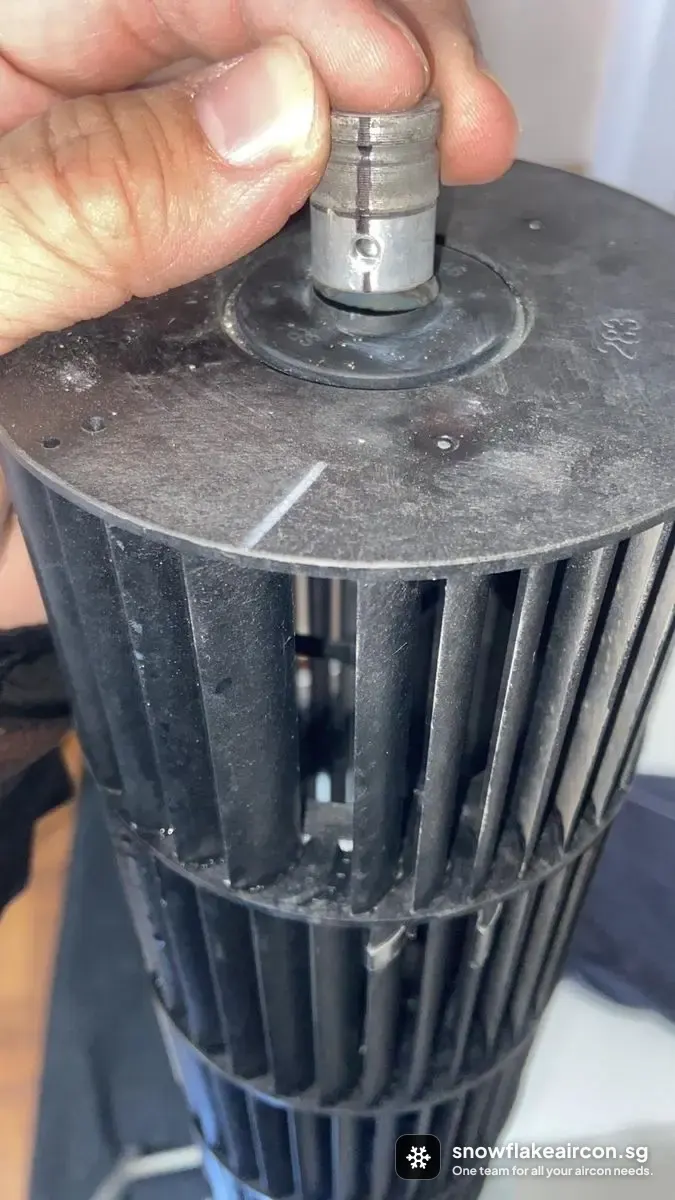
Midea · Wall-mounted
Rattling on startup: blower wheel loose on the shaft
A blower barrel drifted along its shaft after the setscrew backed off
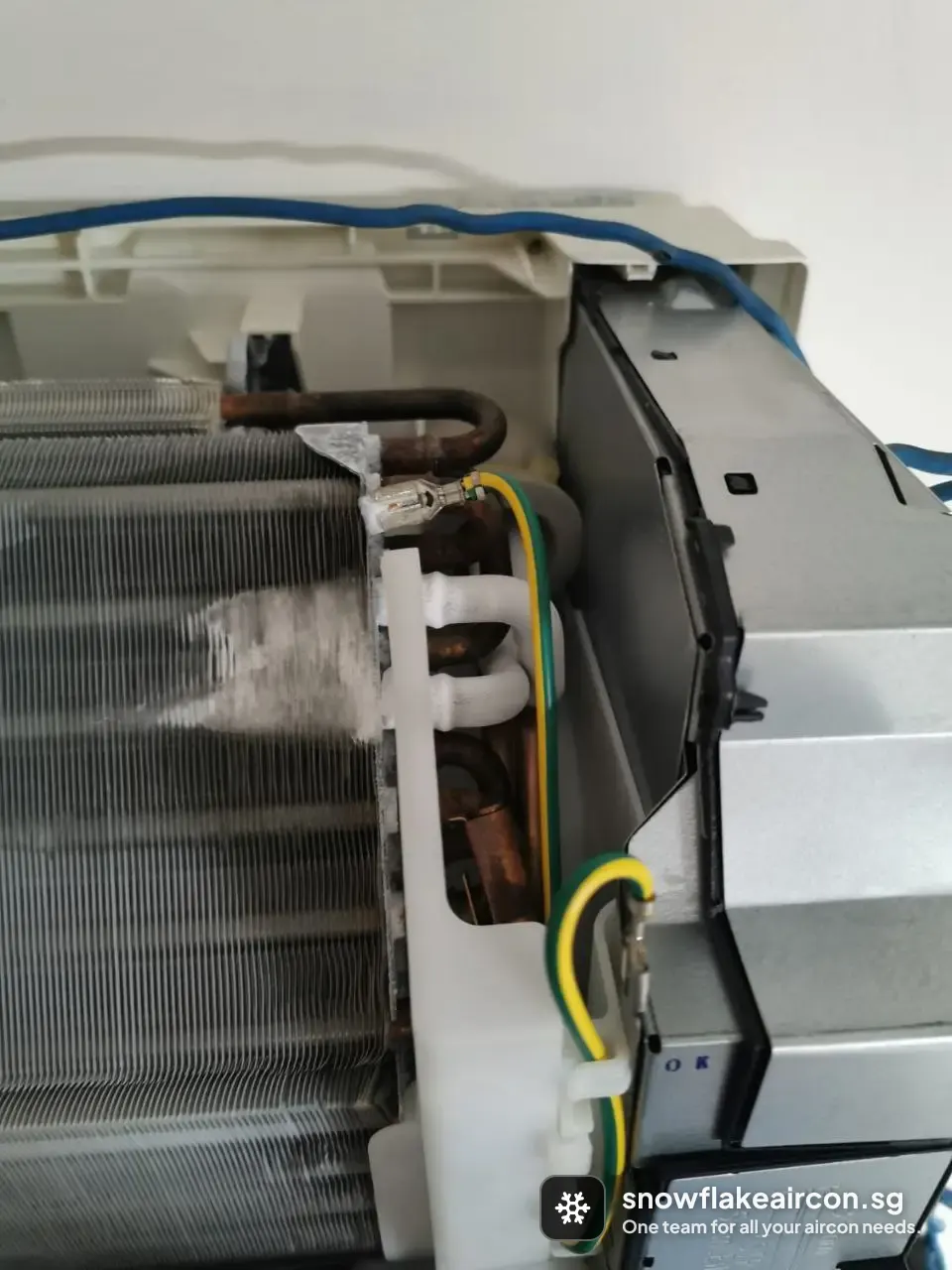
Wall-mounted
Ice forming on the copper pipe: airflow blocked, not gas
Airflow restriction from blower wheel and coil buildup, freezing the coil
Common Questions
Should an indoor aircon unit sit dead level or slope slightly toward its drain pipe?
Why does an aircon leak down one corner even right after clearing the PVC pipe?
Is testing indoor casing tilt with a phone spirit-level app safe without tools?
How do technicians permanently fix a slanted indoor wall backing plate?
Sources
Sources checked 27 Nov 2026