On this page
Quick summary
Gurgling startup sounds behind an indoor grille usually reveal trapped water inside a partially choked drain trap, whereas continuous sharp hissing warns of refrigerant flashing from low gas charge. Capturing a floor-level 10-second phone clip helps technicians pinpoint the fault before leaks or compressor damage develop.
On-site fault check: $30 ($80 VRV), waived if you proceed with repair · See diagnosis & repair
Stay at Floor Level Under EMA, HDB, and MOM Rules
Every homeowner self-check stays strictly at floor level inside your apartment. Under EMA, HDB, and MOM rules, never climb onto aircon ledges or lean out service windows. Never step onto unsteady stools or open 230V electrical terminal covers.
Keep the outer unit casing shut while recording startup audio. Only pull out washable mesh dust screens if they slide freely from standing height. Leave live wiring, copper flare joints, and exterior mounting brackets entirely to licensed crews.
Capture a 10-Second Startup Clip and Compare Clues
Turn off ceiling fans and nearby televisions before switching your indoor blower from fan mode to cool mode. Stand firmly on the floor. Hold your phone microphone about 30 cm below the indoor louver for 10 full seconds.
Low, bubbly glugs that shift volume when bedroom doors swing open signal negative room suction pulling air through drain slime. Conversely, a steady metallic hiss along the right-hand pipe elbow paired with weak cooling signals low R32 refrigerant flashing inside the coil.
Record a second 10-second clip five minutes later if sounds change once the outdoor compressor ramps to full speed.
Run This Pass-Fail Self-Check Table
Review your 10-second recording and basic airflow checks against these pass-fail markers before calling support.
Scroll to see more columns
| Floor-level test | Pass result | Fail sign | Action toward S$30 check |
|---|---|---|---|
| 10s startup audio clip | Even fan breeze only | Bubble glugs or sharp hiss | Send audio clip for S$30 check |
| Bedroom door-ajar test | Gurgle vanishes immediately | Glugs persist with door wide open | Tray slime needs S$30 inspection |
| Supply air chill at 5 mins | Crisp cold air across fins | Warm draft with steady hiss | Book S$30 nitrogen leak check |
| Toilet floor drain check | Smooth clear water trickle | Dry pipe outlet or slug bursts | Schedule S$30 check plus drain flush |
Schedule the Right Repair from Your Audio Test
Send your recording along with the room check result so technicians arrive ready with vacuum pumps and leak gauges:
- Booking an in-room S$30 fault visit removes guesswork. Snowflake waives that fee when repair or cleaning proceeds, backed by a 30-day repair guarantee (VRV checks cost S$80).
- Resolve early drain sluggishness with routine general upkeep priced at S$50 (single), S$30 (two units), or S$25 (three-plus units) under 14-day protection.
- Clear thick algae from drain traps using chemical flushing at S$80 (1 blower), S$70 (2 blowers), or S$60 (3+ blowers) carrying 60-day workmanship protection.
- Pick full dismantled teardowns at S$150 single coil, S$125 per coil on pairs, or S$115 per head when overhauling three or more (90-day cover) if biofilm clogs pan corners.
- Approve dry nitrogen pressure testing across flare nuts before refilling gas whenever continuous hissing fails the cooling check.
Diagnostic Cases for This Fault
Singapore jobs showing what we checked on-site before quoting parts or gas.
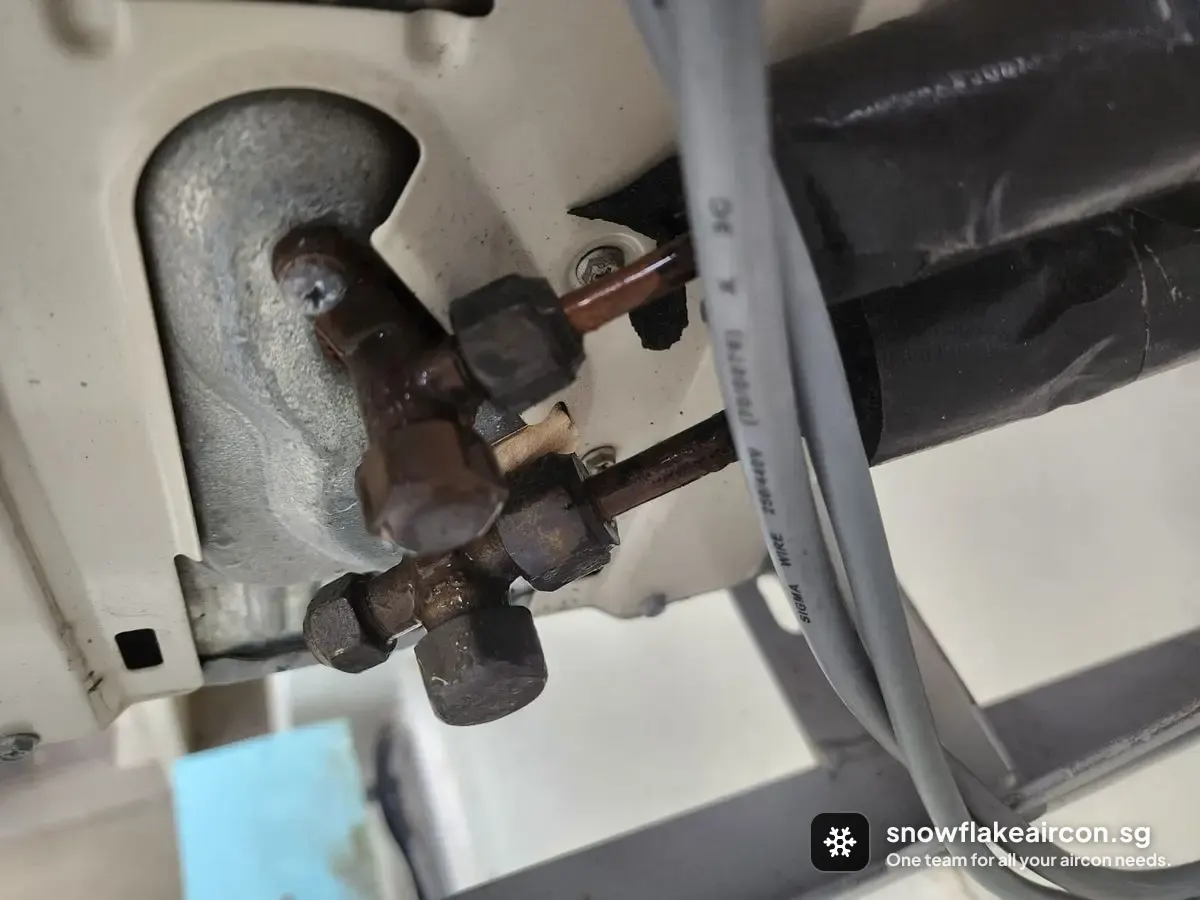
Samsung · Wall-mounted
Coastal unit losing gas again: salt ate the pipe fitting
A corroded outdoor fitting thinned past the point where it can seal
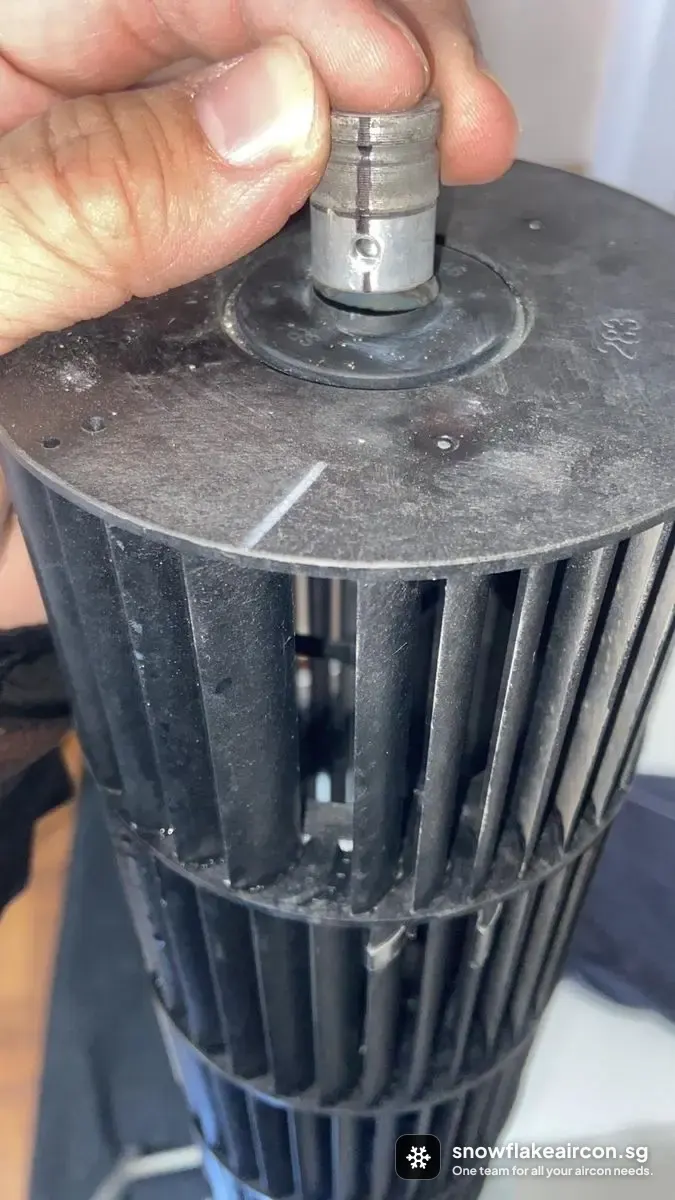
Midea · Wall-mounted
Rattling on startup: blower wheel loose on the shaft
A blower barrel drifted along its shaft after the setscrew backed off