On this page
Quick summary
Floor-level condensate tests help Singapore homeowners distinguish mild bathroom floor-trap airlocks from clogged PVC lines before paying for drain clearing. Watching steady gully drips or running clean lukewarm water through accessible lower tees confirms whether a S$30 diagnostic check and wet vacuum flush are required.
On-site fault check: $30 ($80 VRV), waived if you proceed with repair · See diagnosis & repair
Watch Indoor Floor-Trap Drips During Normal Cooling
Set the bedroom unit to cooling at 25 degrees with medium fan speed. Stand inside the bathroom for twenty minutes to watch the outlet. Clean 16 mm PVC drain pipes drip steadily once humidity condenses across cold fins.
Inspect dry PVC joints along bedroom skirting while cooling runs. Soft water beads along uninsulated bends point toward surface sweat rather than an internal tray clog. Zero floor-trap drips while air blows cold signal algae buildup or flat pipe pitch.
Test Accessible Drain Flow Within EMA, HDB, and MOM Limits
Remain strictly on dry flat bathroom tiles at floor level. Under EMA electrical safety rules, homeowners must never unscrew 230V isolators or indoor terminal covers. HDB home-care advisories and MOM circular rules also ban climbing chairs, window sills, or exterior ledges.
Check whether a washing machine hose shares the same bathroom floor trap. Soap suds sometimes cause minor airlocks inside shallow traps. Where an open tee sits at waist height or below, pour 200 ml of lukewarm water through a clean funnel. Never pour boiling water, because heat warps glued PVC joints.
Compare Pass and Fail Self-Check Signals Before Booking Service
Match each floor-level observation against this pass and fail check table. Escalate failed checks to a S$30 diagnostic inspection promptly.
Scroll to see more columns
| Floor-level check | Safe test step | Pass signal | Fail signal and S$30 escalation |
|---|---|---|---|
| Bathroom floor-trap outlet | Observe end of PVC drain pipe for 20 min at 25 degrees | Steady drip or trickle enters open floor gully | Dry pipe end while indoor tray drips; book S$30 check |
| Floor grate surface hair | Lift visible floor-trap cover while unit stays off | Water clears fast around drain pipe tip | Standing water covers pipe end; clear grate or book S$30 check |
| Accessible lower tee | Pour 200 ml lukewarm water slowly via clean funnel | Equal volume exits freely into bathroom gully | Funnel backs up or leaks along trunking; stop for S$30 check |
| Indoor blower exterior | Inspect casing from floor level without touching 230V covers | Dry shell and even airflow across louver | Ice patches, slime odor, or wall drips; stop for S$30 visit |
Book Drain Vacuuming or Chemical Servicing When Flow Fails
Act promptly on failed drain checks before damp wall stains spread behind plaster:
- Book our S$30 diagnostic visit whenever lukewarm water backs up or concealed trunking drips. That check fee drops to zero when repairs go ahead under a 30-day warranty.
- General cleaning clears early lint inside drain pans and mesh screens. Single blowers cost S$50, twin blowers cost S$30 apiece, and three or more run S$25 per blower (14-day warranty).
- Slimy microbial gel along evaporator trays needs chemical washing. Treat three-plus units at S$60 per head, two units at S$70 per head, or one unit for S$80 (60-day warranty).
- Recurring blockages packed behind rear coil pans demand dismantled chemical overhauls. Complete teardown servicing charges S$115 per coil on three-plus sets, S$125 per coil on pairs, or S$150 for one coil (90-day cover).
Diagnostic Cases for This Fault
Singapore jobs showing what we checked on-site before quoting parts or gas.
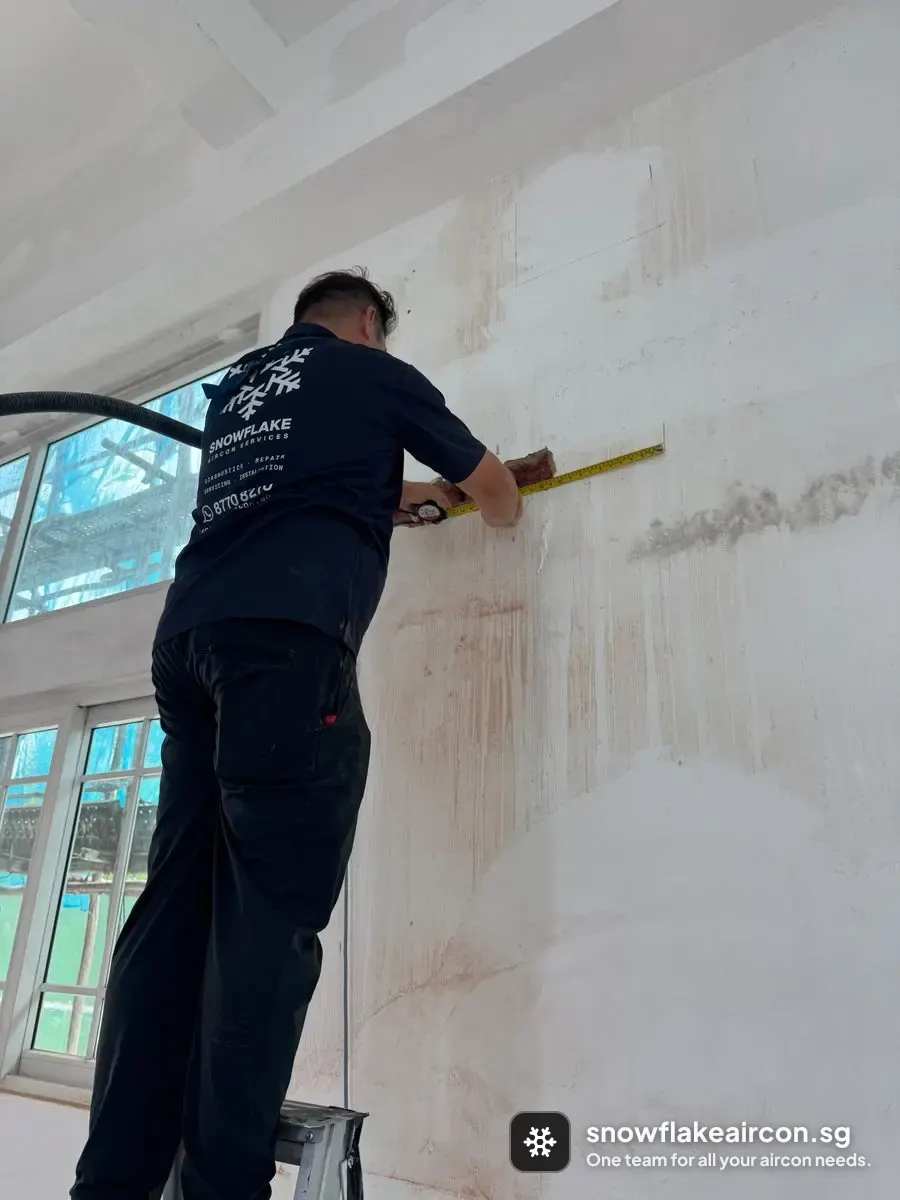
Daikin · Wall-mounted
Water stain down the wall: blocked rear drain trough
Biofilm jelly choking the hidden rear auxiliary drain trough behind the evaporator coil, spilling condensate down the plastered wall while the main trunking pipe stayed intact
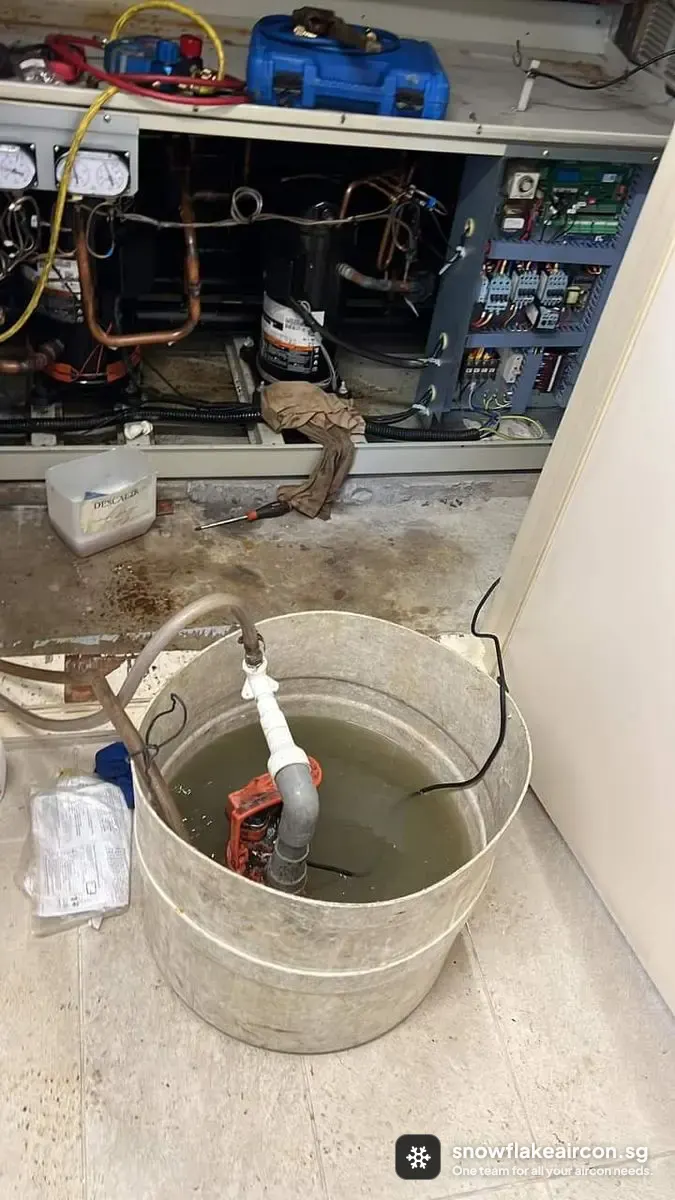
Mitsubishi Electric · Multi-split
Outdoor ledge dripping downstairs: split drain pipe stub
Split outdoor PVC condensate drain stub spilling backed-up water across the ledge
Common Questions
Is pouring vinegar or bleach into an aircon drain pipe safe in HDB flats?
Why does water drip from the indoor unit even when the outdoor compressor runs fine?
Can homeowners open the indoor cover or climb a ladder to blow out a drain line?
When does an aircon drain leak require chemical servicing instead of drain vacuuming?
Sources
Sources checked 27 Nov 2026