On this page
Quick summary
Four-room HDB BTO households running a daytime living hall unit plus two bedrooms overnight typically pull 365 to 440 kWh monthly on five-tick inverter aircons. SP Group charges 31.16 cents/kWh (GST included), putting that combined monthly cooling budget near S$114 to S$137 before clean-coil efficiency losses.
System 2 installed from $2,600 (22 SWG copper) · $30 site survey waived on install · View packages
Separate Daytime Hall Load from Overnight Bedroom Draw
A 4-room HDB living hall spans roughly 30 square metres with strong afternoon sun exposure. An 18,000 BTU blower modulating at 25 degrees averages 1.1 to 1.35 kW during six hot afternoon hours.
Two 9,000 BTU bedrooms behave differently after sundown because lower heat gain lets the inverter throttle down. Each sleep room draws roughly 0.35 to 0.42 kW over eight hours.
Itemise Your Monthly HDB Kilowatt-Hour and SP Group Bill
Use this 30-day table multiplying daily inverter kilowatt-hours by 31.16 cents/kWh (GST included):
Scroll to see more columns
| Cooling zone and schedule | Average inverter draw | Monthly kWh range | Estimated SP Group spend |
|---|---|---|---|
| Living hall (6 hours daily, 25 degrees) | 1.10 to 1.35 kW | 198 to 243 kWh | S$62 to S$76 |
| Master bedroom (8 hours nightly, 25 degrees) | 0.35 to 0.42 kW | 84 to 101 kWh | S$26 to S$31 |
| Second bedroom (8 hours nightly, 25 degrees) | 0.35 to 0.42 kW | 84 to 101 kWh | S$26 to S$31 |
| Combined 4-room BTO budget | Modulated inverter load | 366 to 445 kWh | S$114 to S$139 |
Spot Hidden kWh Creep from Clogged Blowers and Low Setpoints
Dropping setpoints from 25 degrees to 20 degrees pushes compressor speed up by roughly a third. Leaving doors open leaks corridor heat nonstop.
Dust-choked evaporator fins and slimy blower wheels also block airflow, delaying room cut-off by hours nightly. Eligible HDB households upgrading older low-tick units can offset hardware with S$400 NEA vouchers available until December 2027.
Verify Meter Spikes and Schedule Flat-Rate Coil Maintenance
Compare your monthly SP Group statement against the table above before assuming compressor failure:
- Rinse indoor mesh filters every two weeks from floor level to preserve smooth air intake.
- Three-unit routine servicing settles at S$75 total (S$25 apiece), pairs run S$60 combined (S$30 apiece), and lone blowers charge S$50 under 14-day workmanship coverage.
- Flush sticky fin grease blocking heat transfer via chemical servicing at S$80 solo, S$140 paired (S$70 per head), or S$60 per indoor head when servicing three-plus units (60-day coverage).
- Reserve dismantled overhauls for choked coils: single teardowns cost S$150, twin teardowns run S$250 total, and full three-unit teardowns bill S$115 per head under 90-day cover; troubleshooting visits run S$30 and drop off confirmed repair invoices.
Diagnostic Cases for This Fault
Singapore jobs showing what we checked on-site before quoting parts or gas.
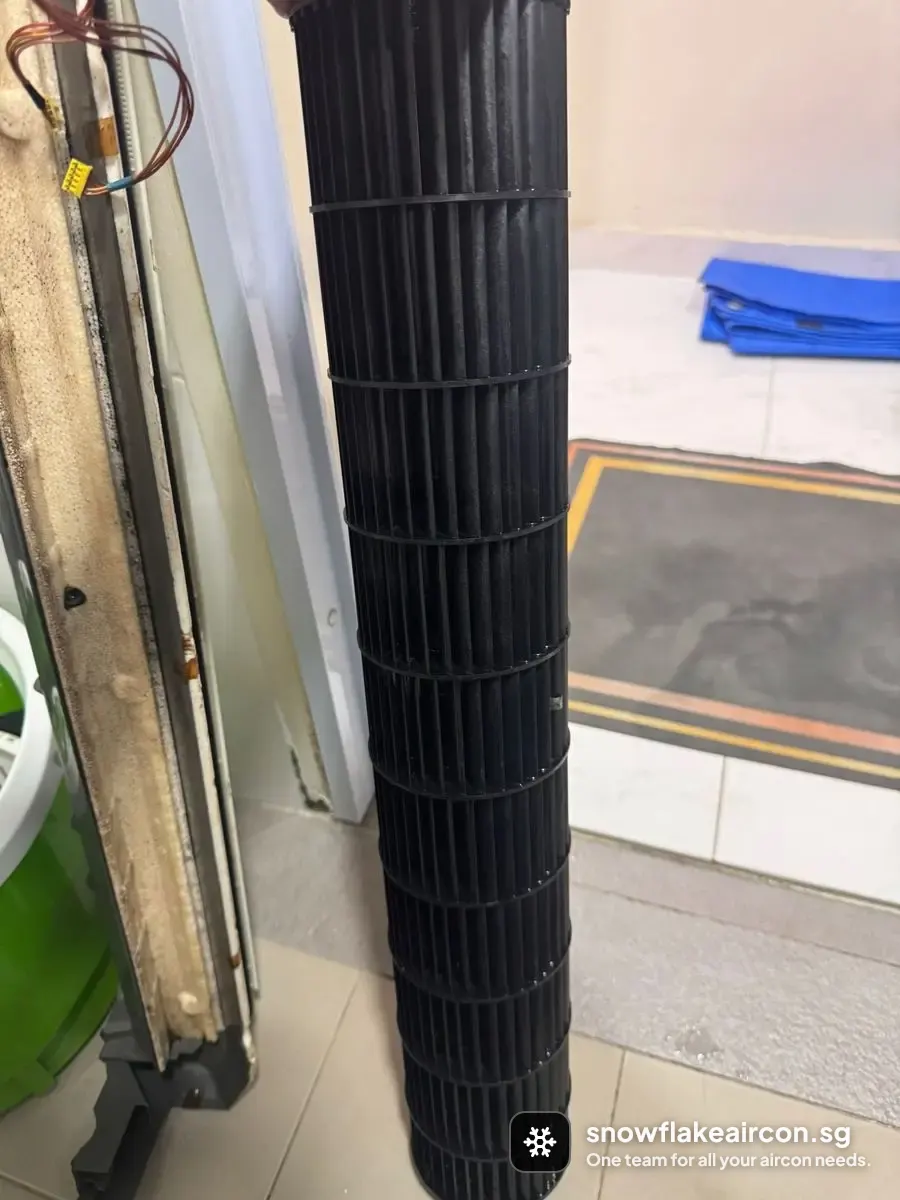
LG · Wall-mounted
LG CH10 clicking then shutdown: cracked blower wheel
A cracked blower wheel bending outward and catching the housing, stalling the motor
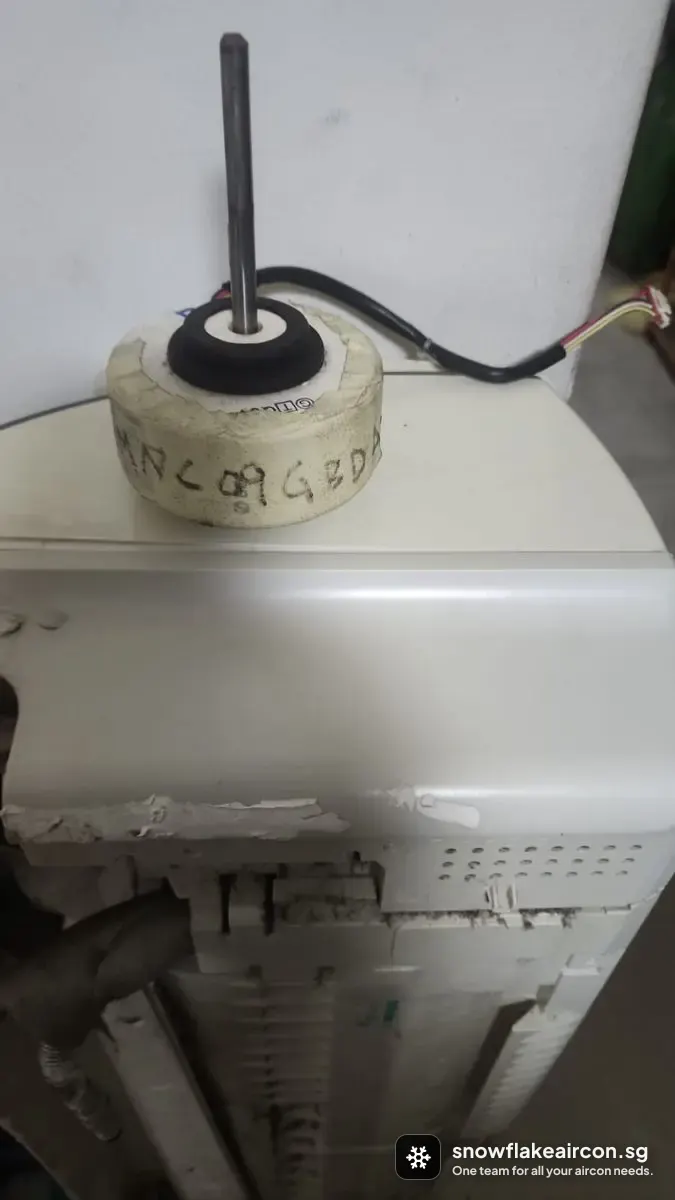
Sharp · Wall-mounted
Sharp 6-0 grinding then shutdown: worn fan motor bearings
Worn indoor fan motor bearings on a unit past its usual service life
Common Questions
How many kWh does a 4-room HDB living room aircon use per afternoon?
Why does my 4-room BTO aircon bill exceed S$150 with only night bedroom use?
Does raising an inverter setpoint from 22 degrees to 25 degrees save much electricity?
When does high electricity draw warrant a S$30 aircon inspection?
Sources
Sources checked 27 Nov 2026