On this page
Quick summary
HDB and SCDF regulations strictly forbid hacking, core-drilling, or anchoring fasteners into reinforced bomb shelter walls, ceilings, or blast-door frames. Routing aircon piping along adjacent partition walls or corridor bulkheads with clean drain fall keeps trunking compliant, service-accessible, and condensation-free.
System 2 installed from $2,600 (22 SWG copper) · $30 site survey waived on install · View packages
Respect HDB and Civil Defence Shelter Drilling Bans
Household shelters in Singapore HDB flats use thick steel-reinforced concrete engineered against blast loads. SCDF and HDB guidelines forbid hacking, coring, chasing channels, or driving screws into shelter walls, floor slabs, or soffits. Even shallow picture nails or plastic wall plugs breach household shelter reinforcement requirements under HDB completion audits.
Blast doors, ventilation sleeves, and rubber gaskets must stay clear during every renovation stage. Fixing indoor fan coils or even glued trunking straight across shelter masonry risks failing mandatory HDB completion checks.
Compare Compliant Perimeter Casing and Detour Routes
Select the cleanest non-shelter route linking bedrooms past the central shelter out toward the HDB aircon ledge:
Scroll to see more columns
| Detour path option | Where pipes travel | HDB rule safeguard | Drain and finish check |
|---|---|---|---|
| Corridor bulkhead ceiling | Above non-structural corridor drop | Zero contact with shelter RC slab | Inspect continuous downward drain slope |
| Adjacent partition wall | Along adjoining brick or drywall face | Clips fix only into partition masonry | Verify door-frame clearance at corners |
| Kitchen beam perimeter | Skirts outer wall into service yard | Avoid structural beam core holes | Keep trunking caps open for servicing |
| Dual-exit split path | Shortens runs to separate floor traps | Bypasses shelter zone completely | Prevents stagnant water in long runs |
Protect Drain Gradient and Casing Access Along Longer Detours
Skirting around a central bomb shelter adds bends and extra horizontal pipe distance. Gravity drains require steady downward fall across every metre of horizontal detour casing. Without continuous gradient toward a bathroom floor trap or service-yard gully, water stalls inside PVC drains. Sharp 90-degree elbows trap slime fast and leak onto corridor ceiling boards.
Specify thick half-inch closed-cell rubber insulation over every copper pipe run. Use 22 SWG copper piping to resist pinhole leaks along hidden ceiling detours. Ask installers to test drain flow with two litres of clean water and keep false-ceiling access hatches near pipe elbows. Inspect wall trunking clips twice yearly so corridor bulkheads never loosen or pull drain slopes off grade.
Verify Floor-Plan Pipe Routes Before Renovation Carpentry Starts
Walk through exact routing lines with your renovation builder and installer prior to ceiling framing:
- Request an on-site survey beforehand at S$30 (waived when installation proceeds). Installers chalk clean non-shelter pipe paths before carpenters frame bulkheads.
- Match physical walls against official HDB floor-plan shelter shading so nobody drills structural concrete by mistake.
- Keep long detour pipes clean through general maintenance under a 14-day warranty. Solo visits cost S$50, dual-unit bookings bill S$30 per blower, and multi-room flats with three or more heads pay S$25 each.
- Should biofilm choke extended detour hoses later, chemical flushing runs S$80 (1), S$70 (2), or S$60 per unit (3+) with 60-day cover. Full teardowns run S$150, S$125, or S$115 per unit (90-day cover).
Diagnostic Cases for This Fault
Singapore jobs showing what we checked on-site before quoting parts or gas.
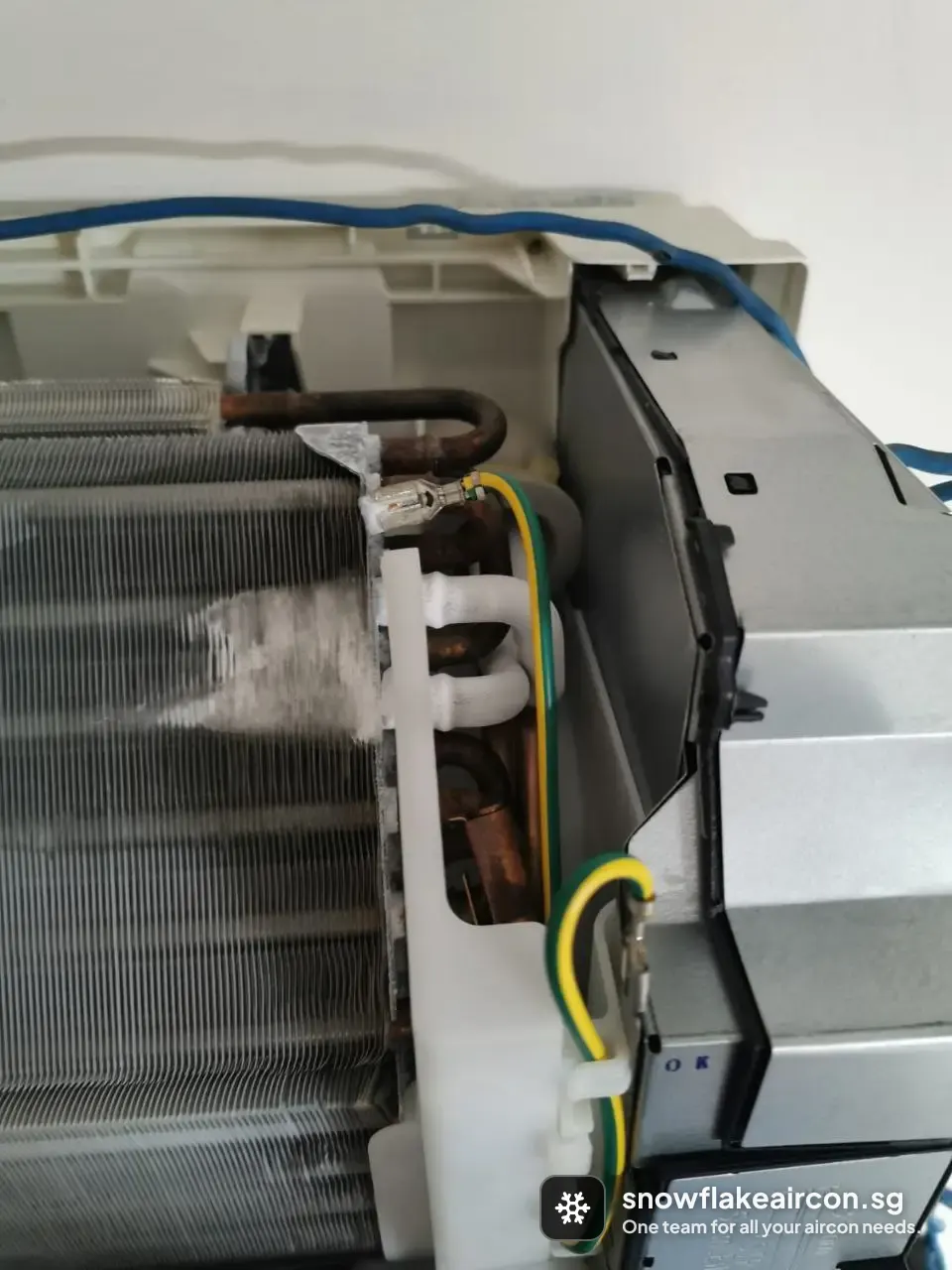
Wall-mounted
Ice forming on the copper pipe: airflow blocked, not gas
Airflow restriction from blower wheel and coil buildup, freezing the coil
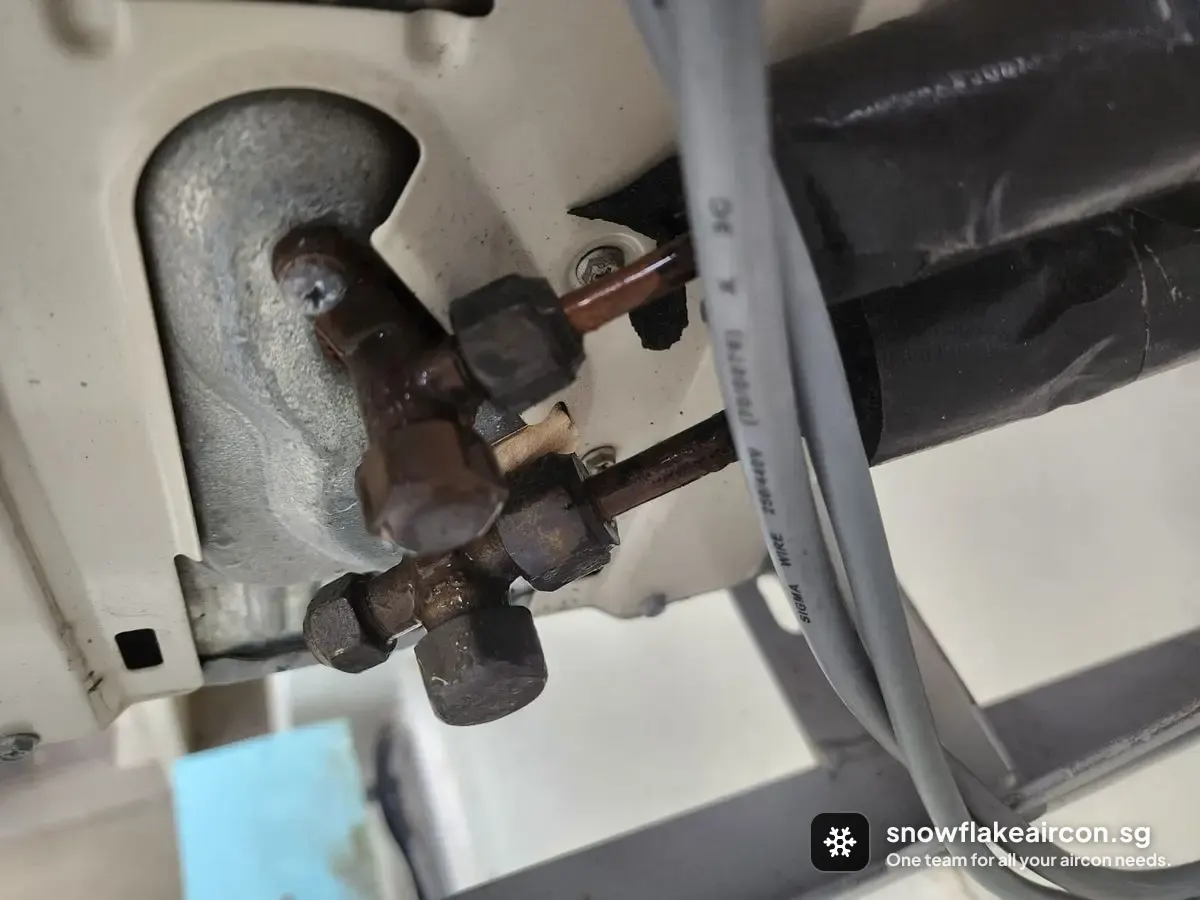
Samsung · Wall-mounted
Coastal unit losing gas again: salt ate the pipe fitting
A corroded outdoor fitting thinned past the point where it can seal
Common Questions
Can installers drill even small screw holes into an HDB bomb shelter wall for trunking?
Can aircon copper pipes pass through the bomb shelter ventilation sleeve instead?
Why do longer aircon detours around a shelter leak water more easily?
Should homeowners conceal detour trunking permanently inside corridor false ceilings?
Sources
Sources checked 27 Nov 2026